
Enquiries and inquiries are both correct English words, and both can refer to requests for information. The confusion comes from the fact that their preferred use changes depending on the variety of English being used and, in some contexts, the level of formality involved.
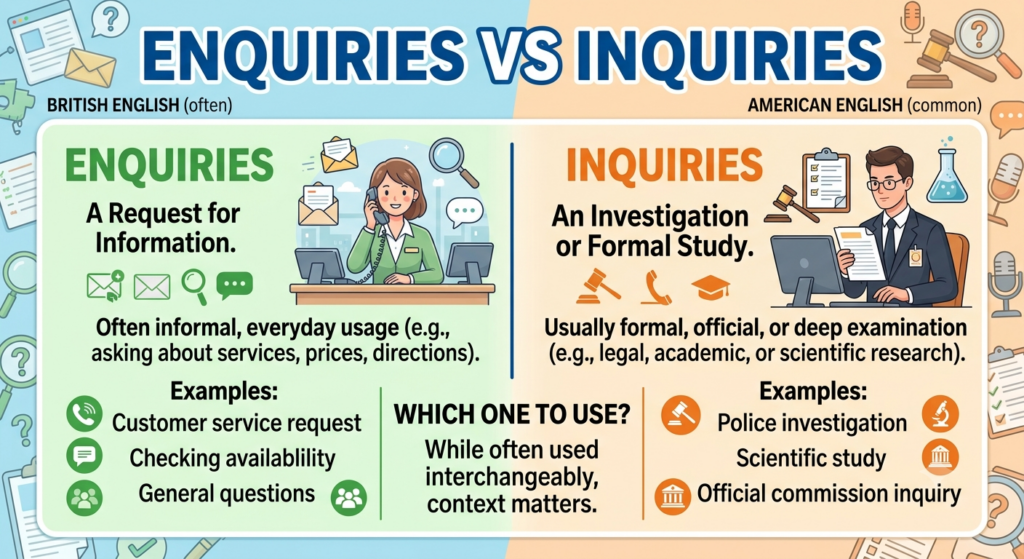
In American English, “inquiries” is by far the more common spelling for almost every situation. In British English, “enquiries” is often used for everyday questions, while “inquiries” may be preferred for formal investigations. However, this distinction is more of a usage convention than an absolute grammatical rule.
Understanding the difference can help you choose the spelling that feels natural to your audience and fits the situation.
What Does Enquiries Mean?
“Enquiries” is the plural form of “enquiry.”
An enquiry is generally a request for information, clarification, or assistance. The spelling is particularly common in British English and other varieties influenced by British usage.
For example:
“We received several enquiries about the course.”
“Customer enquiries should be sent to the support team.”
“The hotel received enquiries about room availability.”
In each case, people are simply asking for information. There is no suggestion of an official investigation.
You will often see “enquiries” in customer service, education, travel, retail, and business communication, especially on websites aimed at British audiences.
A company might write:
“For general enquiries, contact our reception desk.”
That sounds completely natural in British English.
What Does Inquiries Mean?
“Inquiries” is the plural form of “inquiry.”
It can also mean requests for information, but it is the standard spelling in American English.
Examples include:
“We have received several inquiries about the position.”
“Please direct media inquiries to the communications department.”
“The company responded to customer inquiries.”
In the United States, “inquiries” is normally used whether the question is casual, professional, or formal.
The word can also refer to an investigation or examination into an issue.
For example:
“The government announced an inquiry into the incident.”
“The committee opened an inquiry into the allegations.”
Here, “inquiry” means something more serious than an ordinary question. It refers to an organized attempt to discover facts.
Enquiries vs Inquiries in British English
British English sometimes makes a useful distinction between the two spellings.
“Enquiry” is traditionally associated with an ordinary request for information.
“Inquiry” is often associated with a formal investigation.
Consider these examples:
“I made an enquiry about train times.”
“The authorities launched an inquiry into the accident.”
The first sentence involves a simple question. The second describes a formal examination of events.
This distinction can be useful, but writers should not treat it as an unbreakable rule. Modern British usage sometimes overlaps, and “inquiry” can still be used for ordinary questions.
Consistency and audience expectations usually matter more than forcing a strict distinction.
Enquiries vs Inquiries in American English
American English is much simpler on this point.
“Inquiry” and “inquiries” are the standard forms in almost every context.
For example:
“Send all inquiries to our customer service department.”
“The university receives thousands of admissions inquiries each year.”
“Officials began an inquiry into the matter.”
Using “enquiries” in American writing is not necessarily impossible to understand, but it can look unusual or distinctly British.
If your website primarily targets readers in the United States, “inquiries” is usually the safest choice.
Which Spelling Should You Use on a Website?
The best choice depends mainly on your audience and style guide.
For a British English website, “enquiries” works well for customer questions, contact pages, bookings, and general requests for information.
For example:
“General Enquiries”
“Sales Enquiries”
“Booking Enquiries”
For an American English website, use “inquiries” instead:
“General Inquiries”
“Sales Inquiries”
“Media Inquiries”
For a formal investigation, “inquiry” is widely understood in both British and American English.
Choosing one regional spelling and using it consistently across your website helps your writing look more professional.
Common Mistakes With Enquiries and Inquiries
One common mistake is assuming that one spelling is correct and the other is wrong. Both have a long history in English.
Another mistake is switching between them randomly within the same article or website.
For example, a business page might use “customer enquiries” in one section and “sales inquiries” in another without any reason. Unless the organization follows a specific distinction, the inconsistent spelling can look like an editing error.
Writers should also remember that “inquiry” can have a broader meaning than simply asking a question.
Compare:
“She sent an inquiry about the course.”
This means she requested information.
“The university launched an inquiry into the complaint.”
Here, the word means a formal investigation.
Context tells the reader which meaning is intended.
A Simple Way to Remember the Difference
A practical way to choose between the words is to think about location and context.
If you are writing American English, use “inquiry” and “inquiries.”
If you are writing British English, “enquiry” and “enquiries” are common for ordinary questions.
For formal investigations, “inquiry” is generally the more familiar choice, including in British English.
You can remember the traditional British distinction this way:
Enquiry = asking a question.
Inquiry = investigating something.
The distinction is helpful, even though real-world usage is not always perfectly consistent.
Are Enquiries and Inquiries Interchangeable?
In many situations, yes.
“Customer enquiries” and “customer inquiries” communicate essentially the same idea. The difference is mainly regional spelling preference.
However, when “inquiry” refers to an official investigation, replacing it with “enquiry” may sound less natural, particularly in formal writing.
That is why phrases such as “public inquiry,” “official inquiry,” and “government inquiry” commonly use the “inquiry” spelling.
For ordinary questions, your regional writing style should guide your choice.
Final Difference Between Enquiries and Inquiries
Enquiries and inquiries both relate to seeking information, but their usage differs across English-speaking regions.
“Enquiries” is especially common in British English for everyday requests for information. “Inquiries” is the standard American spelling and can be used for both ordinary questions and formal investigations. British English also commonly uses “inquiry” when referring to an official or detailed investigation.
Neither spelling should automatically be considered incorrect. The important thing is to understand your audience, choose the form that matches your variety of English, and use it consistently throughout your writing.