
The phrase “count your days” can sound unsettling when it appears in a text message, social media comment, movie scene or heated conversation. At first glance, it seems to mean literally counting how many days are left. In everyday English, however, its meaning is usually figurative.
Depending on the situation, “count your days” can be a serious warning, a joking threat between friends or a reminder that time is limited. Tone, context and the relationship between the people involved make a major difference.
The expression has also become increasingly visible online, where short phrases can quickly shift between humor, sarcasm and genuine hostility. Understanding what “count your days” means therefore requires looking beyond the words themselves.
What Does “Count Your Days” Mean?
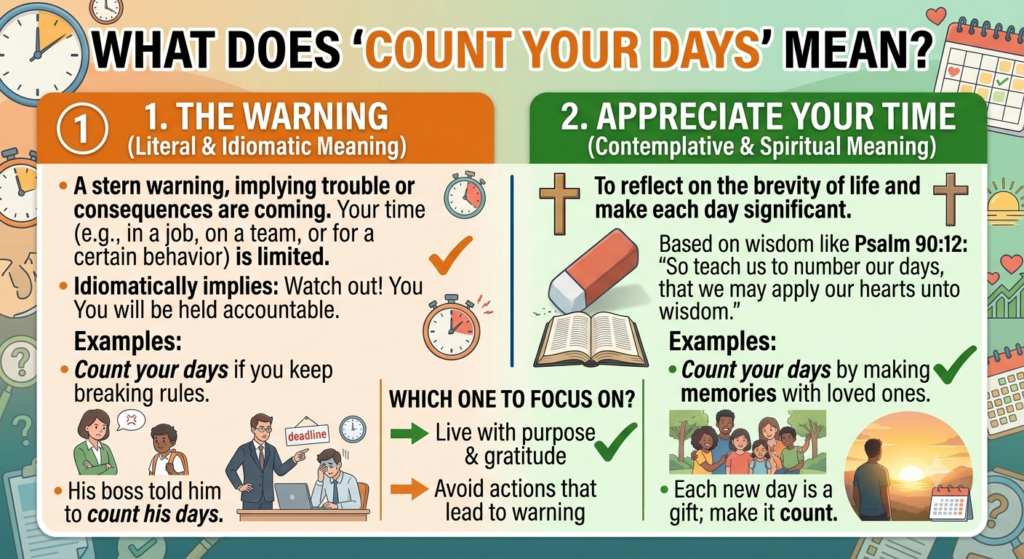
In its most common conversational use, “count your days” means that someone’s time before facing consequences is running out.
For example, imagine one friend eats another friend’s carefully saved dessert. The second friend might jokingly reply, “Count your days.”
In that situation, nobody is usually talking about actual danger. It is an exaggerated and humorous way of saying, “You are going to pay for that.”
The same words can become much more serious during an argument. If they are delivered angrily, repeatedly or alongside other threatening language, they may be understood as a genuine warning.
This is why context matters so much.
Why Does the Phrase Sound Threatening?
The phrase creates a sense that a deadline is approaching.
Someone being told to “count your days” is being told, directly or indirectly, that their current situation may not last much longer.
It carries a similar idea to expressions such as:
“Your time is running out.”
“You’ll regret that.”
“Your days are numbered.”
“You won’t get away with this.”
These expressions do not always refer to death. They can refer to losing a job, ending a relationship, facing punishment or simply dealing with the consequences of an action.
For example:
“If he keeps arriving late, his days at the company may be numbered.”
Here, the meaning is that the person’s job may soon end, not that his life is in danger.
“Count Your Days” Can Also Be a Joke
Online culture has made the phrase more flexible.
People sometimes write “count your days” after something mildly annoying or funny happens. A friend might send an embarrassing photograph to a group chat, and the person in the photograph might respond with the phrase as a playful threat.
A gamer could also use it after losing a match:
“You got lucky this time. Count your days.”
The exaggerated wording is part of the humor.
Memes and social media have made dramatic language common even when the underlying situation is trivial. As a result, readers should avoid assuming that every use of “count your days” is a literal threat.
Still, a phrase used jokingly among friends can sound very different when it comes from a stranger or someone involved in a serious dispute.
When Should the Phrase Be Taken Seriously?
Tone and circumstances provide the biggest clues.
If “count your days” appears during friendly teasing, accompanied by laughter or connected to something obviously harmless, it may be playful.
If it follows an aggressive confrontation, repeated harassment or language suggesting physical harm, it has a much more serious meaning.
The identity of the speaker also matters. A close friend joking about losing a board game creates a very different situation from an angry stranger sending the same words after a disagreement.
People should therefore judge the entire conversation rather than relying on the phrase alone.
Language gains meaning from context.
Is “Count Your Days” the Same as “Your Days Are Numbered”?
The two expressions are related, but they are not always used in exactly the same way.
“Count your days” is usually directed at somebody.
For example:
“You cheated me. Count your days.”
The sentence sounds like a warning that consequences are coming.
“Your days are numbered” generally means that a person, object, situation or period will not continue much longer.
For example:
“With repairs becoming more expensive every month, that old car’s days are numbered.”
Nobody is threatening the car. The expression simply means it will probably need to be replaced soon.
Another example could be:
“Once the company announced the restructuring, employees suspected that the old system’s days were numbered.”
The meaning is that the system is approaching its end.
Understanding this difference helps prevent confusion because the phrases share similar imagery but may serve different purposes.
The Deeper Meaning Behind Counting Your Days
There is also a more reflective interpretation of the idea.
To “count” or “number” your days can mean recognizing that human life is limited. Instead of treating time as endless, a person becomes more conscious of how each day is spent.
This idea appears in religious, philosophical and motivational discussions.
Psalm 90:12 contains the well-known idea of learning to “number our days” so that wisdom can follow. In that context, the message is not a threat. It is about understanding life’s brevity and making thoughtful choices.
That meaning has continued to influence modern discussions about purpose, gratitude and time management.
The lesson is simple. A limited amount of time often makes priorities clearer.
“Count Your Days” and “Make Your Days Count” Are Different
These two phrases are easy to confuse, but their tone is quite different.
“Count your days” often suggests awareness that time is running out. Depending on context, it can sound negative, serious or reflective.
“Make your days count” is usually motivational.
It means using your time well instead of allowing days to pass without purpose.
For example:
“Don’t spend every weekend worrying about work. Make your days count.”
The focus is action rather than warning.
One phrase emphasizes limited time. The other emphasizes what someone should do with that time.
Why Awareness of Limited Time Can Change Priorities
There is a useful life lesson hidden inside the less threatening interpretation of the phrase.
People often behave differently when they stop assuming that there will always be more time.
A conversation with a parent may suddenly feel more important. A postponed trip may move higher on the priority list. Someone may finally begin a project they have delayed for years.
This does not mean living anxiously or treating every day like an emergency.
Instead, it can mean becoming more deliberate.
Small choices matter because days eventually become months and years. Spending time with important people, protecting physical and mental well-being, learning something meaningful and finishing worthwhile goals can become easier to prioritize when time is viewed as valuable rather than unlimited.
Everyday Examples of “Count Your Days”
Understanding the phrase becomes easier when it is placed into realistic situations.
Between friends:
“You posted that embarrassing picture of me? Count your days.”
Here, the tone is likely humorous.
During competition:
“You beat me by one point. Count your days until the rematch.”
Again, this is probably playful.
During a serious argument:
“You betrayed me. Count your days.”
This version sounds much more hostile and could be interpreted as a threat depending on the surrounding circumstances.
In a reflective sense:
“Sometimes remembering that our days are limited helps us stop wasting time on things that do not matter.”
The meaning here is philosophical rather than aggressive.
Why Context Matters More Than the Words
English contains many expressions whose meanings change dramatically depending on tone.
“Count your days” is a good example.
Written casually beneath a funny video, it might be harmless internet slang. Spoken angrily during a confrontation, the same three words can carry a threatening message. Used in a reflective discussion about life, the idea can encourage gratitude and wiser use of time.
The safest interpretation comes from looking at who said it, why they said it and what happened before and after the statement.
Words rarely operate alone.
The Meaning in Simple Terms
“Count your days” usually means that someone’s time before facing consequences is limited. It can be used seriously, jokingly or dramatically.
The related idea of numbering one’s days has another meaning. It reminds people that life itself is limited and encourages them to think carefully about how they spend their time.
That contrast explains why the phrase can appear in an angry argument one day and an inspirational quote the next.
The words stay the same, but context changes everything.