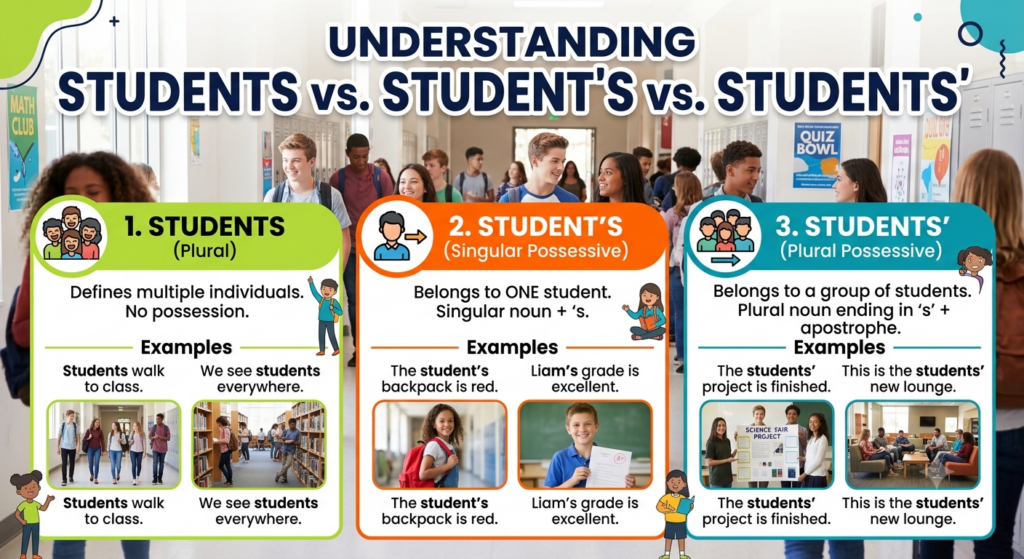

Students, student’s, and students’ are three forms that look almost identical on the page, yet each one has a different job in English. The difference comes down to two simple ideas: how many students you are talking about and whether possession is involved.
This is one of those grammar points that can make even experienced writers stop for a second. Because all three forms sound almost the same when spoken, the mistake usually becomes noticeable only in writing. Once you understand where the apostrophe belongs and why, choosing the correct form becomes much easier.
What Does Students Mean?
“Students” is simply the plural form of “student.” It refers to two or more people who are studying at a school, college, university, training program, or another educational setting.
There is no possession involved, so there is no apostrophe.
For example:
“The students arrived before the lesson started.”
“Several students volunteered for the project.”
“The students are preparing for their final exams.”
In each sentence, the writer is talking about more than one student. Nothing is being described as belonging to them.
A useful rule is to remember that adding an “s” usually makes a regular countable noun plural. One student becomes two students, just as one teacher becomes two teachers.
When Should You Use Student’s?
“Student’s” is the singular possessive form. It tells the reader that something belongs to, relates to, or is associated with one student.
The apostrophe comes before the final “s” because there is only one student involved.
Consider these examples:
“The student’s backpack was left in the classroom.”
“The student’s answer surprised the teacher.”
“We reviewed the student’s application.”
In the first sentence, one backpack is connected to one student. In the second, the answer came from one student. The same possession rule applies even when the thing being discussed is not a physical object.
For instance, “the student’s opinion” means the opinion of one student, while “the student’s progress” describes the progress of one student.
A simple test can help. Try rewriting the phrase using “of the student.”
“The student’s notebook” becomes “the notebook of the student.”
If that meaning works, the singular possessive form is probably correct.
When Is Students’ Correct?
“Students’” is the plural possessive form. It is used when something belongs to or is associated with more than one student.
Because “students” already ends in “s,” you do not add another “s” to create the possessive. You simply place an apostrophe after the existing “s.”
For example:
“The students’ projects were displayed in the hallway.”
“The students’ opinions were included in the report.”
“The school considered the students’ requests.”
These sentences refer to something associated with multiple students.
Compare these two examples:
“The student’s desk was damaged.”
“The students’ desks were replaced.”
The first sentence concerns one student. The second concerns several students. Moving the apostrophe changes the number of people involved.
Students, Student’s and Students’ Compared
The easiest way to understand the difference is to compare all three forms directly.
| Form | Meaning | Example |
|---|---|---|
| Students | More than one student | The students entered the classroom. |
| Student’s | Something connected to one student | The student’s book is missing. |
| Students’ | Something connected to several students | The students’ books are on the table. |
The key question is not simply whether the word ends in “s.” Instead, ask what the sentence is trying to communicate.
If you mean several people, use “students.”
If something belongs to one student, use “student’s.”
If something belongs to several students, use “students’.”
Common Apostrophe Mistakes to Avoid
One of the most common mistakes is adding an apostrophe simply because a word is plural.
For example:
Incorrect: “The student’s are waiting outside.”
Correct: “The students are waiting outside.”
The sentence is simply talking about several students. There is no possession, so an apostrophe is unnecessary.
Another common mistake is leaving the apostrophe out when possession is intended.
Incorrect: “The students books were collected.”
Correct: “The students’ books were collected.”
The books are associated with multiple students, so the apostrophe belongs after the plural “s.”
Writers also sometimes use “students’s.” That construction is not the standard plural possessive form. Because “students” already ends in “s,” possession is shown by adding only an apostrophe: “students’.”
It is also worth checking whether you actually need a possessive construction at all. For example, “student services” normally uses “student” as a noun modifying another noun rather than showing ownership. English does not require an apostrophe every time two nouns appear together.
A Simple Way to Choose the Correct Form
When you are unsure, ask yourself two questions.
First, am I talking about one student or several students?
Second, does something belong to or relate specifically to that student or group of students?
If you are simply talking about several learners, write “students.”
“The students finished the assignment.”
If something is associated with one learner, write “student’s.”
“The student’s assignment received a high score.”
If something is associated with several learners, write “students’.”
“The students’ assignments were returned yesterday.”
This approach works because it focuses on meaning rather than trying to memorize where an apostrophe looks right.
The Final Difference Between Students, Student’s and Students’
Although students, student’s, and students’ differ by only an apostrophe, that small punctuation mark can completely change a sentence.
“Students” means more than one student and does not show possession. “Student’s” refers to something belonging to or associated with one student. “Students’” refers to something belonging to or associated with multiple students.
The quickest memory trick is to look for ownership. No ownership usually means no apostrophe. One student showing possession takes “student’s,” while several students showing possession takes “students’.”
Once you start checking both number and possession, the difference becomes straightforward. It is a small grammar rule, but using it correctly can make school assignments, professional emails, reports, articles, and everyday writing look much clearer and more polished.