
Liason and liaison are often confused because the correct spelling does not match the way many people naturally expect the word to look. Only one of them is standard English.
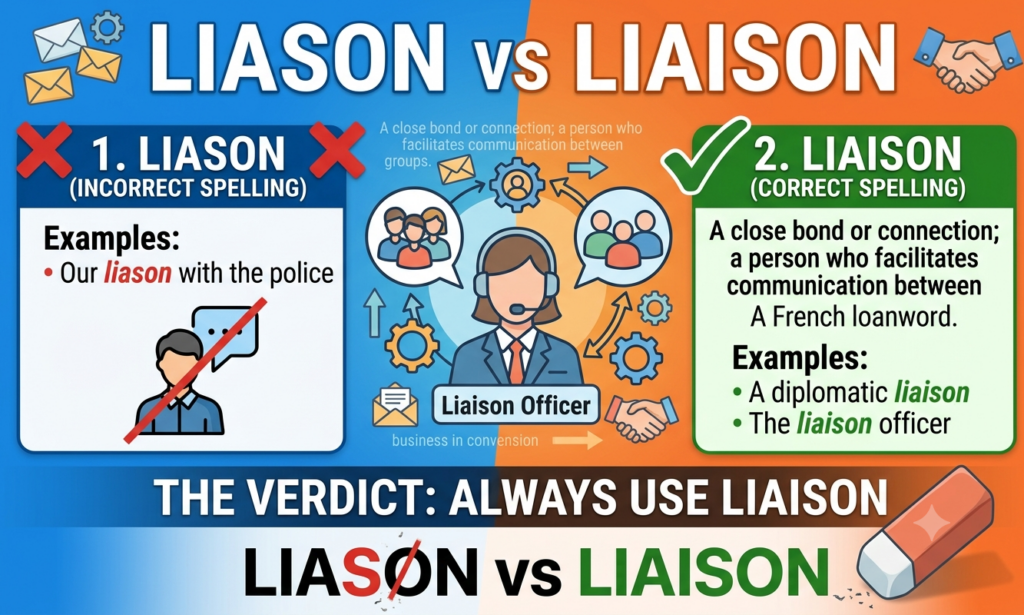
The correct spelling is “liaison.”
“Liason” is a common misspelling and should generally be avoided in formal writing, academic work, business communication, and published content.
The confusion usually comes from pronunciation. Liaison is commonly pronounced in a way that does not make every vowel obvious, so writers sometimes leave out the second “i.” Understanding the spelling, meaning, and origin of the word makes it much easier to remember.
What Does Liaison Mean?
“Liaison” is a noun that usually refers to communication, cooperation, or a connection between people, groups, or organizations.
A liaison can also be a person whose job is to maintain communication between different parties.
For example:
“She works as a liaison between the school and local families.”
“The company appointed a liaison to communicate with government officials.”
“Good liaison between the departments helped the project move faster.”
In these examples, the word relates to communication and coordination.
The term is commonly used in workplaces, schools, government organizations, hospitals, military settings, and community services.
Is Liason a Correct Word?
No. “Liason” is generally considered a spelling error.
The correct form contains two “i” letters:
Liaison
Not:
Liason
The incorrect version appears frequently because English speakers often spell words according to how they sound. Liaison does not make its internal vowel pattern particularly obvious when spoken.
If you are writing professionally, using “liaison” is the correct choice.
Why Is Liaison So Easy to Misspell?
Liaison entered English from French, which helps explain its unusual spelling.
English contains many borrowed words whose spelling does not follow the patterns readers may expect from ordinary English vocabulary. Liaison is one of them.
The sequence “iai” can look unusual, especially to someone seeing the word quickly. This leads people to simplify the spelling to “liason.”
The pronunciation also contributes to the problem. Depending on accent, liaison is commonly pronounced roughly like “lee-ay-zon” or “lee-ay-zuhn.”
Because the second “i” is not strongly heard as a separate sound, writers sometimes forget it.
How to Spell Liaison Correctly
A useful memory trick is to break the word into parts:
Li + ai + son
Another simple method is to remember that “liaison” contains three vowels in a row near the beginning:
i-a-i
So instead of writing:
L-i-a-s-o-n
Remember:
L-i-a-i-s-o-n
Typing the word a few times can also help build visual memory:
liaison
liaison officer
liaison team
community liaison
Once the pattern becomes familiar, the incorrect spelling “liason” usually starts to look obviously incomplete.
What Is a Liaison Person?
A liaison person acts as a connection between two or more individuals, teams, departments, or organizations.
Their role usually involves sharing information, solving communication problems, coordinating activities, and making sure both sides understand what is happening.
For example, a school may employ a family liaison who helps parents communicate with teachers and administrators.
A business may assign a client liaison to maintain communication between customers and internal teams.
A hospital might have a patient liaison who helps patients understand services, policies, or available support.
In each situation, the person serves as a communication link.
Common Uses of Liaison
The word appears in many professional phrases.
Some common examples include:
“liaison officer”
“community liaison”
“client liaison”
“family liaison”
“government liaison”
“military liaison”
“liaison team”
“liaison between departments”
The meaning stays broadly similar in each case. Someone or something is helping maintain communication or cooperation between different groups.
For example:
“The police liaison officer spoke with community leaders.”
“She became the main liaison between the client and the design team.”
“The organization created a liaison group to improve communication.”
Liaison Can Also Mean a Relationship
Liaison has another meaning that appears less often in everyday business writing.
It can describe a close relationship or association between people. In some contexts, particularly literary or older writing, “liaison” may refer to a romantic or secret relationship.
For example:
“The novel describes a complicated liaison between the two characters.”
Because this meaning can carry romantic implications, context is important.
In professional settings, however, liaison almost always refers to communication, cooperation, or a person responsible for connecting different groups.
Liaison vs Liason in a Sentence
Comparing the correct and incorrect forms makes the difference easy to see.
Incorrect:
“She acts as a liason between the departments.”
Correct:
“She acts as a liaison between the departments.”
Incorrect:
“The company hired a new community liason.”
Correct:
“The company hired a new community liaison.”
Incorrect:
“Please contact our customer liason for more information.”
Correct:
“Please contact our customer liaison for more information.”
The meaning does not change. The issue is purely spelling.
Is Liaison Used in British and American English?
Yes. “Liaison” is the standard spelling in both British and American English.
Unlike words such as “colour” and “color,” there is no major regional spelling difference with liaison.
Writers in the United Kingdom, United States, Australia, Canada, and other English-speaking regions generally use the same spelling.
That makes the rule simple:
Use “liaison” regardless of whether you are following British or American English conventions.
Common Mistakes to Avoid
The most common mistake is leaving out the second “i” and writing “liason.”
Another mistake is changing the ending of the word because of its pronunciation. Writers sometimes guess spellings based purely on sound, but borrowed words such as liaison often need to be memorized visually.
It is also worth checking the surrounding sentence.
Because liaison can describe either a person or a connection, make sure the sentence makes the intended meaning clear.
For example:
“She is our liaison with the local authority.”
Here, liaison describes a person.
“There is close liaison between the two departments.”
Here, liaison refers to communication and cooperation.
Both uses are correct.
A Simple Way to Remember Liason vs Liaison
The easiest rule is straightforward:
“Liaison” is correct.
“Liason” is incorrect.
If remembering the spelling is difficult, focus on the vowel pattern:
L-I-A-I-S-O-N
You can also remember the phrase:
“A liaison keeps communication alive.”
Seeing and using the word repeatedly is often the fastest way to make the correct spelling feel natural.
Final Difference Between Liason and Liaison
The difference between liason and liaison is not a matter of British versus American English or formal versus informal usage. It is simply a spelling issue.
“Liaison” is the correct word. It can describe communication between people or organizations, a person responsible for maintaining that communication, or, in some contexts, a close relationship.
“Liason” is a common misspelling created by dropping the second “i.”
When writing emails, reports, applications, articles, or professional documents, always choose “liaison.” Remembering the unusual “iai” vowel pattern can help you avoid one of the most common spelling mistakes associated with this word.