
“Trash” and “garbage” are two everyday words for things people throw away, so it is easy to assume they mean exactly the same thing. In modern American English, they often do. Someone might say “take out the trash” while another person says “take out the garbage,” even when they are referring to the same bag of household waste.
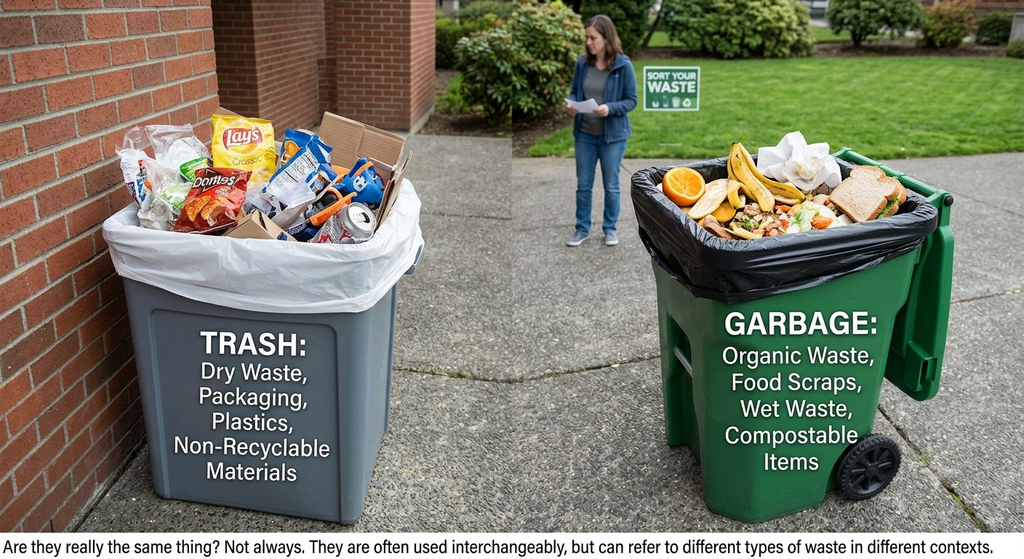
Traditionally, however, there is a slight difference. “Trash” generally refers to dry discarded material such as paper, boxes, wrappers, packaging, and broken household objects. “Garbage” has historically been more closely associated with food scraps, spoiled food, and other kitchen waste.
The distinction is useful to know, but everyday English is much more flexible.
Quick Answer
The basic difference is:
Trash usually means dry or general discarded material.
Garbage traditionally refers more specifically to food and kitchen waste.
For example:
Please put those old magazines in the trash.
The garbage smells because there is leftover food in the bag.
In ordinary American conversation, though, either word may be used for household waste in general.
Trash vs Garbage
Here is a quick comparison:
| Feature | Trash | Garbage |
|---|---|---|
| Basic meaning | Discarded or unwanted material | Household waste, traditionally food waste |
| Traditional association | Paper, packaging, broken objects | Food scraps and kitchen waste |
| Common in US English | Yes | Yes |
| Can describe household waste generally | Yes | Yes |
| Common UK alternative | Rubbish | Rubbish |
| Figurative meaning | Yes | Yes |
The traditional distinction can help English learners, but it should not be treated as an absolute rule.
What Does Trash Mean?
“Trash” is commonly used for material that is no longer wanted and is going to be thrown away.
Examples include:
Paper wrappers
Empty packages
Old newspapers
Broken toys
Cardboard boxes
Disposable cups
Damaged household items
You might hear:
Put the empty box in the trash.
I need to take the trash outside.
There was trash all over the park after the event.
Could you throw this paper in the trash?
In everyday American English, “trash” is also commonly used as a general term for almost everything in a household waste container, including food.
For this reason, “take out the trash” is one of the most common expressions used in American homes.
What Does Garbage Mean?
“Garbage” also refers to unwanted material that is thrown away.
Traditionally, however, it has had a stronger connection with kitchen and food waste.
Examples might include:
Vegetable peelings
Spoiled fruit
Leftover meals
Eggshells
Food scraps
Expired food
You could say:
The garbage needs to be taken outside.
Don’t leave food in the garbage overnight.
The garbage bag is starting to smell.
She threw the spoiled vegetables into the garbage.
Today, many American speakers use “garbage” for household waste generally, so the word does not have to refer only to food.
Are Trash and Garbage the Same?
In everyday conversation, they can be.
Consider these sentences:
I need to take out the trash.
I need to take out the garbage.
Most American speakers would understand these sentences in essentially the same way.
The traditional distinction becomes more useful when someone wants to classify different kinds of waste.
For example, paper packaging might be described as trash, while leftover food could be described as garbage.
Still, you should not assume that every native speaker follows this distinction. Regional habits, household preferences, and local waste systems can all influence which term people use.
Trash in Everyday English
“Trash” appears in many common American expressions.
Take out the trash means to remove household waste and put it outside for collection.
Example:
Can you take out the trash before you leave?
Throw something in the trash means to discard something.
Example:
Don’t throw that receipt in the trash. I still need it.
Trash can refers to a container used for waste.
Example:
There is a trash can beside the desk.
Trash bag refers to a plastic bag used for collecting household waste.
Example:
We need to buy more trash bags.
These expressions are extremely common in casual American English.
Garbage in Everyday English
“Garbage” also appears in several familiar expressions.
Garbage can means a container for household waste.
Example:
Put the bag in the garbage can outside.
Garbage truck refers to the vehicle that collects household waste.
Example:
The garbage truck usually comes early in the morning.
Garbage collection means the service that removes household waste.
Example:
Garbage collection happens twice a week in this neighborhood.
Garbage disposal can refer generally to waste disposal, but in American homes it can also mean the kitchen appliance installed beneath a sink that grinds food waste.
Example:
Don’t put that large piece of food into the garbage disposal.
Context normally makes the intended meaning clear.
Trash Can vs Garbage Can
Is there a meaningful difference between a “trash can” and a “garbage can”?
Usually, no.
Both phrases describe a container where unwanted household material is placed before disposal.
For example:
Throw the bottle in the trash can.
Throw the bottle in the garbage can.
Both sentences sound natural in American English.
Some people may associate a garbage can more strongly with kitchen or outdoor household waste, while a trash can may be used for wastebaskets in bedrooms, offices, or public spaces. However, this distinction is not strict.
American vs British English
“Trash” and “garbage” are especially common in American English.
British English generally prefers the word “rubbish” for ordinary household waste.
American English:
Please take out the trash.
British English:
Please take out the rubbish.
An American might say:
Throw it in the trash can.
A British speaker may be more likely to say:
Put it in the bin.
“Garbage” and “trash” are still understood by British speakers, especially through American films, television, and online content, but “rubbish” and “bin” are generally more characteristic of everyday British usage.
Trash Can, Garbage Can, or Bin?
All three expressions can refer to a container for waste, but regional preference matters.
In the United States, you commonly hear:
Trash can
Garbage can
Wastebasket
In the United Kingdom, you are more likely to hear:
Bin
Rubbish bin
Waste bin
For example:
US: Put it in the trash can.
UK: Put it in the bin.
Neither version is better English. They simply reflect different regional vocabulary.
Real-Life Examples
Here are some natural examples using “trash”:
Please pick up your trash before leaving the picnic area.
I accidentally threw the document in the trash.
The trash can under my desk is full.
We forgot to take the trash outside last night.
There were empty cups and wrappers in the trash.
Examples using “garbage” include:
The garbage truck arrived early this morning.
Please tie the garbage bag before taking it outside.
Something in the kitchen garbage smells unpleasant.
The city changed its garbage collection schedule.
He put the leftover food in the garbage.
These examples show why the two words overlap so frequently.
Trash and Garbage as Figurative Words
Both words can also be used beyond literal household waste.
“Trash” can describe something considered poor in quality.
For example:
He thought the movie was complete trash.
This usage is informal and strongly negative.
“Trash” can also function as a verb meaning to damage, destroy, criticize severely, or leave a place extremely messy.
Example:
The room was trashed after the party.
“Garbage” can similarly describe an idea, statement, or piece of information that someone believes is worthless or untrue.
Example:
That claim is complete garbage.
Because these figurative meanings are negative, they should be used carefully when speaking about another person’s work or opinions.
Common Mistakes
One common mistake is believing that “trash” can only refer to dry material while “garbage” must always refer to food.
That distinction exists historically, but modern American usage is much less strict.
Another mistake is assuming “garbage” should normally be plural.
Incorrect:
There are several garbages outside.
“Garbage” is generally an uncountable noun.
More natural:
There is a lot of garbage outside.
You can count containers or pieces instead:
There are three garbage bags outside.
“There is a pile of garbage beside the road.”
“Trash” is also normally uncountable when it means waste.
Instead of:
Many trashes were left behind.
Say:
A lot of trash was left behind.
Waste vs Trash vs Garbage
“Waste” is a broader and often more formal word.
For example:
Household waste
Food waste
Industrial waste
Medical waste
Electronic waste
“Trash” and “garbage” are more common in everyday American conversation.
Compare:
The city is developing a new waste management system.
Please take the trash out.
The garbage can is full.
The first sentence sounds more formal and administrative, while the other two sound like ordinary household conversation.
Which Word Should You Use?
If you are speaking American English, either “trash” or “garbage” will usually be understood when discussing ordinary household waste.
“Trash” is particularly natural in expressions such as:
Take out the trash.
Throw it in the trash.
Trash can.
“Garbage” is common in expressions such as:
Garbage truck.
Garbage collection.
Garbage disposal.
Garbage can.
If you are writing for a British audience, “rubbish” or “waste” may often sound more natural.
The key is to pay attention to context rather than trying to apply an overly strict rule.
Easy Way to Remember the Difference
A simple memory trick is:
Trash = general or traditionally dry discarded material.
Garbage = traditionally kitchen and food waste.
But remember the second rule:
Everyday American English often uses them interchangeably.
Imagine cleaning two areas of a house.
Old papers and packaging from an office could easily be called trash.
Leftover food from the kitchen could traditionally be called garbage.
Once everything is placed in the same household bag, many Americans may simply call the entire thing either trash or garbage.
Frequently Asked Questions
Is Trash the Same as Garbage?
They often mean the same thing in modern American English. Traditionally, trash refers more to dry discarded materials, while garbage has a stronger association with food and kitchen waste.
Is Garbage Only Food Waste?
Not necessarily. The word has traditionally been connected with food waste, but modern speakers frequently use “garbage” for household waste in general.
Which Word Is More Common in America?
Both are common. The preferred word can depend on the speaker, region, and expression being used.
What Do British People Say Instead of Trash?
British English commonly uses “rubbish.” A waste container is also commonly called a “bin.”
Is It Trash Can or Garbage Can?
Both are correct in American English and usually refer to the same kind of waste container.
Is Garbage Countable?
Usually not. “Garbage” is normally an uncountable noun.
Say:
There is too much garbage.
Not:
There are too many garbages.
Is Trash Countable?
“Trash” is also generally uncountable when referring to discarded material.
Say:
There is a lot of trash on the ground.
What Is the More Formal Word?
“Waste” is generally more suitable in formal, technical, environmental, or administrative writing.
Final Thoughts
The difference between “trash” and “garbage” is easier to understand once you separate traditional meaning from everyday usage.
Traditionally, “trash” has been associated with dry discarded items such as paper, packaging, and broken objects, while “garbage” has been connected more closely with food scraps and kitchen waste.
In modern American English, however, that line is often blurred. People regularly use “trash” and “garbage” to describe the same household waste, and expressions such as “take out the trash” and “take out the garbage” can communicate essentially the same idea.
For everyday conversation, context matters more than a rigid vocabulary rule. Learn the traditional distinction, but also pay attention to how people naturally use these words in real life.