
English keeps changing, and one small grammar question is creating more confusion than many writers expect: should you write “themself” or “themselves”?
For years, “themselves” was taught as the familiar reflexive form connected with “they” and “them.” That rule remains straightforward when several people are involved. However, the growing use of singular “they” has made “themself” increasingly visible in everyday writing, academic discussion, workplaces, media and online communication.
The interesting part is that neither word can simply be dismissed as wrong. The correct choice depends largely on whether “they” refers to one person or several people, along with the style of writing being used.
What Is the Difference Between Themself and Themselves?
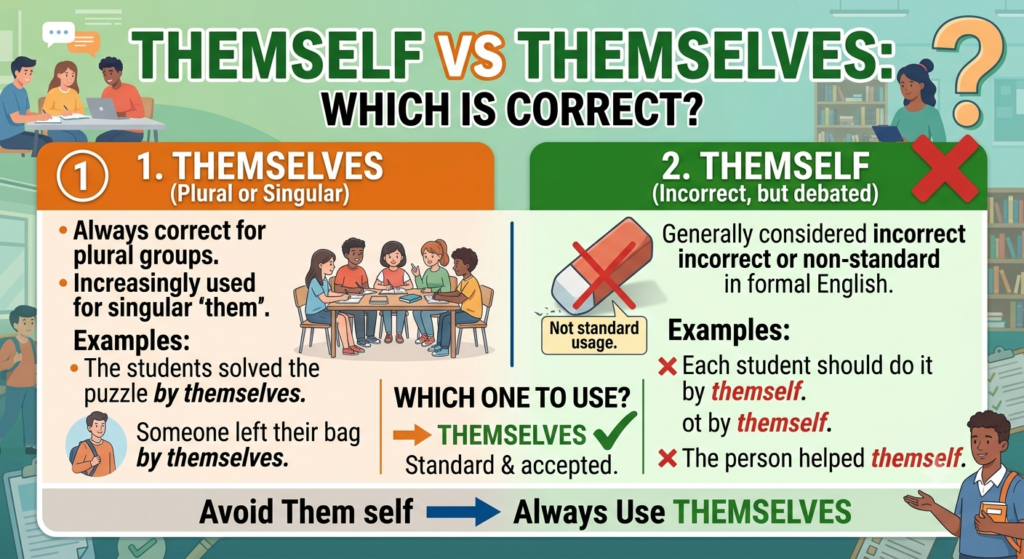
“Themselves” is the standard reflexive pronoun normally used when talking about more than one person.
For example:
“The players prepared themselves for the match.”
Here, “players” clearly refers to several people, so “themselves” is the natural and grammatically established choice.
“Themself,” on the other hand, can be used when “they” refers to one person.
For example:
“Every applicant should prepare themself before the interview.”
The sentence refers to each applicant individually. Because the person’s gender is either unknown or irrelevant, singular “they” works naturally, and “themself” makes the singular meaning particularly clear.
That difference in number is the easiest way to understand why both forms exist.
Is Themself Actually a Correct Word?
Yes, “themself” is a real English word, although its acceptance has not always been universal.
The word has become more noticeable as singular “they” has become increasingly common. Writers now frequently use “they” when a person’s gender is unknown, when gender is irrelevant to the sentence, or when referring to somebody who uses they/them pronouns.
Consider this sentence:
“Someone left their phone behind, but they came back to collect it themselves.”
This construction is already familiar to many English speakers.
Another writer might choose:
“Someone should remind themself to collect their phone.”
Both constructions can appear in modern English, although “themselves” remains more familiar to many readers.
That means using “themself” is not simply a spelling mistake. It reflects a singular interpretation of “they.”
When Should You Use Themselves?
There is one situation where the answer is extremely simple. When “they” clearly refers to multiple people, use “themselves.”
Examples include:
“The children entertained themselves during the journey.”
“The employees introduced themselves at the meeting.”
“The actors prepared themselves before going on stage.”
“The students completed the project themselves.”
Using “themself” in these examples would sound incorrect because the subjects are plural.
You would not normally write:
“The students completed the project themself.”
Several students are involved, so “themselves” is required.
“Themselves” can also be used when singular “they” refers to one person. This usage is well established and is still the version many readers find most natural.
For example:
“Everyone should ask themselves whether they understand the instructions.”
Although “everyone” is grammatically singular, “themselves” works naturally with singular “they.”
When Does Themself Make Sense?
“Themself” becomes especially useful when a writer wants to make it unmistakable that only one individual is being discussed.
For example:
“Each employee should introduce themself to the new manager.”
The word “each” signals that employees are being considered individually rather than as a group.
Other examples include:
“Every contestant must prepare themself before appearing on stage.”
“A new student may find themself feeling nervous on the first day.”
“If someone wants to improve, they should challenge themself.”
These sentences show why the word appeals to some writers. “Themself” follows the same singular pattern found in “himself,” “herself” and “yourself.”
Still, English does not always follow perfect mathematical patterns. Familiar usage matters too, which is why “themselves” remains common even when “they” means one person.
Singular They Changed the Conversation
The debate surrounding “themself” makes much more sense once singular “they” is understood.
Singular “they” allows writers to talk about one person without unnecessarily identifying that person as male or female.
For example:
“If a customer has a problem, they should contact support.”
This sounds ordinary to many English speakers today.
Older writing might have used “he or she,” producing:
“If a customer has a problem, he or she should contact support.”
The second version is not necessarily incorrect, but it can feel cumbersome when repeated throughout an article, policy document or conversation.
Singular “they” offers a simpler alternative.
Once “they” can mean one individual, however, another question naturally appears. Should its reflexive form remain the traditionally plural “themselves,” or should it become the singular “themself”?
Modern English currently allows room for both approaches.
What Should You Use in Formal Writing?
For formal writing, context matters more than trying to find one universal answer.
“Themselves” remains the most widely familiar form and works with both plural “they” and commonly with singular “they.”
For that reason, a sentence such as:
“Every researcher should check their work themselves.”
will usually pass without attracting attention.
“Themself” may be appropriate when emphasizing that the reference is to one person:
“Each researcher should check the data themself.”
Writers preparing academic assignments, company documents or publications should also follow any required house style or editorial guide.
Consistency is particularly important. An article that repeatedly alternates between “themself” and “themselves” for the same type of construction can look careless even when both forms are defensible.
Common Mistakes Writers Should Avoid
One of the biggest errors is using “themself” with an obviously plural subject.
Incorrect:
“The footballers congratulated themself after the victory.”
Correct:
“The footballers congratulated themselves after the victory.”
Another mistake is assuming “themself” must always replace “themselves” whenever singular “they” appears.
That is not necessary.
“Someone might surprise themselves” remains a normal English construction.
Writers should also avoid changing another person’s stated pronouns simply because a different construction feels more familiar. When writing about a known individual, using that person’s preferred pronouns generally produces clearer and more respectful writing.
Why Does Themself Still Sound Strange to Some People?
Language familiarity plays a major role.
Most people have heard phrases such as “enjoy themselves,” “prepare themselves” and “keep themselves safe” throughout their lives. “Themself” appears less frequently, so even a grammatically understandable sentence can initially sound unusual.
The same thing happens whenever language changes. A construction may appear unfamiliar before repeated use makes it feel ordinary.
This does not mean every newer form automatically replaces an older one. In the case of “themself” and “themselves,” the two forms currently perform slightly different but overlapping jobs.
Themself or Themselves: The Simple Rule
For multiple people, the answer is clear: use “themselves.”
For one person referred to with singular “they,” both “themselves” and “themself” can appear in modern English. “Themselves” remains more established and familiar, while “themself” can make the singular meaning more explicit.
A useful shortcut is:
One clearly singular person using “they”: “themself” can work.
Several people: always use “themselves.”
Singular “they” in general writing: “themselves” is also widely accepted.
Ultimately, good writing is not only about following rules. It is about making meaning clear to the reader. If the sentence clearly communicates whether one person or several people are involved, and the usage remains consistent throughout the text, the writer is already solving the most important part of the problem.