
English has many expressions that sound like they could be written as one word. This often causes confusion, especially when people see different spellings in text messages, social media posts, or informal online conversations.
“In front” and “infront” are a good example.
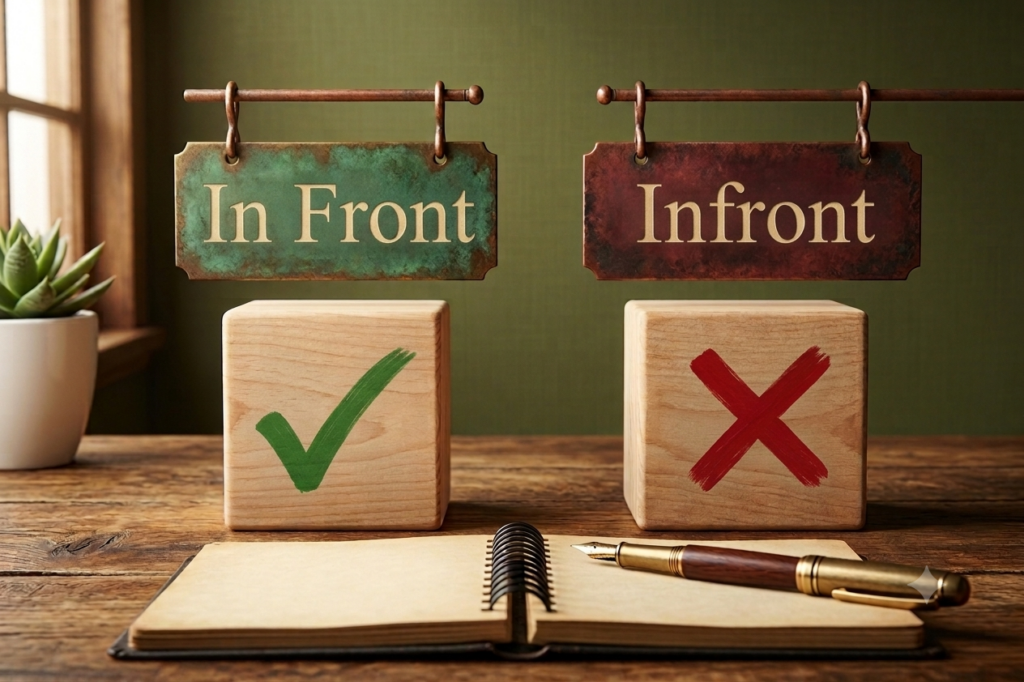
The correct form is “in front,” written as two separate words. “Infront” is not a standard English spelling and should normally be avoided in essays, emails, articles, school assignments, and professional writing.
The rule is the same in both American and British English, so there is no regional spelling difference to remember.
Is It In Front or Infront?
Always use “in front.”
The phrase describes something or someone positioned farther forward than another person, place, or object.
For example:
“The taxi is waiting in front of the hotel.”
“She stood in front of the mirror.”
“There was a long line in front of the store.”
In each sentence, “in front” tells the reader where something is located.
Standard dictionaries recognize “in front” as a phrase meaning farther forward than someone or something else. The form “infront” is not the standard spelling.
A simple rule is therefore:
Correct: in front
Incorrect: infront
Why Is In Front Written as Two Words?
The spelling becomes easier to understand when we look at how the phrase works.
“In” is a preposition.
“Front” is usually a noun in this expression.
Together, they create a phrase that describes position.
Consider this sentence:
“The bicycle is in front of the garage.”
The word “in” helps show the relationship between the bicycle and the garage, while “front” describes the position.
Because the words perform separate jobs, they remain separate.
English does contain many words that began as separate expressions and eventually became compound words. However, “in front” has not developed into a standard one-word form.
What Does In Front Mean?
“In front” usually means farther forward or positioned ahead of something else.
Imagine three people standing in a queue.
If Sarah is first, Tom is second, and David is third, Tom is in front of David.
The phrase can also describe physical locations.
“The café is in front of the station.”
Here, the café is positioned near the forward side of the station.
Another common example is:
“The teacher stood in front of the class.”
This means the teacher was positioned where the students could see them.
“In front” is therefore mainly connected with location, position, or visibility.
How to Use In Front Of Correctly
The expression “in front of” is especially common in everyday English.
It means that someone or something is positioned close to or ahead of another person or object. It is often treated as the opposite of “behind.”
For example:
“The bus stopped in front of the school.”
“Someone parked in front of our driveway.”
“She was sitting in front of me at the cinema.”
“There is a tree in front of the house.”
“He spoke in front of hundreds of people.”
The final example shows that the phrase does not always describe physical distance alone.
Speaking “in front of” people means speaking where those people can see or hear you.
For example:
“She gets nervous when speaking in front of large groups.”
The phrase still involves position, but the main idea is being visible or present before an audience.
Can Infront Ever Be Correct?
In normal standard English, “infront” should not be used as a replacement for “in front.”
You may still see it online.
People sometimes type “infront” because they hear the expression as one continuous sound when speaking. Fast typing on phones can also make people combine the two words accidentally.
The same thing happens with other expressions.
Writers sometimes incorrectly combine words because similar-looking English expressions do exist as single words.
For example, “inside” is one word.
“Into” is also one word.
Because of this, someone may assume that “in front” should become “infront.”
It does not.
For normal English writing, keep the space between “in” and “front.”
In Front in American and British English
There is no difference between American and British English for this expression.
American English uses “in front.”
British English also uses “in front.”
This makes the rule easier than spelling differences such as “color” and “colour,” or “traveled” and “travelled.”
You do not need to change the spelling depending on your audience.
Whether you are writing for readers in the United States, United Kingdom, Australia, Canada, India, or another English-speaking region, “in front” is the standard choice.
Common Examples of In Front
Learning through sentences is often easier than memorizing a grammar rule.
Here are several natural examples:
“The children waited in front of the school gate.”
“My car is parked in front of your house.”
“She placed the chair in front of the television.”
“A police officer was standing in front of the entrance.”
“We met in front of the restaurant.”
“He stood in front of everyone and gave a short speech.”
“The person in front of me bought the last ticket.”
“There is a beautiful garden in front of the building.”
In all of these examples, “in front” remains two words.
In Front and In the Front Are Not Always the Same
Another useful distinction involves “in front of” and “in the front of.”
They may look similar, but they can describe different positions.
Consider:
“She waited in front of the car.”
This usually means she was outside the car, near its forward side.
Now compare:
“She sat in the front of the car.”
This means she was inside the vehicle, usually in one of the front seats.
The word “the” changes the meaning.
Another example:
“He stood in front of the building.”
He is outside the building.
“He waited in the front of the building.”
Depending on the context, this could suggest he was inside the building near its front area.
Understanding this small distinction can make descriptions much clearer.
Why People Commonly Write Infront
The mistake is easy to make because spoken English does not contain a noticeable pause between the words.
If someone says:
“Wait in front of the door.”
“In front” may sound like one word during normal conversation.
English spelling, however, does not always follow the way words sound.
Another reason is that people see many compound words in English.
Examples include:
“Inside”
“Outside”
“Upstairs”
“Into”
“Nearby”
This can make “infront” seem reasonable even though it is not standard.
The safest method is to remember that “front” remains its own word.
In Front vs Ahead
“In front” and “ahead” sometimes communicate similar ideas, but they are not always interchangeable.
For example:
“The red car is in front of us.”
“The red car is ahead of us.”
Both can work.
However, “ahead” can also refer to time or progress.
“We have a difficult week ahead.”
You would not normally replace “ahead” with “in front” in that sentence.
Similarly:
“Our team is ahead by three points.”
This describes a lead in a competition.
“In front” can sometimes also describe being in the lead, particularly in British English, but the exact wording depends on context. Cambridge lists “in front” as having a competition-related meaning in British usage.
For ordinary descriptions of physical position, “in front of” is usually very clear.
Common Mistakes to Avoid
A typical spelling mistake looks like this:
Incorrect: “She parked infront of my house.”
Correct: “She parked in front of my house.”
Another example:
Incorrect: “Please wait infront of reception.”
Correct: “Please wait in front of reception.”
The error does not usually make a sentence impossible to understand. Most readers will know what the writer means.
However, using the correct spelling matters in professional communication, academic work, published articles, resumes, and business documents.
Small spelling mistakes can make otherwise good writing look less polished.
An Easy Trick to Remember In Front
Think about the question:
“Where is it?”
Your answer might be:
“In front.”
The two words work together, but they remain separate.
Another simple trick is to remember this sentence:
“The word ‘front’ needs space in front of it.”
It sounds a little playful, but it can help you remember the spelling.
You can also search your document for “infront” during proofreading. If it appears as an ordinary location phrase, change it to “in front.”
The Correct Choice Is Always In Front
The difference between “in front” and “infront” is straightforward once you know the rule.
“In front” is the standard English form. It is written as two words and is used to describe someone or something positioned farther forward than another person or object.
“Infront” is not the standard spelling.
The rule does not change between American and British English.
So, whether you are writing an email, article, assignment, message, or professional report, remember the simple form:
“In front” is correct.
Keeping those two words separate will make your writing clearer, more accurate, and more natural.