
“To bad” and “too bad” sound exactly the same when spoken, so it is easy to understand why people mix them up. In writing, however, only one form is normally correct when you want to show sympathy, disappointment, or regret.
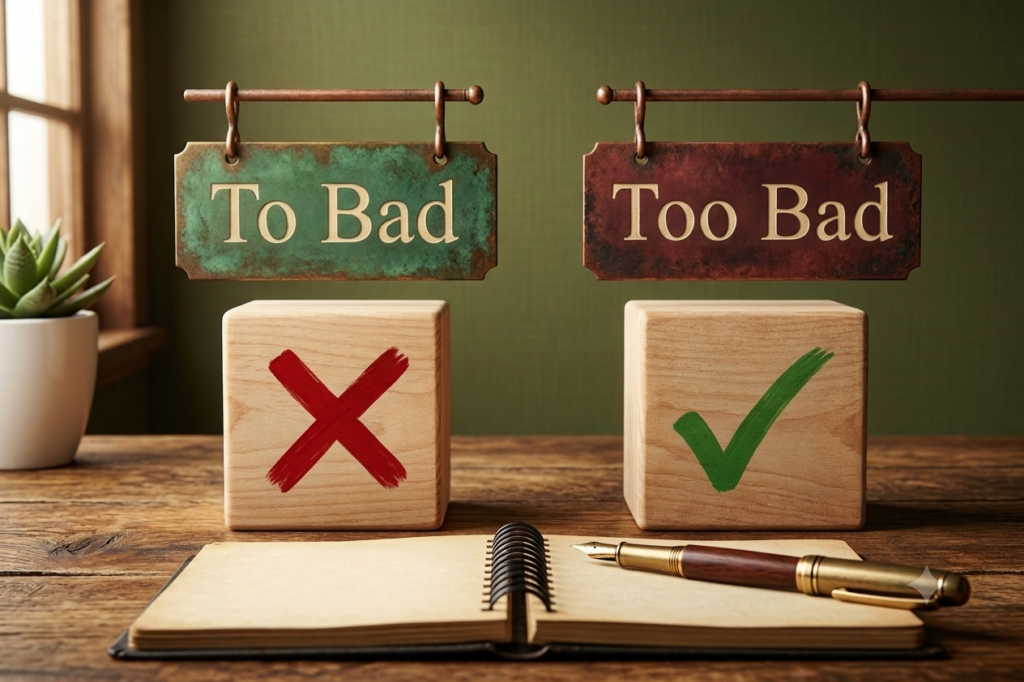
The correct expression is “too bad.”
For example, you might say, “It’s too bad that you missed the concert” or “That’s too bad. I hope everything works out.”
“To bad” is usually incorrect when used in this way. It can appear correctly when “to” belongs to a larger phrase, such as “exposure to bad weather” or “returning to bad habits.” The difference becomes simple once you understand what “to” and “too” actually do in a sentence.
Is It To Bad or Too Bad?
If you are describing something unfortunate or expressing sympathy, write “too bad.”
Examples include:
“It’s too bad we cannot attend.”
“That’s too bad about your cancelled trip.”
“Too bad the match ended so early.”
In each case, “too bad” works as a familiar English expression. Cambridge Dictionary describes it as an informal phrase that can communicate sympathy about an unpleasant situation. Tone can also change its meaning, because the same phrase can sometimes sound dismissive rather than sympathetic.
Writing “to bad” in those sentences would be incorrect.
You would not normally write:
“That’s to bad.”
Instead, use:
“That’s too bad.”
What Does Too Bad Mean?
“Too bad” generally means that something is unfortunate, disappointing, or regrettable.
Imagine a friend tells you that their holiday was cancelled because of bad weather. You might answer:
“That’s too bad. Were you able to reschedule it?”
Here, the phrase shows sympathy.
It can also describe your own disappointment:
“It’s too bad I have to work this weekend.”
The speaker is saying that the situation is unfortunate.
However, context and tone are important.
Someone could also respond with “Too bad” in a firm or dismissive way. For example, if a person complains about a rule and someone replies, “Too bad, the rule still applies,” the expression does not communicate sympathy. It means something closer to “that is unfortunate, but nothing will change.” Cambridge notes both uses of the expression.
Why Is Too Bad Correct?
The key word is “too.”
“Too” is an adverb. Depending on the sentence, it can mean “also” or indicate an excessive degree.
For example:
“This coffee is too hot.”
Here, “too” means hotter than is comfortable or necessary.
“I want to come too.”
Here, it means “also.”
“Too bad” has also developed into a common English expression used when something is disappointing or unfortunate.
“To” has a different grammatical role. It is commonly used as a preposition or as part of an infinitive.
Examples include:
“She went to school.”
“I want to sleep.”
“They drove to London.”
Because “to” does not perform the same job as “too,” it cannot simply replace it in the expression “too bad.”
Can To Bad Ever Be Correct?
Yes, but only when the two words happen to appear next to each other as part of a larger sentence.
Consider:
“The lack of sleep led to bad decisions.”
Here, “to” belongs with “led to,” while “bad” describes “decisions.”
Another example is:
“He returned to bad habits after the holiday.”
Again, “to bad” appears in the sentence, but it is not the expression “to bad.” The word “to” introduces the noun phrase “bad habits.”
You could also write:
“The plants were exposed to bad weather.”
This sentence is correct because “to” is functioning normally as a preposition.
That is very different from writing “That’s to bad,” which is incorrect.
To vs Too: What Is the Difference?
The easiest way to avoid the mistake is to understand the basic difference between “to” and “too.”
| Word | Main Use | Example |
|---|---|---|
| To | Direction, destination, or infinitive marker | We went to the store. |
| Too | Also or an excessive degree | I want one too. |
| Too bad | Shows disappointment, regret, or sympathy | It’s too bad you missed it. |
“To” often points toward somewhere or appears before a verb.
For example:
“I am going to work.”
“She wants to learn.”
“Too” has different uses:
“The bag is too heavy.”
“He wants to join us too.”
And when paired with “bad,” it forms the familiar expression:
“That’s too bad.”
Examples of Too Bad in Everyday Sentences
Seeing the phrase in context makes the rule easier to remember.
“It’s too bad that Sarah cannot join us.”
“That’s too bad about your exam result.”
“Too bad the restaurant was closed.”
“It would be too bad to cancel the whole trip.”
“It’s too bad we did not meet earlier.”
“That’s too bad. I hope you recover soon.”
All of these examples use “too bad” naturally.
Notice that the phrase can appear at the beginning, middle, or end of a sentence depending on its structure.
Common Mistakes With To and Too
The confusion usually happens because “to” and “too” are homophones. They sound alike when spoken but have different spellings and meanings.
A common mistake is:
“I’m going too the office.”
The correct sentence is:
“I’m going to the office.”
Another mistake is:
“That’s to bad.”
The correct version is:
“That’s too bad.”
Writers sometimes also confuse “too” with “two,” which represents the number 2.
Compare:
“I have two dogs.”
“I have a dog too.”
“I am going to the park.”
The three words sound similar in normal speech, but they perform completely different jobs in writing.
Is Too Bad Formal English?
“Too bad” is most common in conversation and informal writing.
Cambridge describes the expression as informal, particularly when it is used as a short reaction to another person’s situation.
For example:
“I missed my flight.”
“That’s too bad.”
In more formal writing, alternatives may sound better.
Instead of:
“It is too bad that the event was cancelled.”
You could write:
“Unfortunately, the event was cancelled.”
Other alternatives include “regrettably,” “unfortunately,” “disappointingly,” or a more specific description of what happened.
This does not mean “too bad” is grammatically wrong in formal writing. It simply tends to sound more conversational.
How Tone Can Change the Meaning
One interesting feature of “too bad” is that tone can completely change how it sounds.
A sympathetic response might be:
“That’s too bad. I hope she feels better soon.”
A dismissive response could be:
“Too bad. You still have to finish the work.”
The words are the same, but the attitude is different.
This matters especially in text messages and emails, where the reader cannot hear your voice.
Writing only “Too bad” after someone shares difficult news can sometimes sound cold. Adding another sentence can make your meaning clearer.
For example:
“That’s too bad. I’m sorry you had to deal with that.”
An Easy Trick to Remember the Correct Phrase
There is a simple way to remember whether you need “to” or “too.”
The word “too” has an extra O.
Think of that extra O as representing “extra.”
“Too much” means an extra amount.
“Too hot” means hotter than needed.
And “too bad” is the familiar expression used for something unfortunate.
Meanwhile, “to” has only one O and is usually connected with direction or a verb:
“Go to work.”
“Travel to France.”
“Want to eat.”
This small memory trick can help you catch the mistake quickly when proofreading.
The Simple Rule
When you are expressing regret, sympathy, or disappointment, use “too bad.”
Write:
“That’s too bad.”
“It’s too bad you missed the event.”
“Too bad we cannot stay longer.”
Use “to bad” only when “to” naturally belongs before a phrase beginning with “bad,” such as “to bad weather,” “to bad habits,” or “to bad decisions.”
The difference may look small, but using the correct form makes your writing clearer and more natural. Once you remember that “too bad” is the expression for an unfortunate situation, this common English mistake becomes much easier to avoid.