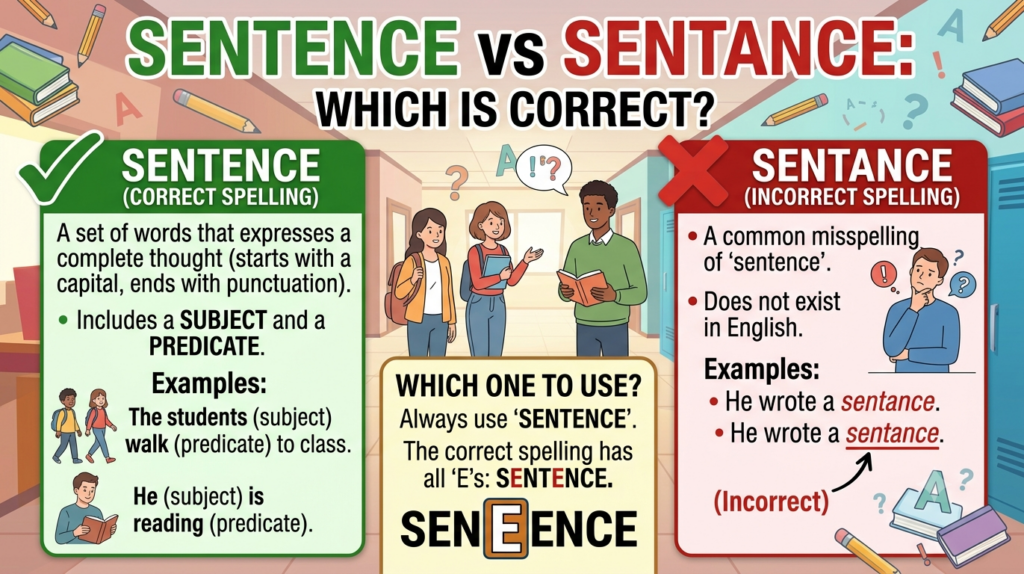

Sentence and sentance are often confused because they sound very similar when spoken. However, only one spelling is correct in standard English.
The correct spelling is “sentence.”
“Sentance” is a common misspelling and should not be used in formal writing, schoolwork, emails, articles, or professional communication.
The confusion usually happens because the final unstressed sound in “sentence” can make the ending difficult to hear clearly. Once you know the correct spelling and understand how the word is used, it becomes much easier to remember.
What Does Sentence Mean?
A sentence is a group of words that expresses a complete thought.
In basic grammar, a sentence usually contains a subject and a verb.
For example:
“The dog is sleeping.”
“She opened the window.”
“We are going to school.”
Each of these examples communicates a complete idea.
A sentence normally begins with a capital letter and ends with punctuation such as a period, question mark, or exclamation mark.
For example:
“Where are you going?”
“That was amazing!”
“The meeting starts at nine.”
These are all complete sentences.
Is Sentance a Correct Word?
No. “Sentance” is not the standard spelling.
The correct spelling is:
Sentence
The incorrect spelling is:
Sentance
People often write “sentance” because they spell the word according to how it sounds. In everyday speech, the middle and ending sounds of “sentence” can be less distinct.
However, standard English spelling uses an “e” in the second syllable:
S-e-n-t-e-n-c-e
Not:
S-e-n-t-a-n-c-e
If you are writing for school, work, publishing, or a website, “sentence” is always the correct choice.
Why Is Sentence Commonly Misspelled?
The main reason is pronunciation.
When people say “sentence” quickly, the second vowel is often weak. This can make it sound closer to “sentance,” especially to learners who are spelling the word by ear.
English spelling does not always follow pronunciation perfectly. Some vowels become softer when spoken, but their written form stays the same.
This is why memorizing the visual pattern can be helpful.
Sentence contains “ten” in the middle:
sen-ten-ce
That can be an easy way to remember the spelling.
How to Spell Sentence Correctly
The correct spelling is:
S-E-N-T-E-N-C-E
A simple memory trick is to divide it into parts:
Sen + ten + ce
You can also remember that there is an “e” before the second “n.”
Try writing a few common phrases:
complete sentence
short sentence
long sentence
sentence structure
sentence example
sentence correction
Seeing the correct spelling repeatedly helps the word become familiar.
Sentence Meaning in Grammar
In grammar, a sentence is more than just a group of words.
It needs to express a complete idea.
For example:
“Because I was tired.”
This may sound natural, but it is not a complete sentence by itself because it leaves the reader waiting for more information.
Compare it with:
“Because I was tired, I went to bed early.”
Now the thought is complete.
This is why understanding sentence structure is important in writing. A complete sentence makes communication clearer and easier to follow.
What Are the Main Types of Sentences?
English sentences can be grouped into several common types based on purpose.
A declarative sentence makes a statement.
For example:
“The library closes at six.”
An interrogative sentence asks a question.
For example:
“What time does the library close?”
An imperative sentence gives an instruction or request.
For example:
“Please close the door.”
An exclamatory sentence expresses strong feeling.
For example:
“What a beautiful view!”
These different forms help writers communicate information, questions, instructions, and emotions clearly.
Sentence vs Sentance in Examples
Comparing the correct and incorrect spellings makes the difference easy to remember.
Incorrect:
“Please write a complete sentance.”
Correct:
“Please write a complete sentence.”
Incorrect:
“This sentance is too long.”
Correct:
“This sentence is too long.”
Incorrect:
“The teacher corrected every sentance.”
Correct:
“The teacher corrected every sentence.”
The meaning remains the same, but only “sentence” is accepted as the correct spelling.
Does Sentence Have Other Meanings?
Yes. Sentence is not used only in grammar.
It can also refer to a punishment given by a court after someone has been convicted of a crime.
For example:
“The judge announced the sentence.”
“He received a prison sentence.”
In this context, the word still has exactly the same spelling.
“Sentance” does not become correct in legal writing.
Sentence can also function as a verb.
For example:
“The judge sentenced the defendant.”
Here, “sentenced” means that the court officially imposed a punishment.
Is Sentence Spelled the Same in British and American English?
Yes.
“Sentence” is the standard spelling in both British and American English.
There is no regional difference between forms such as “sentence” and “sentance.”
Writers in the United States, United Kingdom, Canada, Australia, and other English-speaking regions generally use the same spelling.
That makes this rule easy to remember.
Always use “sentence.”
Common Mistakes to Avoid
The biggest mistake is replacing the second “e” with an “a.”
Incorrect:
sentance
Correct:
sentence
Another common problem is confusing spelling with pronunciation. Just because a word sounds a certain way does not mean it should be spelled exactly as it sounds.
Writers should also avoid relying completely on autocorrect. Spell-checking tools can be useful, but learning the correct form helps prevent mistakes in handwritten work, examinations, forms, and situations where automated correction is unavailable.
A Simple Trick to Remember Sentence
One useful trick is to focus on the word “ten” inside sentence:
sen-TEN-ce
Sentence contains “ten.”
That gives you the correct vowel immediately.
You can also remember:
“There are ten letters in the phrase ‘a sentence’.”
The exact phrase is less important than creating a visual reminder that helps you keep the “e” in the middle.
The simplest rule remains:
Sentence is correct.
Sentance is incorrect.
Why Correct Spelling Matters
A single spelling mistake may seem small, but repeated mistakes can make writing look less polished.
Correct spelling is especially important in resumes, school assignments, professional emails, website content, reports, and applications.
Using “sentence” correctly also matters because the word itself often appears in grammar lessons and writing advice. A misspelling in that context can be particularly noticeable.
Good spelling helps readers focus on your message instead of being distracted by avoidable errors.
Final Difference Between Sentence and Sentance
The difference between sentence and sentance is simple.
“Sentence” is the correct English spelling.
“Sentance” is a misspelling.
A sentence is a group of words that expresses a complete thought, and the word can also refer to a legal punishment. In both meanings, the spelling remains exactly the same.
If you are ever unsure, remember the word “ten” inside sentence:
sen-ten-ce
That small memory trick can help you choose the correct spelling every time.