
Tomatoes and tomatos may look almost the same, but only one of them is correct in standard English.
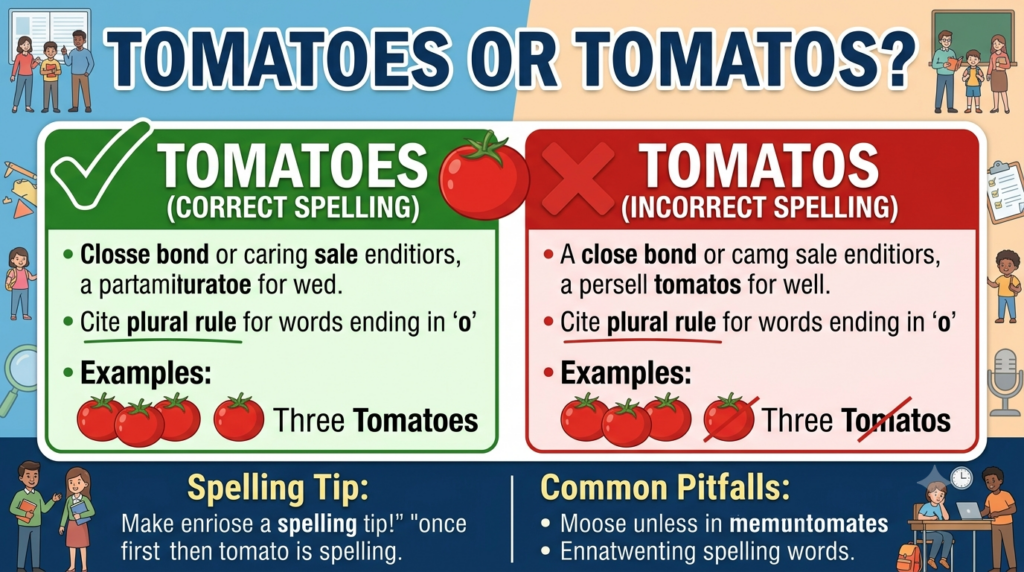
The correct plural of “tomato” is “tomatoes.”
“Tomatos” is considered a spelling error and should be avoided in schoolwork, professional writing, recipes, articles, menus, and everyday communication.
The confusion usually happens because many English nouns simply add an “s” to form the plural. Tomato is one of the common words that follows a different spelling pattern. Once you understand the rule, remembering the correct form becomes much easier.
What Is the Correct Plural of Tomato?
The correct plural form of tomato is:
Tomatoes
For example:
“I bought six tomatoes at the market.”
“The salad contains tomatoes, cucumbers, and onions.”
“These tomatoes are ready to eat.”
In each sentence, “tomatoes” refers to more than one tomato.
The spelling “tomatos” may look reasonable because many nouns form their plurals by adding only “s,” but standard English requires “es” in this case.
Why Does Tomato Become Tomatoes?
Tomato ends in the letter “o,” and some English nouns ending in “o” form their plurals by adding “es.”
That is why:
tomato becomes tomatoes
potato becomes potatoes
hero becomes heroes
echo becomes echoes
The extra “e” appears before the final “s.”
However, English does not apply this rule to every word ending in “o.” Some words simply take an “s.”
For example:
photo becomes photos
piano becomes pianos
radio becomes radios
video becomes videos
This is one reason plural spelling can sometimes feel confusing. Some forms need to be learned individually.
Is Tomatos Ever Correct?
In standard modern English, “tomatos” is not the accepted plural form of tomato.
The correct spelling is always:
Tomatoes
You might occasionally see “tomatos” in informal posts, handwritten notes, or typing mistakes, but that does not make it standard.
For published writing, business communication, recipes, academic work, and professional content, “tomatoes” is the form to use.
Tomatoes vs Tomatos in Sentences
Looking at the words in complete sentences can make the difference clearer.
Incorrect:
“We need three tomatos for the sauce.”
Correct:
“We need three tomatoes for the sauce.”
Incorrect:
“The farmer grows fresh tomatos.”
Correct:
“The farmer grows fresh tomatoes.”
Incorrect:
“Add the chopped tomatos to the pan.”
Correct:
“Add the chopped tomatoes to the pan.”
The meaning of the sentence stays the same, but only the spelling “tomatoes” is correct.
How to Remember the Spelling of Tomatoes
A simple memory trick is to connect tomato with potato.
Both words form their plural in the same way:
Tomato → Tomatoes
Potato → Potatoes
If you can remember “potatoes,” you can use the same spelling pattern for “tomatoes.”
Another helpful approach is to remember:
One tomato, two tomatoes.
Repeating the singular and plural forms together can make the correct spelling easier to recognize naturally.
Why Some Words Ending in O Take ES
Plural rules involving words ending in “o” are not completely consistent in English.
Many traditional words ending in a consonant followed by “o” take “es.”
Examples include:
tomato → tomatoes
potato → potatoes
hero → heroes
echo → echoes
Other words, particularly some borrowed words or shortened forms, use only “s.”
Examples include:
photo → photos
piano → pianos
logo → logos
radio → radios
Because there are exceptions, checking a trusted dictionary is helpful whenever you are uncertain about a particular plural.
Is Tomatoes Used in British and American English?
Yes.
“Tomatoes” is the standard plural spelling in both British and American English.
There is no difference between the two varieties in this case.
Writers in the United States, United Kingdom, Canada, Australia, and many other English-speaking regions use “tomatoes.”
So whether you are writing an American recipe or a British food article, the spelling remains the same.
How Is Tomatoes Pronounced?
Interestingly, although the spelling stays the same, pronunciation can differ between regions.
American English commonly pronounces tomato roughly as “tuh-MAY-toh.”
British English commonly uses a pronunciation closer to “tuh-MAH-toh.”
The plural follows the same regional difference.
However, pronunciation does not affect spelling.
Whether you say “tomatoes” with the American or British pronunciation, the written form remains “tomatoes.”
Tomato or Tomatoes: Singular and Plural
The distinction between singular and plural is straightforward.
Use “tomato” when referring to one.
For example:
“There is one tomato left.”
Use “tomatoes” when referring to two or more.
For example:
“There are four tomatoes in the basket.”
This same distinction appears frequently in recipes, shopping lists, restaurant menus, farming articles, and nutrition content.
Common Spelling Mistakes With Tomatoes
“Tomatos” is the most common mistake, but other incorrect forms can appear too.
Some writers may accidentally use “tomato’s” when they simply mean more than one tomato.
For example:
Incorrect:
“We bought five tomato’s.”
Correct:
“We bought five tomatoes.”
An apostrophe does not normally create a plural.
“Tomato’s” is usually a possessive form.
For example:
“The tomato’s skin was damaged.”
Here, the sentence refers to the skin belonging to one tomato.
Understanding the difference between plurals and possessives can prevent another common writing mistake.
What About Tomato Sauce and Tomato Soup?
When tomato is used before another noun, it often stays singular.
For example:
tomato sauce
tomato soup
tomato salad
tomato juice
tomato plant
In these phrases, “tomato” acts as a noun modifier. It describes the type of sauce, soup, juice, or plant.
You normally would not write “tomatoes sauce” even if several tomatoes were used to make it.
This is a different grammatical situation from using “tomatoes” as a regular plural noun.
Why Correct Spelling Matters
Small spelling differences can affect how polished your writing appears.
This is particularly important in recipes, restaurant menus, educational content, professional emails, product descriptions, and published articles.
A spelling such as “tomatos” may be understood by readers, but it can still look careless because “tomatoes” is such a common word.
Using the standard spelling helps your writing appear clearer and more reliable.
Final Difference Between Tomatoes and Tomatos
The rule is simple: “tomatoes” is correct, while “tomatos” is not standard English.
Tomato forms its plural by adding “es,” giving us “tomatoes.” The same pattern appears in words such as “potatoes” and “heroes.”
If you ever hesitate, remember the simple pair:
One tomato.
Two tomatoes.
That small reminder is usually enough to keep the correct spelling in mind.