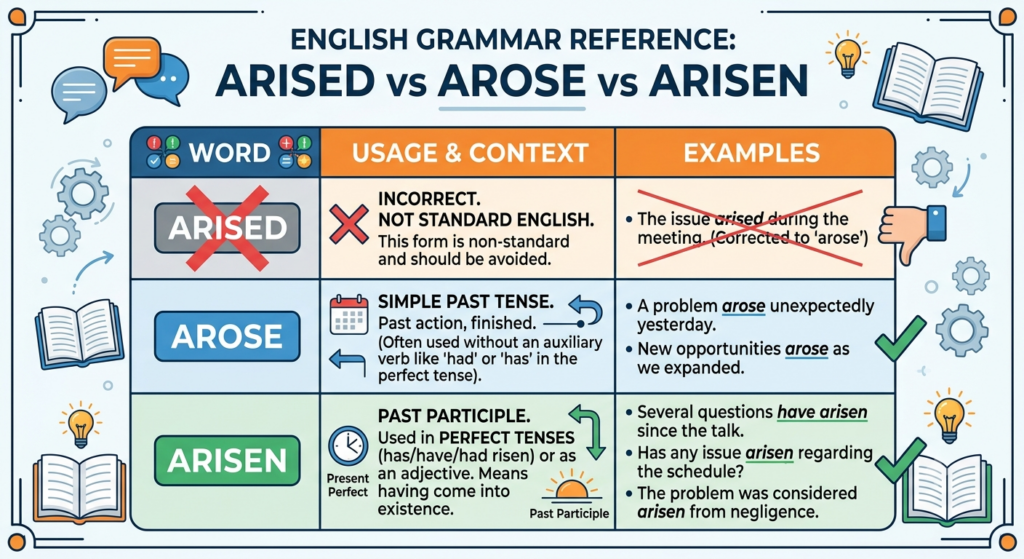

“Arised,” “arose,” and “arisen” can easily cause confusion because they all seem like possible forms of the verb “arise.” Only two of them, however, are correct in standard English.
The simple past tense of “arise” is “arose,” while its past participle is “arisen.” The form “arised” is incorrect because “arise” is an irregular verb and does not create its past tense by adding “-ed.”
For example, you should write, “A problem arose during the meeting,” not “A problem arised during the meeting.” When using “has,” “have,” or “had,” the correct form is “arisen,” as in “Several problems have arisen recently.”
The easiest pattern to remember is:
Arise → Arose → Arisen
Once you learn these three forms, the difference between arose and arisen becomes much simpler.
Quick Answer
Here are the correct forms of “arise”:
| Verb Form | Correct Word |
|---|---|
| Base form | Arise |
| Simple past | Arose |
| Past participle | Arisen |
| Present participle | Arising |
| Third-person singular | Arises |
| Incorrect form | Arised |
Examples:
Present: Problems sometimes arise unexpectedly.
Past: A problem arose yesterday.
Present perfect: Several problems have arisen recently.
“Arised” should not be used as the past tense or past participle of “arise.”
What Does Arise Mean?
“Arise” generally means to happen, develop, appear, emerge, or come into existence.
It is often used when talking about situations, questions, difficulties, opportunities, conflicts, or unexpected circumstances.
For example:
Problems can arise during complicated projects.
A question may arise during the discussion.
New opportunities often arise from unexpected situations.
Several difficulties arose during construction.
The word does not usually describe someone physically standing up in modern everyday English, although that meaning can appear in literary or formal contexts.
In most modern usage, “arise” is closely connected with something beginning or becoming noticeable.
What Is the Past Tense of Arise?
The past tense of “arise” is “arose.”
Use “arose” when something happened, appeared, or developed at a particular time in the past.
Examples:
A disagreement arose during the meeting.
Several problems arose after the software update.
An opportunity arose unexpectedly.
Questions arose about the accuracy of the report.
A technical issue arose yesterday morning.
In each sentence, the event occurred in the past, so “arose” is the correct choice.
A common mistake is:
A problem arised during the meeting.
The correct sentence is:
A problem arose during the meeting.
Why Is Arised Incorrect?
“Arised” may seem logical because many English verbs form their past tense by adding “-ed.”
For example:
Talk → talked
Walk → walked
Start → started
Change → changed
However, “arise” is an irregular verb. Its spelling changes when it moves into the past tense.
The correct pattern is:
Arise → arose
Not:
Arise → arised
This is similar to other irregular verbs that cannot simply take an “-ed” ending.
For example:
Rise → rose
Drive → drove
Write → wrote
Speak → spoke
Because English irregular verbs follow their own patterns, their past forms often need to be memorized.
What Does Arose Mean?
“Arose” is the simple past tense of “arise.”
It refers to something that appeared, developed, or happened in the past.
For example:
A misunderstanding arose between the two teams.
Unexpected complications arose during the project.
An interesting question arose during class.
A new opportunity arose after she completed the course.
Concerns arose about the proposed changes.
You can often replace “arose” with words such as “occurred,” “developed,” “appeared,” or “emerged,” depending on the context.
For example:
A problem arose during testing.
This could also mean:
A problem occurred during testing.
What Does Arisen Mean?
“Arisen” is the past participle of “arise.”
It is usually used with helping verbs such as:
has
have
had
For example:
Several problems have arisen.
A new issue has arisen.
Many questions had arisen before the meeting ended.
The formula is:
has/have/had + arisen
Correct:
A problem has arisen.
Incorrect:
A problem has arose.
Incorrect:
A problem has arised.
The helping verb is an important clue. If you see “has,” “have,” or “had,” you will normally need “arisen,” not “arose.”
Arose vs Arisen
The main difference between “arose” and “arisen” is grammatical.
“Arose” is the simple past tense.
“Arisen” is the past participle.
Compare:
A problem arose yesterday.
A problem has arisen.
The first sentence uses the simple past because the event happened at a specific time.
The second sentence uses the present perfect because the problem developed before now and remains relevant to the present situation.
Another example:
Several questions arose during the presentation.
Several questions have arisen since the presentation.
Both sentences are correct, but they use different tense structures.
Arise, Arose, and Arisen
Understanding all three forms together can make the rule easier to remember.
Arise
Use “arise” for the base or present form.
Problems sometimes arise without warning.
Questions often arise during discussions.
Unexpected opportunities can arise at any time.
Arose
Use “arose” for the simple past.
A problem arose yesterday.
Several questions arose during the interview.
An unexpected opportunity arose last month.
Arisen
Use “arisen” as the past participle with has, have, or had.
A problem has arisen.
Several questions have arisen.
Unexpected difficulties had arisen before the project was completed.
The basic pattern remains:
Arise → Arose → Arisen
Examples of Arose in Sentences
Here are some natural examples:
A technical problem arose during the presentation.
An argument arose between the two colleagues.
Several difficulties arose after the changes were introduced.
A new opportunity arose when the company expanded.
Concerns arose about the cost of the project.
A question arose during the interview.
Unexpected complications arose during construction.
A misunderstanding arose because the instructions were unclear.
All of these sentences describe situations that developed in the past.
Examples of Arisen in Sentences
“Arisen” appears with perfect tense structures.
For example:
Several problems have arisen recently.
A new opportunity has arisen.
Questions have arisen about the new policy.
Unexpected difficulties had arisen before the deadline.
Concerns have arisen over the project’s cost.
Many challenges have arisen since the business expanded.
A disagreement has arisen between the two departments.
In each example, a form of “have” accompanies “arisen.”
Has Arose or Has Arisen?
The correct expression is:
Has arisen
Not:
Has arose
“Arose” cannot normally follow “has,” “have,” or “had.”
Incorrect:
A problem has arose.
Correct:
A problem has arisen.
Incorrect:
Several issues have arose.
Correct:
Several issues have arisen.
Incorrect:
Questions had arose before the meeting.
Correct:
Questions had arisen before the meeting.
Remember:
Simple past = arose
Perfect tense = has/have/had arisen
Present, Past, and Perfect Forms
Seeing the verb across several tenses can make its pattern clearer.
Present:
Problems arise occasionally.
Simple past:
Problems arose yesterday.
Present continuous:
Problems are arising more frequently.
Past continuous:
Problems were arising throughout the project.
Present perfect:
Problems have arisen recently.
Past perfect:
Problems had arisen before the investigation started.
Future:
Problems may arise later.
Future perfect:
Several issues may have arisen by then.
The word changes depending on the tense, but “arised” is never required.
Arise vs Rise
“Arise” and “rise” look similar, but they are not always interchangeable.
“Arise” usually means to happen, emerge, or develop.
Example:
A problem arose during the meeting.
“Rise” usually means to move upward, increase, or get higher.
Example:
The temperature rose quickly.
Their verb forms are:
Arise → arose → arisen
Rise → rose → risen
Compare:
Questions arose during the discussion.
Prices rose during the summer.
The first sentence refers to questions appearing or developing.
The second refers to prices increasing.
Arise vs Raise
“Arise” and “raise” are also different.
“Arise” normally does not take a direct object.
Example:
A problem arose.
“Raise” usually means to lift, increase, or bring something up, and it often takes an object.
Example:
She raised her hand.
The company raised its prices.
He raised an important question.
Their verb patterns are also different:
Arise → arose → arisen
Raise → raised → raised
Notice that “raise” is regular, while “arise” is irregular.
Arise vs Occur
“Arise” and “occur” can sometimes have similar meanings.
For example:
A problem arose during the test.
A problem occurred during the test.
Both sentences are natural.
However, “arise” often emphasizes something developing or coming into existence, while “occur” simply indicates that an event happened.
Another example:
Questions arose after the announcement.
This suggests that the announcement caused or prompted the questions to emerge.
Common Phrases With Arise
Learning common word combinations can help you use “arise” naturally.
Problems arise:
Problems may arise during installation.
Questions arise:
Questions often arise during training.
Difficulties arise:
Unexpected difficulties can arise.
Opportunities arise:
New opportunities may arise in the future.
Conflicts arise:
Conflicts sometimes arise because of poor communication.
Issues arise:
Technical issues occasionally arise.
Concerns arise:
Concerns may arise when information is unclear.
These combinations are especially common in professional, academic, and formal English.
Common Mistakes
One of the most common mistakes is using “arised.”
Incorrect:
A problem arised yesterday.
Correct:
A problem arose yesterday.
Another common mistake is using “arose” after “has” or “have.”
Incorrect:
Several problems have arose.
Correct:
Several problems have arisen.
Writers may also confuse “arose” with “rose.”
Incorrect:
A problem rose during the meeting.
Correct:
A problem arose during the meeting.
But:
The temperature rose during the afternoon.
The distinction depends on meaning.
Use “arose” when something emerged or happened.
Use “rose” when something moved upward or increased.
Is Arose Formal?
“Arose” is perfectly acceptable in both general and formal English, although “arise” is often more common in professional or written contexts than in very casual conversation.
For example:
A problem arose during negotiations.
This sounds natural in a report or professional email.
In casual conversation, someone might simply say:
We had a problem during the meeting.
Both communicate a similar idea, but “arose” often gives the sentence a slightly more formal tone.
Synonyms for Arise
Depending on the sentence, alternatives to “arise” may include:
Occur
Emerge
Appear
Develop
Happen
Surface
Begin
Come up
For example:
A problem arose during the project.
A problem emerged during the project.
A problem developed during the project.
A problem came up during the project.
The best alternative depends on the context and tone of the sentence.
Easy Trick to Remember
The easiest way to remember the correct forms is to repeat this pattern:
Arise → Arose → Arisen
Then connect each word with a simple sentence:
Problems arise.
A problem arose.
Problems have arisen.
You can also compare the verb with “rise”:
Rise → rose → risen
Arise → arose → arisen
The two patterns look similar, which can make them easier to memorize.
Just remember that neither verb creates its past tense by adding “-ed.”
Frequently Asked Questions
Is Arised a Correct Word?
No. “Arised” is not the standard past tense or past participle of “arise.” Use “arose” or “arisen” depending on the tense.
What Is the Past Tense of Arise?
The simple past tense of “arise” is “arose.”
Example:
A problem arose yesterday.
What Is the Past Participle of Arise?
The past participle is “arisen.”
Example:
Several problems have arisen.
Is It Arose or Arisen?
Use “arose” for the simple past and “arisen” after helping verbs such as “has,” “have,” and “had.”
Is It Has Arose or Has Arisen?
“Has arisen” is correct.
Example:
A new issue has arisen.
Can I Say Problems Arised?
No.
Correct:
Problems arose.
Or:
Problems have arisen.
What Is the Difference Between Rose and Arose?
“Rose” is the past tense of “rise” and usually refers to upward movement or an increase.
“Arose” is the past tense of “arise” and usually means appeared, developed, or occurred.
Example:
The temperature rose.
A problem arose.
Final Thoughts
The difference between “arised,” “arose,” and “arisen” becomes straightforward once you remember that “arise” is an irregular verb.
“Arised” is not the correct form.
Use “arose” when describing something that happened or developed in the simple past:
A problem arose yesterday.
Use “arisen” as the past participle, normally with “has,” “have,” or “had”:
Several problems have arisen.
The complete pattern is:
Arise → Arose → Arisen
Remembering these three forms will help you avoid one of the most common mistakes with this verb and make your English sound clearer in everyday, academic, and professional writing.