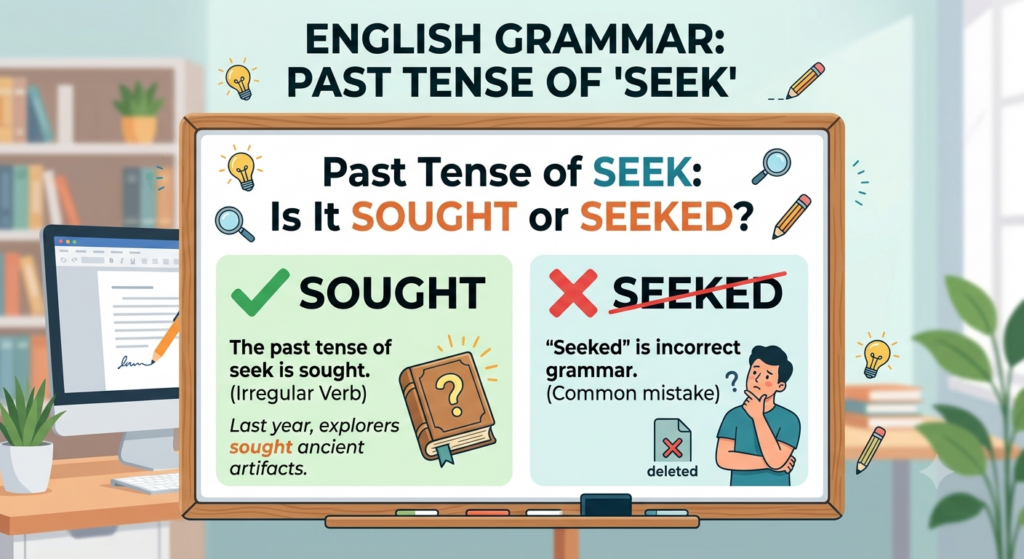

The past tense of “seek” is “sought.” Because “seek” is an irregular verb, it does not form its past tense by simply adding “-ed.” This is why “seeked” may sound logical to English learners, but it is not the standard past-tense form.
For example, you would say, “She sought advice from her teacher,” not “She seeked advice from her teacher.”
“Sought” is also the past participle of “seek,” which means the same form appears in sentences using “has,” “have,” or “had.” Once you remember the pattern seek, sought, sought, using this verb correctly becomes much easier.
Quick Answer
The correct verb forms are:
| Verb Form | Word |
|---|---|
| Base form | Seek |
| Simple past | Sought |
| Past participle | Sought |
| Present participle | Seeking |
| Third-person singular | Seeks |
Examples:
Present: I seek professional advice when necessary.
Past: I sought professional advice last week.
Present perfect: I have sought professional advice before.
Future: I will seek professional advice tomorrow.
The most important rule is simple:
Seek → Sought → Sought
“Seeked” is not the standard past tense.
What Does Seek Mean?
“Seek” means to try to find, obtain, achieve, or receive something.
It often sounds slightly more formal than “look for.”
For example:
She is seeking a new job.
They seek answers to difficult questions.
You should seek medical advice if necessary.
The company is seeking new investors.
People often use “seek” with words such as:
help
advice
information
permission
guidance
answers
employment
treatment
opportunities
attention
For example:
The student sought advice from his professor.
Here, “sought” means that the student tried to obtain advice.
What Is the Past Tense of Seek?
The simple past tense of “seek” is “sought.”
Correct:
He sought help from his neighbors.
They sought shelter during the storm.
She sought a better opportunity elsewhere.
The researchers sought an explanation for the unexpected result.
These actions happened in the past, so “sought” is required.
Incorrect:
He seeked help.
Correct:
He sought help.
Unlike regular verbs such as “walked,” “talked,” and “worked,” the verb “seek” changes form rather than taking an “-ed” ending.
Seek, Sought, Sought
Learning the three main forms together is one of the easiest ways to remember irregular verbs.
For “seek,” they are:
V1: Seek
V2: Sought
V3: Sought
The V1 form is used for the present tense and after certain helping verbs.
Example:
They seek better opportunities.
The V2 form is used for the simple past.
Example:
They sought better opportunities last year.
The V3 form is used in perfect tenses and some passive constructions.
Example:
They have sought better opportunities for several years.
Because the V2 and V3 forms are identical, you only need to remember one new word: “sought.”
How to Use Sought in Sentences
“Sought” can be used whenever “seek” describes an action completed or attempted in the past.
Examples:
She sought advice before making the decision.
He sought permission from his manager.
The family sought shelter from the heavy rain.
Police sought information from witnesses.
The company sought ways to reduce its expenses.
Researchers sought evidence to support the theory.
The athlete sought professional guidance after the injury.
They sought a peaceful solution to the disagreement.
In every example, the search or attempt happened in the past.
Seek vs Sought
The difference between “seek” and “sought” is mainly tense.
“Seek” is the base or present form.
“Sought” is the past tense and past participle.
Compare:
I seek advice from experienced colleagues.
I sought advice from an experienced colleague yesterday.
They seek new customers every month.
They sought new customers during the campaign.
She seeks help whenever she needs it.
She sought help after experiencing the problem.
Words such as “yesterday,” “last year,” “earlier,” and “two weeks ago” often indicate that the past-tense form “sought” is needed.
Is Seeked Correct?
“Seeked” is a common mistake, but it is not the standard past tense of “seek.”
Incorrect:
She seeked help from her teacher.
Correct:
She sought help from her teacher.
Incorrect:
They have seeked another solution.
Correct:
They have sought another solution.
The mistake occurs because many English verbs form their past tense by adding “-ed.”
For example:
work → worked
talk → talked
help → helped
search → searched
But “seek” is irregular:
seek → sought
The safest approach is to memorize it as an irregular verb rather than trying to apply the normal “-ed” rule.
Past Participle of Seek
The past participle of “seek” is also “sought.”
It commonly appears after “have,” “has,” or “had.”
Examples:
I have sought advice from several experts.
She has sought help before.
They had sought another supplier before signing the agreement.
The organization has sought additional funding.
“He has sought” is correct.
“He has seeked” is incorrect.
“He has seek” is also incorrect.
The presence of “has,” “have,” or “had” is a useful clue that you need the past participle.
Present Perfect With Sought
The present perfect follows this pattern:
has/have + sought
For example:
She has sought professional advice.
They have sought several solutions.
I have sought information about the program.
This tense often describes an action that occurred in the past but remains relevant to the present.
Compare:
She sought help yesterday.
This refers to a specific completed time in the past.
She has sought help.
This tells us the action happened before now without necessarily stating exactly when.
Past Perfect With Sought
The past perfect uses:
had + sought
For example:
They had sought permission before beginning the work.
She had sought advice before accepting the offer.
The company had sought additional funding before reducing its operations.
The past perfect is useful when describing one past event that happened before another past event.
For example:
He had sought legal advice before he signed the document.
First, he sought advice. Later, he signed the document.
Present, Past, and Future of Seek
Seeing the verb in different tenses can make its forms easier to remember.
Present:
I seek advice when I need help.
Past:
I sought advice yesterday.
Future:
I will seek advice tomorrow.
Present continuous:
I am seeking advice now.
Past continuous:
I was seeking advice when you called.
Present perfect:
I have sought advice several times.
Past perfect:
I had sought advice before making my decision.
Future perfect:
I will have sought advice before the meeting begins.
Notice that “sought” appears whenever the simple past or past participle is required.
Common Expressions With Seek
“Seek” and “sought” appear in several common combinations.
Seek help:
She sought help from a specialist.
Seek advice:
He sought financial advice before investing.
Seek information:
The journalist sought additional information.
Seek permission:
They sought permission to enter the property.
Seek treatment:
He sought treatment after the accident.
Seek employment:
She sought employment after graduating.
Seek opportunities:
The graduates sought opportunities abroad.
Seek answers:
Investigators sought answers about what happened.
Learning these combinations can make the verb easier to use naturally.
Sought After Has a Different Use
“Sought-after” is also a common expression, but it has a slightly different meaning.
Something that is “sought-after” is highly wanted or desirable.
For example:
She is a highly sought-after designer.
Homes in that neighborhood are increasingly sought-after.
The product became one of the most sought-after items of the year.
Here, the phrase describes something that many people want.
Do not confuse this adjective with the ordinary past-tense use of “sought.”
Compare:
Many companies sought his services.
He became a sought-after consultant.
Both sentences come from the verb “seek,” but they use “sought” differently.
Seek vs Look For
“Seek” and “look for” can sometimes express similar ideas.
For example:
She is seeking employment.
She is looking for a job.
Both mean that she is trying to find work.
However, “seek” often sounds more formal.
Everyday conversation:
I’m looking for my keys.
Formal or professional writing:
The organization is seeking qualified applicants.
It would sound unusually formal to say:
I am seeking my keys.
In casual conversation, “looking for” is normally more natural for ordinary physical objects.
Common Mistakes With Seek
One of the most frequent errors is using “seeked.”
Incorrect:
They seeked assistance.
Correct:
They sought assistance.
Another mistake is using the base form after “has” or “have.”
Incorrect:
She has seek help.
Correct:
She has sought help.
Another error is mixing the present and past tense.
Incorrect:
He sought advice every day and seeks help yesterday.
Correct:
He seeks advice every day and sought help yesterday.
Paying attention to time expressions can help you select the correct form.
Easy Trick to Remember Sought
The best way to remember the verb is as a three-word pattern:
Seek → Sought → Sought
You can also connect “sought” with other irregular past-tense words that have a similar ending:
think → thought
bring → brought
buy → bought
seek → sought
These verbs do not follow exactly the same spelling transformation, but grouping their unusual forms together may make them easier to remember.
A simple example can also help:
Today I seek help.
Yesterday I sought help.
I have sought help before.
Repeat these three sentences until the forms begin to sound natural.
Frequently Asked Questions
What Is the Past Tense of Seek?
The past tense of “seek” is “sought.”
Example:
She sought advice before making her decision.
What Is the Past Participle of Seek?
The past participle is also “sought.”
Example:
They have sought several solutions.
Is Seeked a Word?
“Seeked” is not the standard past-tense or past-participle form of “seek.” Use “sought” instead.
Is It Seek or Sought?
Use “seek” for the present or base form and “sought” when referring to the past.
Present:
I seek advice.
Past:
I sought advice.
Is It Has Sought or Has Seeked?
“Has sought” is correct.
Example:
She has sought professional guidance.
Can Sought Mean Wanted?
Yes. In the expression “sought-after,” it describes a person or thing that is highly desirable.
Example:
He is a sought-after photographer.
Final Thoughts
The past tense of “seek” is “sought,” and the past participle is also “sought.” Because “seek” is an irregular verb, forms such as “seeked” should be avoided in standard English.
The basic pattern is easy to remember:
Seek → Sought → Sought
Use “seek” when talking about the present, “sought” for actions in the past, and “sought” after helping verbs such as “has,” “have,” and “had.”
For example:
I seek advice when necessary.
I sought advice yesterday.
I have sought advice before.
Once you remember these three forms, using “seek” correctly becomes much simpler in everyday, academic, and professional English.