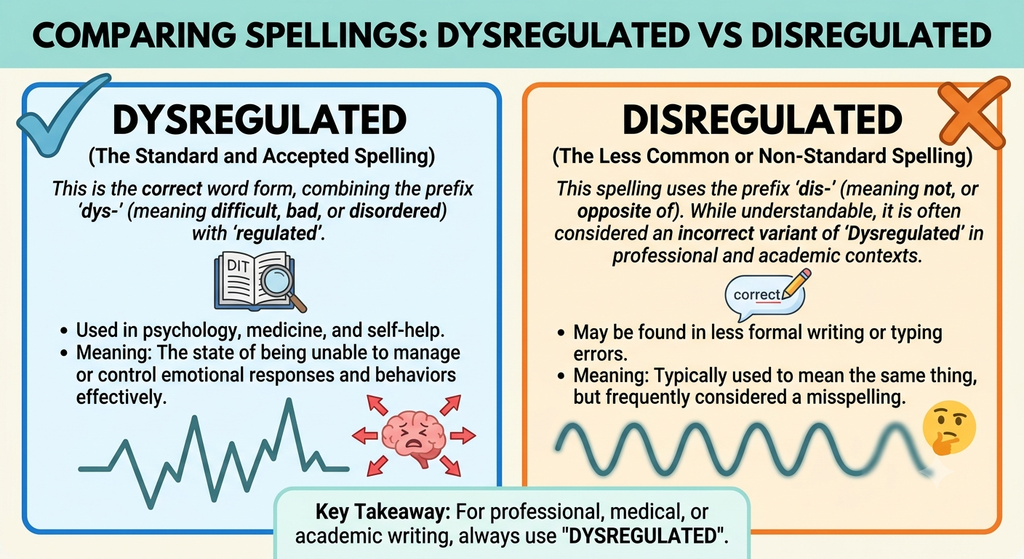

Dysregulated and disregulated are easy to confuse because both look as though they could describe something that is not being properly regulated. In standard English, however, dysregulated is the established and widely accepted word when referring to abnormal, impaired, or poorly functioning regulation.
Disregulated occasionally appears in informal writing, but it is generally treated as a nonstandard variation when the intended meaning is dysregulated. The difference becomes especially important in psychology, medicine, biology, education, and other professional fields where precise terminology matters.
If you are describing emotions, behavior, biological systems, hormones, metabolism, or other processes that are not being regulated normally, dysregulated is usually the correct choice.
Quick Answer
The standard word is:
Dysregulated
Example:
The researchers observed dysregulated immune responses.
The less accepted form is:
Disregulated
A simple rule to remember is that dysregulated uses the prefix dys-, which often indicates difficulty, abnormality, or impaired function.
Dysregulated vs Disregulated
The two spellings may look similar, but they are not equally accepted in standard usage.
| Word | Standard? | Meaning |
|---|---|---|
| Dysregulated | Yes | Regulated abnormally, poorly, or ineffectively |
| Disregulated | Usually no | Often used as a mistaken form of dysregulated |
For professional, academic, medical, psychological, or scientific writing, dysregulated is the safer and more conventional choice.
What Does Dysregulated Mean?
Dysregulated describes something whose normal system of control or regulation is not working properly.
It may refer to emotions, behavior, biological functions, or other controlled processes.
For example:
The study found dysregulated hormone activity.
The child showed signs of emotional dysregulation.
Researchers identified dysregulated gene expression.
The system became dysregulated under prolonged stress.
In each example, regulation still exists in some form, but it is not functioning normally.
Why Does Dysregulated Begin With Dys?
The prefix dys- appears in many English words connected with difficulty, abnormality, or impaired functioning.
Examples include:
Dysfunction
Dyslexia
Dysphagia
Dysregulation
Dysregulated
Because dysregulated is related to dysregulation, the spelling follows the same pattern.
You can think of the word as:
dys + regulated
This gives the general idea of regulation that is not working as it normally should.
Why Do People Write Disregulated?
The mistake is understandable because dis- is one of the most familiar prefixes in English.
It appears in words such as:
Disagree
Disconnect
Dislike
Disapprove
Disorganize
Because dis- can suggest separation, reversal, or opposition, some writers assume that disregulated should mean the opposite of regulated.
However, the established technical term is dysregulated.
Correct:
The emotional response became dysregulated.
Less standard:
The emotional response became disregulated.
Is Disregulated a Real Word?
Disregulated occasionally appears in informal or less edited writing, so you may encounter it online.
However, when the intended meaning is impaired or abnormal regulation, dysregulated is the recognized form in mainstream professional usage.
For example:
Standard:
The study focused on dysregulated metabolic processes.
Nonstandard:
The study focused on disregulated metabolic processes.
Even if readers understand the second sentence, the first version looks more natural and professional.
Dysregulated in Psychology
Dysregulated is frequently used in discussions about emotions and behavior.
For example:
The article examined dysregulated emotional responses.
A person experiencing emotional dysregulation may have difficulty managing the intensity or duration of certain emotional reactions.
However, dysregulated should not automatically be used whenever someone is upset, angry, sad, or stressed.
For example, instead of writing:
She became dysregulated after receiving the bad news.
you might write:
She became deeply upset and struggled to calm down after receiving the bad news.
The more technical word is most useful when regulation itself is relevant to the discussion.
Emotional Dysregulation Meaning
Emotional dysregulation generally refers to difficulty managing, modifying, or recovering from emotional responses.
For example:
The study examined emotional dysregulation during periods of intense stress.
The noun is:
Dysregulation
The adjective is:
Dysregulated
Compare:
The researchers studied emotional dysregulation.
The researchers studied dysregulated emotional responses.
Both sentences are correct, but the words have different grammatical roles.
Dysregulated in Medicine and Biology
Dysregulated is also common in scientific writing.
It may describe processes such as:
Immune activity
Hormone production
Gene expression
Metabolism
Cell signaling
Inflammatory responses
For example:
The researchers observed dysregulated inflammatory signaling.
This means the normal process controlling the signaling was not functioning as expected.
The word does not necessarily mean that all control disappeared. Instead, the regulation became abnormal or ineffective.
Dysregulated vs Unregulated
Dysregulated and unregulated are not the same.
Dysregulated means regulation exists but is functioning abnormally.
Unregulated means something is not controlled by an established regulatory system.
Compare:
The patient showed dysregulated hormone activity.
The company operates in an unregulated market.
In the first sentence, a biological regulatory process is functioning abnormally.
In the second, formal external regulation is absent.
An easy distinction is:
Dysregulated = regulation is impaired
Unregulated = regulation is absent
Dysregulated vs Deregulated
Deregulated has another meaning.
It generally refers to regulations or formal controls being removed or reduced.
For example:
The government deregulated the industry.
This means official restrictions or controls were reduced.
Compare:
The biological system became dysregulated.
This means the system’s internal regulation became abnormal.
Remember:
Dysregulated = regulation is malfunctioning
Deregulated = regulations have been removed or reduced
Regulated vs Dysregulated
Regulated means something is being controlled according to a normal or established process.
For example:
Blood sugar is normally regulated through several biological mechanisms.
Dysregulated indicates that the process is no longer working normally.
For example:
The researchers identified dysregulated blood sugar control.
The basic contrast is:
Regulated = controlled normally
Dysregulated = controlled abnormally or inadequately
Correct Examples of Dysregulated
Here are some natural examples:
The researchers identified dysregulated immune activity.
Several biological pathways became dysregulated.
The paper examined dysregulated emotional responses.
Scientists observed dysregulated gene expression.
The system remained dysregulated throughout the experiment.
Prolonged stress may affect normally regulated processes.
The researchers investigated dysregulated metabolic signaling.
These examples show how the word commonly appears in academic and professional writing.
Common Mistakes
One of the most common mistakes is replacing dys- with dis-.
Incorrect:
The system became disregulated.
Correct:
The system became dysregulated.
Another mistake is confusing dysregulated with deregulated.
Incorrect:
The government dysregulated the industry.
Correct:
The government deregulated the industry.
Another potential problem is using dysregulated as a vague synonym for upset.
Instead of:
He was dysregulated after the argument.
A clearer everyday sentence might be:
He was extremely upset after the argument and found it difficult to calm down.
Use technical vocabulary when it adds useful precision.
How to Use Dysregulated in a Sentence
A common pattern is:
Dysregulated + noun
Examples:
Dysregulated behavior
Dysregulated emotions
Dysregulated metabolism
Dysregulated response
Dysregulated signaling
Another structure is:
Become + dysregulated
Example:
The regulatory process became dysregulated.
You can also use:
Remain + dysregulated
Example:
The system remained dysregulated for several hours.
For the noun form:
Evidence of dysregulation
Example:
The researchers found evidence of metabolic dysregulation.
Easy Trick to Remember the Spelling
Connect dysregulated with dysfunction.
Both begin with:
Dys-
If a system is not functioning normally, think:
Dysfunction
Dysregulation
Dysregulated
You can also memorize the word family:
Regulate
Regulation
Dysregulation
Dysregulated
This makes the spelling easier to recognize and remember.
Frequently Asked Questions
Is Dysregulated a Correct Word?
Yes. Dysregulated is a standard term used to describe a process, response, or system whose regulation is impaired or abnormal.
Is Disregulated Correct?
It may occasionally appear in informal writing, but dysregulated is the established form when referring to abnormal or impaired regulation.
How Do You Spell Dysregulated?
The correct spelling is:
D-Y-S-R-E-G-U-L-A-T-E-D
What Does Dysregulated Mean?
It generally means poorly, abnormally, or ineffectively regulated.
Is Dysregulated the Same as Unregulated?
No. Dysregulated means a regulatory process is functioning abnormally, while unregulated usually means regulation is absent.
Is Dysregulated the Same as Deregulated?
No. Deregulated generally means formal regulations have been removed or reduced.
Can Dysregulated Describe Emotions?
Yes. The term is commonly used when discussing emotional regulation, particularly in psychological and educational contexts.
Is Disregulated the British Spelling?
No. Disregulated is not simply a British alternative to dysregulated. Dysregulated is the established technical form.
Final Thoughts
The difference between dysregulated and disregulated is easier to understand once you recognize the prefix dys-.
Dysregulated is the standard word for describing something whose normal regulation is impaired, abnormal, or functioning ineffectively. It is widely used in psychology, medicine, biology, education, and scientific writing.
Disregulated may occasionally appear, but it is generally best avoided when you mean impaired regulation.
Also remember that dysregulated, unregulated, and deregulated have different meanings. Dysregulated refers to faulty regulation, unregulated refers to the absence of regulation, and deregulated usually describes the removal of formal regulatory controls.
When you mean that a system or process is not being regulated normally, dysregulated is the word to use.