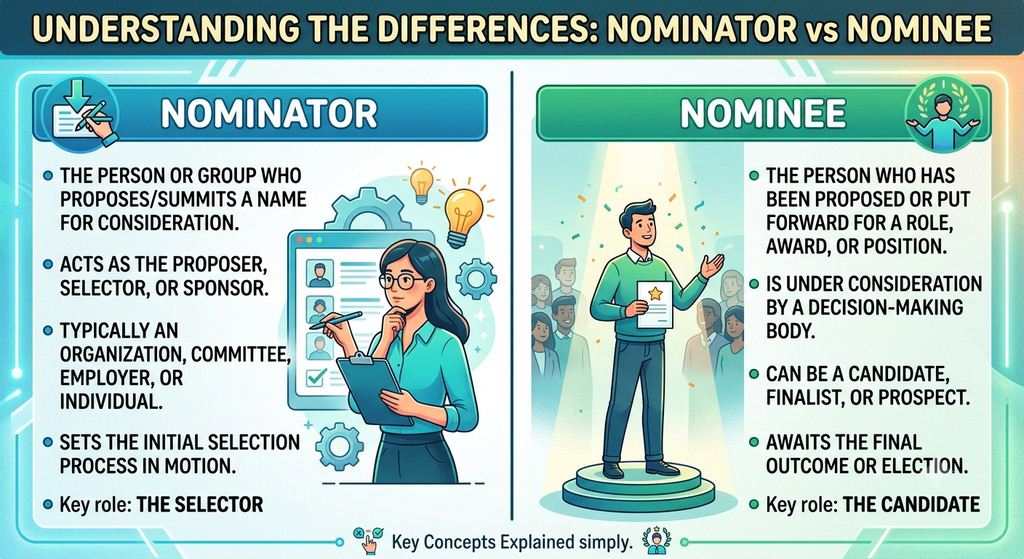

“Nominator” and “nominee” are closely related words, but they describe two different people or roles in a nomination process. A nominator is the person or organization that puts someone forward, while a nominee is the person who has been put forward for consideration.
For example, if Emma recommends Noah for an employee award, Emma is the nominator and Noah is the nominee. Noah has not necessarily won the award. He has simply been nominated and may now be considered alongside other nominees.
The easiest way to remember the difference is to focus on who performs the action and who receives it.
Nominator = makes the nomination
Nominee = receives the nomination
Understanding this distinction is useful in awards, scholarships, professional recognition, academic programs, workplace programs, and other formal selection processes.
Quick Answer
A nominator is someone who nominates another person.
A nominee is someone who has been nominated.
Example:
Laura nominated Kevin for the leadership award.
Laura = nominator
Kevin = nominee
The nomination is the act of putting Kevin forward for consideration.
A nominee is not automatically the winner. Winning or receiving the position usually happens later in the selection process.
Nominator vs Nominee
Here is a simple comparison:
| Term | Meaning | Role |
|---|---|---|
| Nominator | Person or organization making a nomination | Takes the action |
| Nominee | Person or organization being nominated | Receives the nomination |
| Nomination | The act or formal submission | The process |
| Recipient | Person who ultimately receives something | Final outcome |
| Winner | Person selected as the winner | Final result |
Think about the direction of the action:
Nominator → nominates → nominee
This pattern solves most confusion between the two words.
What Does Nominator Mean?
A nominator is a person, group, or organization that formally puts someone forward for consideration.
For example:
The professor was the student’s nominator for the scholarship.
Each nominator must complete the recommendation form.
Her manager acted as the nominator for the company award.
The organization asked nominators to explain why their chosen employee deserved recognition.
The word comes directly from the verb “nominate.”
If Daniel nominates Sophia, Daniel is the nominator.
What Does a Nominator Do?
The exact responsibilities of a nominator depend on the process.
A nominator may be required to identify someone who qualifies, submit a nomination form, explain why the person deserves consideration, provide supporting information, or write a recommendation.
For example:
The nominator submitted a letter describing the student’s achievements.
In another program, the nominator may only need to provide the nominee’s name and contact details.
The important point is that the nominator begins or participates in the process of putting another person forward.
Who Can Be a Nominator?
A nominator does not always have to be one individual.
Depending on the rules of a program, the nominator could be a colleague, teacher, manager, employer, university department, committee, organization, or professional association.
For example:
The university nominated one student for the national award.
In this situation, the university is effectively acting as the nominator.
Another example:
Maria nominated her coworker for Employee of the Month.
Maria is the nominator.
The role depends on who makes the nomination, not whether that party is an individual or an organization.
What Does Nominee Mean?
A nominee is a person or organization that has been formally nominated for something.
For example:
Rachel is a nominee for the teaching award.
Five nominees were selected for final consideration.
Each nominee will be interviewed before the final decision.
He became a nominee after his department submitted his name.
Being a nominee means that someone has been put forward for consideration. It does not necessarily mean that the person has already been chosen as the final recipient.
Does Nominee Mean Winner?
No. A nominee and a winner are not automatically the same thing.
Consider this sentence:
Six people were nominated for the award, but only one became the winner.
All six people were nominees.
Only one was the winner.
The usual process may look something like this:
Nomination → nominee → evaluation → selection → winner
The exact procedure differs from one program to another, but nomination generally happens before the final result.
This distinction is particularly important when writing news, announcements, award descriptions, or professional profiles.
Nominator, Nomination, and Nominee
These three words come from the same word family but perform different jobs.
Nominator refers to the person or group taking the action.
Nomination refers to the action, recommendation, or submission itself.
Nominee refers to the person or group receiving the nomination.
For example:
Olivia nominated Ethan for the award.
Olivia = nominator
The recommendation she submitted = nomination
Ethan = nominee
A simple memory formula is:
Nominator → nomination → nominee
Nominator vs Nominee in Awards
Awards provide one of the clearest examples of the difference.
Imagine that a company asks employees to recommend coworkers for a customer service award.
Daniel recommends Priya.
Daniel is the nominator because he makes the nomination.
Priya is the nominee because she is being considered for the award.
Later, a panel may compare Priya with other nominees and choose a winner.
Priya remains a nominee even if someone else ultimately wins.
Nominator vs Nominee in Scholarships
The same distinction applies to scholarship programs that use nominations.
For example:
Professor Martin nominated Ella for an academic scholarship.
Professor Martin is the nominator.
Ella is the nominee.
The scholarship committee may later review Ella’s academic achievements and decide whether she receives the scholarship.
This distinction can be especially important when completing forms.
If a form says:
Nominator information
it wants information about the person making the nomination.
If it says:
Nominee information
it wants details about the person being recommended.
Nominator vs Nominee in the Workplace
Workplace recognition programs frequently use both terms.
For example:
Michael nominated Hannah for the annual teamwork award.
Michael = nominator
Hannah = nominee
If the company later chooses Hannah, she becomes the award winner or recipient.
These roles describe separate stages of the process, so they should not be confused.
Nominator vs Candidate
A nominator and a candidate have different roles.
A nominator puts someone forward.
A candidate is someone being considered for a position, role, opportunity, or result.
For example:
A manager may nominate an employee for a leadership program.
The employee may then become one of several candidates being evaluated.
A nominee can sometimes also be called a candidate, depending on the process, but “nominator” cannot replace “candidate.”
Nominee vs Applicant
An applicant usually applies for something directly.
A nominee is normally put forward through a nomination process.
Compare:
Lucas applied for the scholarship.
Lucas is an applicant.
Now compare:
Lucas was nominated for the academic award.
Lucas is a nominee.
The same person could be an applicant in one process and a nominee in another.
The difference is how the person entered the selection process.
Nominee vs Recipient
A nominee is being considered.
A recipient has actually received something.
For example:
Ten students were nominees for the scholarship.
One student became the scholarship recipient.
The first sentence describes the consideration stage.
The second describes the final result.
This distinction is useful because describing every nominee as a recipient would incorrectly suggest that all nominees received the scholarship.
Nominee vs Winner
“Nominee” and “winner” should not be treated as synonyms.
For example:
Amelia was one of four nominees for the design award.
Later:
Amelia was announced as the winner.
Before the final announcement, Amelia was a nominee.
After being selected, she could be described as the winner or recipient.
A person can therefore be both a nominee and eventually a winner, but nomination alone does not guarantee victory.
Can Someone Be Both Nominator and Nominee?
Yes, this is possible when self-nomination is allowed.
For example:
Jordan nominated himself for the professional development award.
Jordan performs two roles.
He is the nominator because he submitted the nomination.
He is also the nominee because he is the person being put forward.
Not every program allows self-nomination, so the rules of the particular award or opportunity matter.
Grammatically, however, there is nothing contradictory about one person filling both roles.
How to Use Nominator in a Sentence
Here are some natural examples:
The nominator submitted the application before the deadline.
Each nominator must provide a short recommendation.
Her professor served as her nominator.
The nominator explained why the employee deserved recognition.
Please enter the nominator’s contact information.
The organization contacted every nominator for additional details.
In each sentence, “nominator” refers to the person or entity making the nomination.
How to Use Nominee in a Sentence
Examples include:
She is a nominee for the annual writing award.
The nominees will be announced next week.
Each nominee submitted additional information.
He became the youngest nominee in the program.
The committee interviewed all five nominees.
Every nominee will receive a certificate.
Here, the person is receiving the nomination rather than making it.
Common Sentence Patterns
“Nominator” often appears in patterns such as:
The nominator submitted…
The nominator recommended…
The nominator provided…
Who is the nominator?
Please provide the nominator’s details.
“Nominee” commonly appears in patterns such as:
Nominee for an award
Nominee for a scholarship
Nominee for a position
The nominees were announced…
Each nominee will…
Learning these common structures can help the difference feel natural.
Common Mistakes
One common mistake is calling the person being nominated the nominator.
Incorrect:
Sophie was the nominator for the excellence award.
If Sophie was the person being considered, write:
Sophie was the nominee for the excellence award.
Another mistake is calling the person who submitted the nomination the nominee.
Suppose:
Alex nominated Mia.
Correct:
Alex is the nominator.
Mia is the nominee.
Another common error is assuming that nominee means winner.
Incorrect:
He was nominated, so he became the winner.
Better:
He became a nominee and was later selected as the winner.
The nomination and final selection are separate stages.
Nominator vs Nomination
“Nominator” and “nomination” also cause occasional confusion.
A nominator is a person or entity.
A nomination is an action or submission.
For example:
The nominator submitted the nomination.
This sentence uses both words correctly.
You would not normally say:
The nomination submitted the form.
A nomination cannot perform the action because it is the submission itself, not the person making it.
Easy Trick to Remember the Difference
Look at the endings.
Nominator ends in “-or,” similar to many words describing someone who performs an action.
For example:
Creator creates.
Instructor instructs.
Editor edits.
Nominator nominates.
Now think about “nominee” as the person receiving the nomination.
A useful memory sentence is:
The nominator nominates the nominee.
If you remember that single sentence, the distinction becomes much easier.
Quick Decision Guide
Ask yourself one question:
Who is making the nomination?
That person or organization is the nominator.
Then ask:
Who is being nominated?
That person or organization is the nominee.
If you are referring to the act itself, use nomination.
For example:
James nominated Sarah.
James = nominator
Sarah = nominee
The action = nomination
Why the Difference Matters
Mixing up “nominator” and “nominee” can create real confusion in forms, award announcements, scholarship applications, workplace documents, and professional communication.
Imagine a form asking for:
Nominator email address
If the nominee enters their own email by mistake, the organization may contact the wrong person.
Similarly, describing someone as a winner when they are only a nominee changes the meaning of the information.
Using the right term keeps each person’s role clear.
Frequently Asked Questions
What Is the Difference Between Nominator and Nominee?
A nominator makes a nomination. A nominee is the person or organization that has been nominated.
Who Is the Nominator?
The nominator is whoever puts another person or entity forward for consideration.
Who Is the Nominee?
The nominee is the person or entity being put forward.
Is a Nominee the Winner?
Not necessarily. A nominee has been nominated but may still need to go through a selection or evaluation process.
Can a Nominee Become a Winner?
Yes. A nominee may later become the winner if selected.
Can Someone Be Both Nominator and Nominee?
Yes, when the rules allow self-nomination. Someone can nominate themselves and therefore perform both roles.
What Is the Difference Between Nominee and Applicant?
An applicant normally applies directly, while a nominee enters the process through a nomination.
What Is the Difference Between Nominee and Candidate?
A nominee has specifically been nominated. A candidate is someone being considered for a position, opportunity, or outcome. The two terms may overlap in some situations.
Is Nominator a Correct Word?
Yes. “Nominator” is the correct term for a person or organization that makes a nomination.
What Is the Plural of Nominee?
The plural is “nominees.”
Example:
The committee interviewed all the nominees.
What Is the Plural of Nominator?
The plural is “nominators.”
Example:
All nominators must submit their forms before Friday.
Final Thoughts
The difference between “nominator” and “nominee” becomes simple when you focus on the direction of the nomination.
A nominator puts someone forward.
A nominee is the person being put forward.
The nomination is the action connecting the two.
Remember this simple formula:
Nominator → nomination → nominee
A nominee may later become a winner, recipient, candidate, or appointee, depending on the process, but being nominated does not automatically mean being selected.
If you are ever unsure which word to use, ask who performed the nomination and who received it. That will usually give you the correct answer immediately.