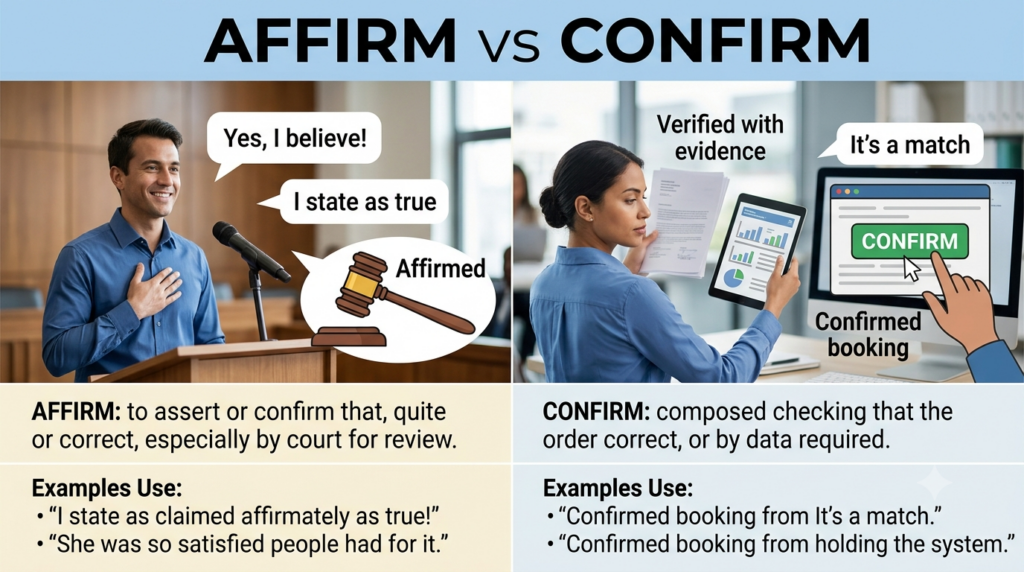

The words “affirm” and “confirm” can look very similar at first. Both are connected with truth, certainty, and agreement. That is why English learners sometimes use one when they really need the other.
The basic difference is quite simple. To affirm something usually means to state, support, or declare it as true. To confirm something means to check, verify, or establish that it is true or correct.
For example, you can affirm your commitment to helping a team. But you would confirm the time of a team meeting.
Once that difference becomes clear, choosing between affirm and confirm becomes much easier.
What Does Affirm Mean?
Affirm is a verb used when someone makes a positive statement, declares something to be true, or expresses support for an idea, belief, person, or decision.
It often carries a sense of confidence.
A person might affirm their loyalty to a company. A leader could affirm support for a proposal. Someone could also affirm that they believe a statement is true.
The word appears frequently in formal situations, although it is not limited to formal English. It can also be used when talking about personal beliefs, values, relationships, and encouragement.
Some natural examples include:
- She affirmed her commitment to the project.
- The organization affirmed its support for the new program.
- He affirmed that his statement was accurate.
- The teacher affirmed the student’s progress.
- They affirmed their belief in equal treatment.
The main idea is that someone is making a declaration or showing support.
What Does Confirm Mean?
Confirm also relates to truth, but its purpose is different.
To confirm something means to establish that information is correct, accurate, genuine, or settled. It normally involves checking a fact, responding to a request, or receiving additional evidence.
This is why confirm appears so often in daily conversations and professional emails.
You might confirm a hotel booking before travelling. You may confirm a doctor’s appointment. A company can confirm that a payment has arrived. A friend may call you to confirm plans for the weekend.
Examples include:
- Please confirm your attendance by Thursday.
- The hotel confirmed our reservation.
- She called to confirm the interview time.
- The company confirmed receipt of the payment.
- New evidence confirmed the earlier report.
In each case, information already exists. The speaker is checking it, validating it, or making it certain.
The Main Difference Between Affirm and Confirm
The easiest way to separate the two words is to think about the purpose of the action.
Affirm is mainly about declaring or supporting something.
Confirm is mainly about checking or verifying something.
That small difference can completely change which word sounds natural in a sentence.
Consider these two examples:
“I affirm my support for the plan.”
Here, the person is openly expressing support.
“I confirm the meeting for Monday.”
Here, the person is verifying that the meeting will take place on Monday.
The words are connected with certainty, but they reach that certainty in different ways.
When Should You Use Affirm?
Use affirm when you are making a confident declaration or expressing support, commitment, belief, or agreement.
It works particularly well with words such as commitment, belief, support, values, rights, position, and decision.
A company may affirm its commitment to customer service. A person may affirm their belief in a particular principle. A government or institution might affirm its support for an agreement.
The word also appears in personal situations.
For example, parents may affirm their children’s efforts by recognizing and encouraging them. Someone can also affirm a friendship by expressing appreciation and support.
In all these cases, there is no need to check a booking, date, or factual detail. The speaker is making a positive statement.
When Should You Use Confirm?
Confirm is the better choice when something needs to be checked or verified.
It is especially common with appointments, reservations, bookings, schedules, attendance, payments, orders, identities, and travel arrangements.
If an airline emails you before a flight, it might ask you to confirm your booking.
If an employer schedules an interview, you may receive an email asking you to confirm your availability.
A business could also confirm that an order has been received.
These are situations where information needs to be checked or officially acknowledged.
That makes confirm one of the most useful verbs in everyday business communication.
Affirm vs Confirm in Business English
The difference becomes especially useful at work.
Confirm appears regularly in professional communication because workplaces constantly deal with schedules, orders, payments, meetings, and other details that need to be verified.
You might write:
“Please confirm that you received the document.”
Or:
“Can you confirm your availability for Tuesday?”
Affirm has a different role.
Business leaders may use affirm when expressing values or commitments.
For example:
“We affirm our commitment to providing a safe workplace.”
A company could also affirm its support for employees or affirm the principles behind a new policy.
So, in business English, confirm normally deals with practical information. Affirm is more often connected with principles, support, or formal statements.
Affirm vs Confirm in Legal English
Legal English gives affirm a particularly important meaning.
An appellate court can affirm a lower court’s judgment. In this situation, affirm means the earlier ruling remains in place.
A person giving evidence can also make an affirmation rather than taking a religious oath in certain legal systems.
Confirm has a broader verification meaning in legal and administrative situations.
Someone might confirm an identity, confirm details in a document, or confirm that evidence matches other available information.
This legal distinction is one reason the words should not automatically be treated as synonyms.
Can Affirm and Confirm Be Interchanged?
Usually, no.
There are situations where the meanings come close, but replacing one with the other can make a sentence sound unnatural or change its meaning.
For example:
“I confirm my reservation” sounds natural.
“I affirm my reservation” does not normally work because a reservation is something you verify rather than a belief or position you declare.
Now compare:
“The organization affirmed its commitment to the community.”
Changing affirmed to confirmed would create a different meaning. “Confirmed its commitment” could suggest the commitment was already known and has now been verified. “Affirmed its commitment” means the organization openly expressed that commitment.
Context matters.
Common Mistakes With Affirm and Confirm
One frequent mistake is using affirm for appointments or bookings.
A sentence such as “I affirm my appointment” sounds unusual in normal English.
“I confirm my appointment” is the natural choice because you are verifying that the appointment will happen.
Another area where confusion happens is legal language.
When a higher court agrees that a lower court’s ruling should remain in effect, the standard term is often “affirm the judgment,” rather than simply using confirm in the everyday sense.
Writers can avoid many mistakes by asking one question:
Am I declaring something, or am I checking something?
If you are declaring or supporting it, affirm is likely the better word.
If you are checking or verifying it, confirm is usually correct.
Everyday Examples Make the Difference Clear
Imagine someone says:
“I affirm my promise to support you.”
That statement expresses commitment.
Now imagine a hotel sends this message:
“Please confirm your reservation before arrival.”
The hotel is asking you to verify information already in its system.
The same difference appears in many other situations.
A manager may affirm support for an employee’s idea, while the HR department confirms the employee’s interview schedule.
A school may affirm its commitment to student safety, while its office confirms the date of a parent meeting.
A person can affirm their values while confirming their travel plans.
Looking at the purpose behind the sentence usually gives you the answer.
An Easy Way to Remember Affirm vs Confirm
A simple memory trick can make the distinction easier.
Think of A in affirm as A for assert.
When you affirm something, you assert it, declare it, or express support for it.
Then think of C in confirm as C for check.
When you confirm something, you check that it is correct.
This does not cover every special use of the words, but it works well in most everyday situations.
Affirm equals assert.
Confirm equals check.
Related Words That Can Cause Confusion
Several other English verbs sit close to affirm and confirm.
Verify usually means to check whether something is accurate.
Validate can mean showing that something is acceptable, legitimate, or correct.
Authenticate means establishing that something is genuine.
Ratify usually describes formally approving an agreement or decision.
Assure means trying to remove someone’s doubts, while ensure means making certain that something happens.
Knowing these differences can make writing more precise, especially in professional or formal communication.
The Simple Rule to Remember
Affirm and confirm are related, but they do different jobs.
Use affirm when you are declaring something, expressing a belief, showing support, or stating a commitment.
Use confirm when you are checking information, verifying a fact, acknowledging a booking, or making sure details are correct.
You affirm your beliefs.
You confirm your reservation.
You affirm your commitment.
You confirm your appointment.
Once you start thinking of affirm as a declaration and confirm as a verification, the difference becomes much easier to remember. The result is clearer writing and more natural English in everyday conversations, business messages, and formal situations.