
In and within are two common English prepositions that can sometimes appear to mean the same thing. Both can describe time, location, position, and limits, but they are not interchangeable in every sentence.
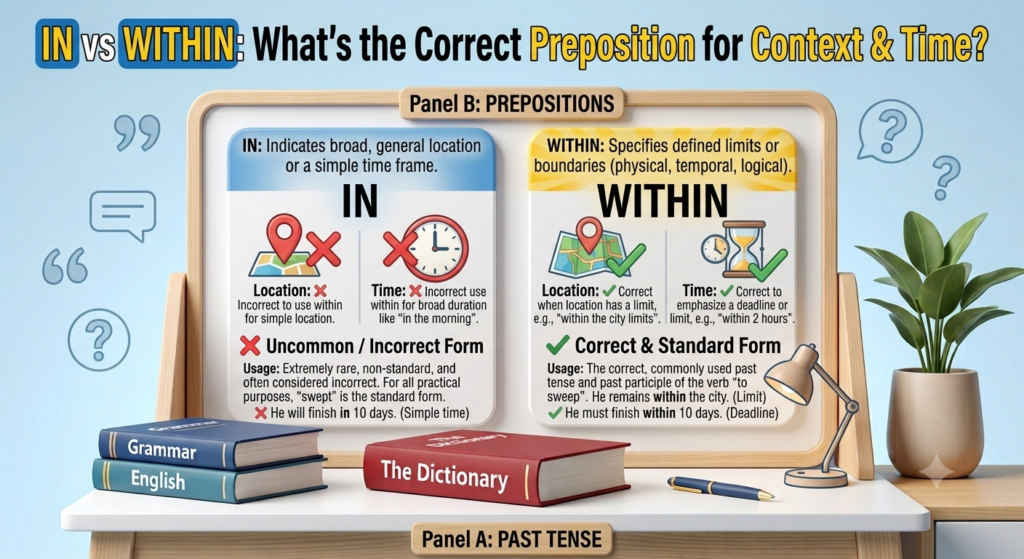
The easiest way to understand the difference is to think about precision. In usually gives general information about where or when something happens. Within places more emphasis on a boundary, deadline, distance, or maximum limit.
For example, “I will finish the report in three days” generally tells us how long the task will take. “I will finish the report within three days” means the report could be completed sooner, but it will not take longer than three days.
That small difference matters in everyday conversation, business writing, instructions, contracts, and academic English.
Expert Grammar Rule: In vs Within
Both in and within can function as prepositions, but they do slightly different jobs.
Use in when you are describing a general place, time, condition, or situation.
Examples:
“She is in the kitchen.”
“We moved here in 2024.”
“The meeting is in the afternoon.”
“He is in trouble.”
Use within when you want to emphasize that something remains inside a particular limit or must happen before a maximum amount of time passes.
Examples:
“Please respond within 48 hours.”
“The house is within the city limits.”
“We need to stay within our budget.”
“The hotel is within walking distance.”
A useful rule is:
In = general position or time
Within = inside a defined limit or no later than a stated time
This distinction explains why the words can sometimes appear in similar sentences while producing slightly different meanings.
When to Use In in Everyday English
In is one of the most frequently used prepositions in English. It works naturally when you simply want to state where something is, when something happens, or what situation someone is experiencing.
For location, you might say:
“The keys are in the drawer.”
“She lives in Canada.”
“He is waiting in the office.”
“The children are playing in the garden.”
Nothing in these sentences requires us to think about a precise boundary. We simply want to describe location.
In is also commonly used with years, months, seasons, parts of the day, and longer periods.
Examples:
“She was born in 1998.”
“We usually travel in December.”
“They moved to the city in spring.”
“I work better in the morning.”
The word also appears in many expressions that have little to do with physical location.
“He is in danger.”
“She is in a hurry.”
“They are in agreement.”
“The company is in financial difficulty.”
In these examples, replacing in with within would either change the meaning or make the sentence sound unnatural.
That is why in remains the natural choice for most ordinary conversations and general writing.
When to Use Within for Limits and Deadlines
Within becomes especially useful when the sentence involves a clear maximum, boundary, range, or restriction.
Time is one of the most common examples.
“Please complete the form within seven days.”
This means the form can be completed today, tomorrow, or at any other point before seven days have passed. Seven days is the maximum allowed period.
Compare:
“I will complete the work in seven days.”
This generally suggests the work will take seven days.
“I will complete the work within seven days.”
This means it will be finished no later than seven days from now.
The same principle applies to shorter periods:
“The technician will arrive within an hour.”
“You should receive your confirmation within 24 hours.”
“Applications must be submitted within five working days.”
Within is particularly useful in business communication because it can make deadlines clearer.
It also works with physical boundaries:
“The property lies within the national park.”
“All vehicles must remain within the marked area.”
“Only residents living within the district can apply.”
Here, within does more than simply show location. It draws attention to a boundary.
Within can also refer to financial or other abstract limits:
“We need to remain within budget.”
“The decision is within your authority.”
“The proposal falls within the scope of the project.”
“Everything must remain within the law.”
These examples show why within is useful when precision matters.
In vs Within for Time, Place, and Distance
Time expressions are where the distinction between in and within is easiest to notice.
Consider:
“The bus will arrive in 20 minutes.”
This usually presents 20 minutes as the expected waiting time.
Now compare:
“The bus will arrive within 20 minutes.”
This gives a maximum waiting period. The bus might arrive in five, ten, or fifteen minutes, but it should arrive before 20 minutes have passed.
The distinction becomes especially important when deadlines are involved.
“Send the documents in five days” can sound as though the documents should be sent five days from now.
“Send the documents within five days” clearly means they may be sent at any point before the five-day deadline.
For locations, in is normally enough when you simply identify a place.
“She works in London.”
“The files are in the office.”
“They live in the city.”
Within is more useful when the area’s boundaries matter.
“The building is within London’s congestion zone.”
“The property is located within the city boundary.”
“All equipment must stay within the designated area.”
Distance expressions also frequently use within.
“The pharmacy is within two miles of our house.”
“The station is within walking distance.”
“Several restaurants are within a ten-minute walk of the hotel.”
In these examples, within means no farther than the stated distance or limit.
Can In and Within Be Interchangeable?
Sometimes they can, but changing the preposition may change the emphasis.
Consider:
“She finished the assignment in two hours.”
This tells us approximately how long completing the assignment took.
“She finished the assignment within two hours.”
This tells us that the task was completed before two hours had passed.
Both sentences are correct, but they communicate slightly different information.
The same issue appears with locations.
“The children are in the school grounds.”
This simply identifies their location.
“The children must remain within the school grounds.”
Here, the boundaries become important. The children should not go outside the permitted area.
There are also many sentences where replacing in with within sounds unnatural.
Natural:
“She lives in Delhi.”
Unnatural in ordinary conversation:
“She lives within Delhi.”
The second version might make sense only if you deliberately want to emphasize official city boundaries.
Similarly:
“The book is in my bag.”
is the natural everyday sentence.
“The book is within my bag.”
sounds unnecessarily formal and unnatural.
This is why writers should not treat within as a more sophisticated replacement for every use of in.
Within vs Inside and Common Mistakes
Within and inside can sometimes describe similar ideas, but they are not identical.
Inside usually emphasizes physical position.
“The keys are inside the drawer.”
“The children are inside the house.”
“The documents are inside the envelope.”
Within often focuses more strongly on limits or boundaries.
“The house is within the protected zone.”
“The company must operate within legal guidelines.”
“Please complete the task within two hours.”
Inside can occasionally express a time limit in informal usage, but within is usually clearer when discussing deadlines.
Another common mistake is using within simply because it sounds more formal.
For example:
“She works within an office.”
This is technically understandable but unnatural if you simply mean that her workplace is an office.
A more natural sentence is:
“She works in an office.”
Likewise:
“We met within the restaurant.”
sounds unnecessarily awkward.
“We met in the restaurant.”
is better.
Another common problem involves deadlines.
Consider:
“You must reply in 24 hours.”
Depending on the context, this may be interpreted as replying 24 hours from now.
“You must reply within 24 hours.”
is clearer when you mean any time before the 24-hour deadline expires.
Precision matters particularly in instructions, policies, contracts, customer service messages, and workplace communication.
Professional Writing Guidance and Easy Examples
Within often appears more frequently in professional and formal writing because formal documents regularly deal with limits, deadlines, responsibilities, and boundaries.
For example:
“Employees must report the incident within 24 hours.”
“All expenses must remain within the approved budget.”
“The application must be submitted within ten business days.”
“The activity must remain within company guidelines.”
“The matter falls within the department’s responsibility.”
These sentences benefit from the precision that within provides.
In is still perfectly appropriate in professional writing when no specific limit needs to be emphasized.
“The meeting will take place in the conference room.”
“The company was established in 2008.”
“She works in the finance department.”
“The information is included in the report.”
A quick way to choose between the two is to ask one question:
Am I simply describing where or when something happens, or am I emphasizing a maximum limit?
If you are giving general information, use in.
If you are emphasizing a deadline, boundary, distance, range, or restriction, within is usually the clearer choice.
Compare these examples:
“The documents are in the cabinet.”
“The documents must remain within the secure area.”
“We will meet in the afternoon.”
“You will receive a response within two hours.”
“She lives in the city.”
“The property is within the city limits.”
“He completed the test in 40 minutes.”
“The test must be completed within 60 minutes.”
The contrast becomes much easier to recognize when the sentences are viewed together.
The final rule is simple. Use in for general locations, times, situations, and conditions. Use within when you want to emphasize that something does not go beyond a particular boundary, deadline, distance, or limit.
Neither word is automatically better or more correct. The best choice depends on the meaning you want your sentence to communicate.
When precision matters, especially with deadlines and boundaries, within is often the stronger choice. For ordinary descriptions of time and place, in usually sounds simpler and more natural.