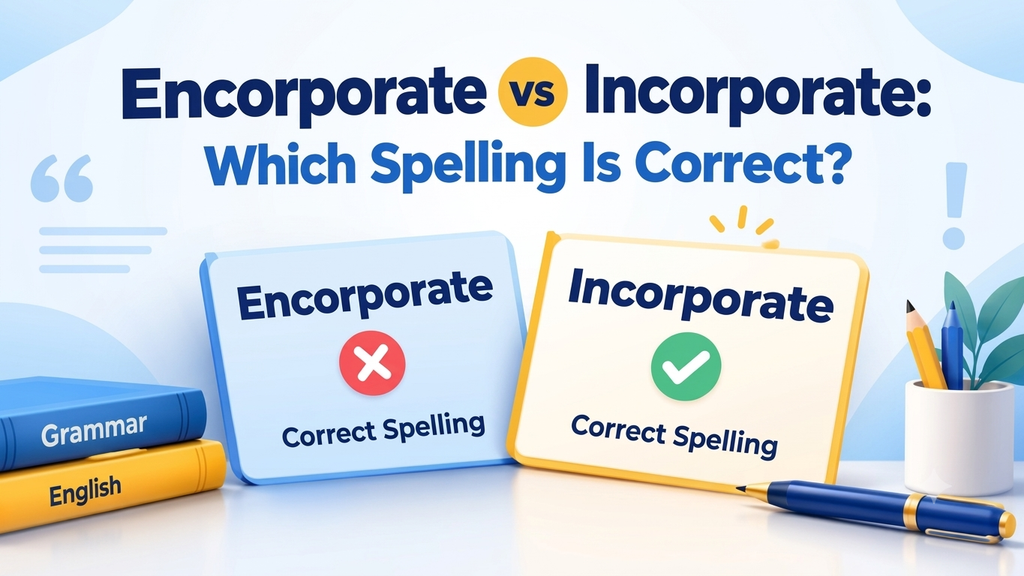

A single vowel can turn a perfectly useful English word into a spelling mistake. That is exactly what happens with “encorporate” and “incorporate.” They may sound nearly identical in conversation, but only one is the standard spelling used in modern English.
“Incorporate” is correct. It means to include something as part of a larger whole, combine elements so they work together, or, in a business context, legally establish a company as a corporation. Major English dictionaries recognize these uses of “incorporate.”
“Encorporate” is commonly written by mistake, often because English speakers are familiar with words beginning with “en-,” such as encourage, enable, and enrich.
The simplest rule is easy to remember: when you mean include, combine, or make part of something larger, write “incorporate.”
Encorporate vs Incorporate: Quick Answer
The correct spelling is:
Incorporate
The incorrect spelling in standard modern English is:
Encorporate
Examples:
Correct: We should incorporate the new ideas into the project.
Incorrect: We should encorporate the new ideas into the project.
Correct: The designer incorporated natural materials into the interior.
Incorrect: The designer encorporated natural materials into the interior.
Here is the difference at a glance:
| Word | Correct? | Meaning |
|---|---|---|
| Incorporate | Yes | Include, combine, integrate, or legally form a corporation |
| Encorporate | No in standard modern usage | Common misspelling of incorporate |
A helpful memory trick is to connect “incorporate” with “into.” When something is incorporated, it is often put into a larger whole.
What Does Incorporate Mean?
“Incorporate” is primarily a verb. Its most common meaning is to include something so that it becomes part of a larger structure, system, plan, design, or idea.
For example:
The teacher incorporated group activities into the lesson.
The architect incorporated large windows into the design.
The updated software incorporates several security improvements.
She wants to incorporate more exercise into her daily routine.
In these sentences, the new element is not simply placed nearby. It becomes part of the overall whole.
This is why “incorporate” can sometimes communicate a slightly stronger idea than “add.”
Compare:
We added customer comments to the document.
We incorporated customer feedback into the final proposal.
The first sentence tells us that comments were added. The second suggests that the feedback influenced or became part of the proposal itself.
“Incorporate” can also mean to combine different elements.
For example:
The recipe incorporates traditional spices and modern techniques.
The building incorporates glass, stone, and wood.
The course incorporates both practical training and classroom instruction.
Another important meaning appears in business and law. “Incorporate” can mean to legally create or organize a company as a corporation.
For example:
The founders decided to incorporate the business.
The company was incorporated several years after it was established.
This legal meaning is different from simply including one thing within another, although both senses share the broader idea of forming something into an organized whole.
The history of the word also helps explain its spelling. “Incorporate” ultimately comes through Latin forms connected with the idea of uniting something into a body. Its “in-” element carries the sense of “into” or “in.”
That gives us a useful spelling clue:
IN + corporate = incorporate
Why Is Encorporate Incorrect?
“Encorporate” looks convincing because “en-” is a real and productive beginning in English.
Consider these words:
Encourage
Enable
Enrich
Enlarge
Enclose
Because these words are so familiar, it is easy to assume that “encorporate” follows the same pattern.
It does not.
When you mean to include, combine, integrate, or form a corporation, standard modern English uses “incorporate.”
Incorrect:
The report should encorporate the latest figures.
Correct:
The report should incorporate the latest figures.
Incorrect:
We are encorporating customer suggestions.
Correct:
We are incorporating customer suggestions.
Incorrect:
The team encorporated several new features.
Correct:
The team incorporated several new features.
Pronunciation also contributes to the mistake. In natural speech, the first syllable of a longer word may be unstressed, making “in-” and “en-” difficult to distinguish clearly.
That is why relying only on sound can lead to the wrong spelling.
Instead, remember the meaning:
You put something IN a larger whole, so you INcorporate it.
How to Use Incorporate Correctly
One of the most common patterns is:
incorporate something into something
For example:
We incorporated the new data into the report.
The designer incorporated recycled materials into the product.
The teacher incorporated music into the lesson.
The company incorporated customer suggestions into its strategy.
“Incorporate in” is also possible in appropriate constructions.
For example:
The changes were incorporated in the final version.
Several new features are incorporated in the design.
“Incorporate with” may appear when emphasizing combination.
For example:
Traditional techniques were incorporated with modern methods.
However, “incorporate into” is often the clearest choice when describing something becoming part of a larger whole.
The main verb forms are straightforward:
| Form | Word |
|---|---|
| Base form | Incorporate |
| Third-person singular | Incorporates |
| Past tense | Incorporated |
| Past participle | Incorporated |
| Present participle | Incorporating |
| Noun | Incorporation |
Examples:
Present: The program incorporates several useful tools.
Past: The program incorporated several useful tools.
Present continuous: The team is incorporating new features.
Present perfect: The company has incorporated customer feedback.
Noun: The incorporation of these changes improved the final design.
Do not carry the spelling mistake into related forms.
Incorrect:
Encorporated
Encorporating
Encorporation
For the standard word family, use:
Incorporated
Incorporating
Incorporation
You may also see “Incorporated” in company names, often shortened to “Inc.”
For example:
ABC Technologies, Inc.
In that context, “Inc.” indicates a corporate form of business organization rather than the general meaning of adding something to a larger whole.
Incorporate vs Include, Integrate, and Combine
“Incorporate” has several close synonyms, but choosing the most natural word depends on what you want to emphasize.
“Incorporate” often suggests making something a functional part of a larger whole.
Example:
The new plan incorporates suggestions from employees.
“Include” is broader and often simpler. It tells us that something is present as part of a group or whole.
Example:
The package includes breakfast.
You would not normally need to say:
The package incorporates breakfast.
That sounds unnecessarily formal because no meaningful integration is taking place.
“Integrate” often emphasizes bringing separate parts together so they work effectively as one system.
Example:
The company integrated the new software with its existing platform.
You might also say:
The company incorporated new security features into its platform.
The difference is subtle. “Integrate” often stresses coordination between parts, while “incorporate” emphasizes making an element part of something larger.
“Combine” simply means bringing things together.
Example:
Combine the flour and sugar.
“Incorporate” can sometimes be used in cooking as well:
Slowly incorporate the flour into the mixture.
Here, “incorporate” suggests blending the ingredient thoroughly into the mixture.
The same idea applies in different settings.
Academic writing:
The revised paper incorporates evidence from recent studies.
Business writing:
We incorporated client feedback into the final proposal.
Technology:
The update incorporates several privacy improvements.
Design:
The building incorporates natural light and open spaces.
Everyday life:
I’m trying to incorporate more vegetables into my meals.
In many casual sentences, “include” or “add” may sound simpler. Good writing does not require using the most formal word available. Use “incorporate” when the idea of becoming part of a larger whole matters.
Frequently Asked Questions
Is Encorporate a Correct Word?
When you mean “include,” “combine,” or “make part of a larger whole,” “encorporate” is not the standard modern English spelling. Use “incorporate.”
Is It Encorporate or Incorporate?
“Incorporate” is correct.
Example:
We need to incorporate these changes into the document.
What Does Incorporate Mean?
“Incorporate” usually means to include or combine something so that it becomes part of a larger whole. It can also mean to legally form a corporation.
How Do You Spell Incorporate?
The correct spelling is:
I-N-C-O-R-P-O-R-A-T-E
Remember that the word begins with “in-,” not “en-.”
What Is the Past Tense of Incorporate?
The past tense is “incorporated.”
Example:
She incorporated several new ideas into the presentation.
What Is the ING Form of Incorporate?
The “-ing” form is “incorporating.”
Example:
The company is incorporating new technology into its operations.
Is It Incorporate Into or Incorporate In?
Both constructions can occur.
“Incorporate into” is especially common when something is being made part of something else:
We incorporated the changes into the final report.
“Incorporated in” often appears in passive constructions:
The changes were incorporated in the final report.
Is Incorporate the Same as Include?
Not always. “Include” simply means that something is part of a group or whole. “Incorporate” often suggests that something has been deliberately worked into or integrated with a larger structure.
Can Incorporate Refer to a Business?
Yes. In business and legal contexts, “incorporate” can mean forming a company as a legally recognized corporation.
How Can I Remember Incorporate Instead of Encorporate?
Think:
Put it IN → INcorporate.
If an idea, feature, ingredient, or suggestion is being put into a larger whole, spell the word with “in-.”
The confusion between “encorporate” and “incorporate” ultimately comes down to one small spelling detail. “Incorporate” is the standard word, whether you are talking about adding ideas to a report, blending ingredients, including new features in software, or legally forming a corporation.
For clear professional, academic, and everyday English, remember the simple pattern: put something IN, then INcorporate it.