
“Stared” and “starred” are easy to confuse because they differ by only one letter and sound very similar in everyday speech. Their meanings, however, are completely different.
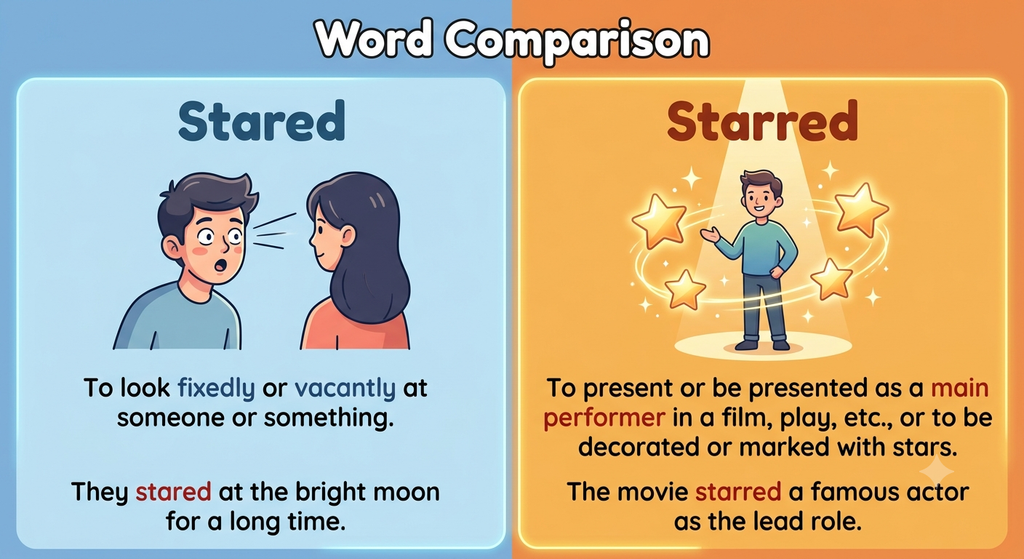
“Stared” is the past tense of “stare.” It means looked at someone or something for a noticeable length of time, often with concentration, surprise, confusion, or curiosity.
“Starred” is the past tense of “star.” It can mean played an important or leading role in a movie, television show, play, or other production. It can also mean marked something with a star symbol.
Compare these two sentences:
She stared at the actor.
She starred in the movie.
The first sentence is about looking. The second is about performing.
The easiest way to remember the difference is:
Stared = looked
Starred = featured or marked with a star
Quick Answer
Use “stared” when someone looked intensely at something.
Example:
He stared at the strange message on his screen.
Use “starred” when someone appeared prominently in a production or when something was marked with a star.
Example:
She starred in several television dramas.
Another example:
I starred the important emails.
The two words come from different base verbs:
Stare → stared
Star → starred
Stared vs Starred
Here is a simple comparison:
| Word | Base Verb | Meaning | Common Pattern |
|---|---|---|---|
| Stared | Stare | Looked fixedly or intently | Stared at |
| Starred | Star | Played a major role | Starred in |
| Starred | Star | Marked with a star | Starred item |
The most important clue is the meaning of the sentence.
If someone is looking, use “stared.”
If someone is performing or being highlighted with a star, use “starred.”
What Does Stared Mean?
“Stared” is the simple past and past participle of the verb “stare.”
To stare means to look at someone or something steadily for longer than an ordinary glance.
For example:
She stared at the painting for several minutes.
He stared at his phone in disbelief.
The children stared at the magician.
I stared through the window while waiting.
Someone might stare because they are curious, shocked, distracted, fascinated, confused, or deeply focused.
The word itself does not necessarily tell you why the person is looking.
Stared as the Past Tense of Stare
The base verb is:
Stare
Its past tense is:
Stared
For example:
Present:
I stare at the screen when I am thinking.
Past:
I stared at the screen for several minutes.
Present perfect:
I have stared at this page long enough.
Because “stare” already ends in “e,” you simply add “d” to form “stared.”
Compare:
Care → cared
Share → shared
Stare → stared
Common Uses of Stared
“Stared” commonly appears with the preposition “at.”
For example:
She stared at the photograph.
He stared at me without speaking.
Everyone stared at the unusual sculpture.
The dog stared at the food on the table.
It can also appear with other expressions.
For example:
She stared in disbelief.
He stared blankly at the wall.
They stared silently at each other.
I stared into the distance.
These phrases add information about how or where someone was looking.
Stared At vs Stared Into
“Stared at” and “stared into” are both correct, but they can create slightly different images.
“Stared at” simply identifies the object receiving someone’s attention.
For example:
He stared at the lake.
“Stared into” can suggest looking into the depth, interior, or distance of something.
For example:
He stared into the lake.
Another comparison:
She stared at the mirror.
She stared into the mirror.
The second version can sound more reflective or suggest looking deeply at the image in the mirror.
What Does Starred Mean?
“Starred” is the past tense and past participle of the verb “star.”
It has two especially common meanings.
First, it can mean appearing in a major or important role in a film, television show, play, or other production.
For example:
She starred in a popular comedy.
Second, it can mean marking something with a star symbol.
For example:
I starred the messages I wanted to read later.
Both meanings come from the word “star,” not “stare.”
Starred in Movies and Television
One of the most common phrases is:
Starred in
It means that someone played a significant or leading role in a production.
For example:
He starred in three successful films.
She starred in a television series.
The actor starred in several stage productions before moving into film.
The movie starred a well-known comedian.
Notice the difference between these sentences:
She stared at the actor.
She starred in the film.
The extra “r” completely changes the meaning.
Starred as Marked With a Star
“Starred” can also mean that someone placed a star symbol next to an item.
For example:
I starred the most important tasks.
The teacher starred the questions students should review.
She starred several messages so she could find them later.
The starred items require immediate attention.
This meaning is especially common in email programs, messaging applications, note-taking tools, forms, and online services.
Stared In vs Starred In
This is one of the most common sources of confusion.
If you mean that an actor appeared in a production, use:
Starred in
Correct:
She starred in the movie.
Incorrect:
She stared in the movie.
However, “stared in” can occasionally be grammatically possible when “in” belongs to another part of the sentence.
For example:
He stared in disbelief.
Here, “in disbelief” describes his reaction.
Another example:
She stared in through the open window.
This means she looked inside through the window.
So “stared in” is not automatically impossible, but it does not mean “performed in a movie.”
Why Does Starred Have Two Rs?
The base word “star” ends with a consonant after a short vowel sound.
When “-ed” is added, the final consonant is doubled:
Star → starred
A similar pattern appears in words such as:
Plan → planned
Stop → stopped
Beg → begged
Star → starred
The spelling of “stared” follows a different pattern because the base word is “stare,” which already ends in silent “e.”
Stare → stared
This is why the two words look so similar but are spelled differently.
Stare vs Star
Understanding the base words makes everything easier.
“Stare” means to look fixedly.
Example:
Do not stare at people.
“Star” can mean to feature prominently or perform in a major role.
Example:
She will star in the new production.
“Star” can also mean to mark something with a star symbol.
Example:
Please star the most important items.
Their past forms are:
Stare → stared
Star → starred
Staring vs Starring
The same difference appears in the “-ing” forms.
Staring comes from “stare.”
Example:
He is staring at the television.
Starring comes from “star.”
Example:
She is starring in a new drama.
Notice the spelling:
Stare → staring
Star → starring
“Starring” has two Rs because the final consonant in “star” is doubled before adding “-ing.”
Stared vs Starring
These words are not interchangeable because they come from different verbs and are also in different grammatical forms.
For example:
He stared at the stage.
This is past tense.
She is starring in the play.
This is present continuous.
The first sentence describes looking.
The second describes performing.
Examples of Stared in Sentences
Here are some natural examples:
The child stared at the enormous cake.
She stared at the message for several seconds.
He stared through the window during the meeting.
They stared at each other in silence.
I stared at the map, trying to understand the route.
Everyone stared when the lights suddenly went out.
She stared blankly at the computer screen.
The audience stared in surprise.
He stared into the distance.
The dog stared at its owner hopefully.
Every sentence involves looking.
Examples of Starred in Sentences
Here are examples using “starred”:
She starred in several independent films.
The actor starred in the television drama for five seasons.
He starred alongside several famous performers.
The movie starred a young actor in the lead role.
I starred the email so I could find it later.
The important questions were starred.
She starred three tasks on her list.
The starred items should be completed first.
The production starred several local performers.
He starred in his first major film at a young age.
These examples involve performing or marking something with a star.
Common Mistakes
One frequent mistake is using “stared” instead of “starred” when writing about actors.
Incorrect:
She stared in the film.
Correct:
She starred in the film.
Another mistake is adding an unnecessary second R to “stared.”
Incorrect:
He starred at me strangely.
Correct:
He stared at me strangely.
A third mistake is assuming that “starred” always refers to acting.
It can also mean marking something with a star.
For example:
I starred the important message.
This sentence has nothing to do with movies or celebrities.
Stared at vs Starred in
These two patterns are useful memory shortcuts.
Stared at = looked at
Starred in = performed in
For example:
The child stared at the television.
The actor starred in the television series.
If you remember these two common prepositions, choosing the correct word becomes much easier.
Starred With vs Starred In
“Starred in” usually names the production.
For example:
She starred in a comedy.
“Starred with” can identify another performer.
For example:
She starred with a well-known actor.
You can also say:
She starred alongside a well-known actor.
The exact wording depends on what information you want to emphasize.
Starred as a Digital Action
Modern technology has made another meaning of “starred” very common.
Many email, messaging, and productivity apps allow users to mark something with a star.
For example:
I starred the email.
Check your starred messages.
The starred files are easier to find.
Here, “starred” usually means marked as important, saved for later, or added to a favorites-style category.
The exact function may vary depending on the application.
Pronunciation of Stared and Starred
“Stared” and “starred” can sound extremely similar in many accents.
That is why pronunciation alone may not help you choose the correct spelling.
Instead, focus on meaning.
Ask:
Is someone looking?
Use “stared.”
Is someone acting, featuring prominently, or marking something with a star?
Use “starred.”
Meaning is a more reliable guide than sound.
Stared vs Glared
“Stared” and “glared” are also related to looking, but they do not mean exactly the same thing.
“Stared” means looked steadily or intensely.
Example:
She stared at the unusual object.
“Glared” usually suggests looking angrily or with strong disapproval.
Example:
She glared at him after his rude comment.
Someone can stare without being angry.
A glare normally carries a stronger negative emotion.
Stared vs Gazed
“Gazed” often suggests a longer, calmer, or more thoughtful look.
For example:
They gazed at the stars.
“Stared” can sound more intense or direct.
For example:
He stared at the unexpected message.
The exact difference depends on context, but “gaze” often sounds softer or more reflective than “stare.”
Starred vs Featured
In entertainment writing, “starred” and “featured” can sometimes overlap.
For example:
The film starred a well-known actor.
The film featured a well-known actor.
However, “starred” often suggests an especially important or leading role.
“Featured” can simply indicate that someone or something appeared in the production.
The distinction may vary depending on context.
Easy Trick to Remember Stared vs Starred
Use this simple rule:
Stared = stare + d
Starred = star + red
You can also remember these phrases:
Stared at
Starred in
Another memory trick is to connect the extra R with “role.”
Starred has an extra R, and actors have roles.
Starred = role
Stared = looking
This can help when the spellings begin to look confusing.
Quick Decision Guide
Ask yourself what is happening in the sentence.
Is someone looking intensely?
Use:
Stared
Example:
She stared at the door.
Is someone performing in a movie, show, or play?
Use:
Starred
Example:
She starred in the play.
Is something being marked with a star?
Use:
Starred
Example:
I starred the message.
Identifying the base meaning solves nearly every case.
Frequently Asked Questions
What Is the Difference Between Stared and Starred?
“Stared” means looked intensely or fixedly. “Starred” means played an important role or was marked with a star.
Is It Stared in a Movie or Starred in a Movie?
The correct expression is:
Starred in a movie.
Example:
She starred in a popular movie.
Is It Stared at or Starred at?
If someone is looking at something, use “stared at.”
Example:
He stared at the painting.
Why Does Starred Have Two Rs?
“Star” doubles its final R before the past-tense ending “-ed” is added.
Star → starred
Why Does Stared Have Only One R?
“Stared” comes from “stare,” which already ends in silent “e.”
Stare → stared
What Is the Difference Between Staring and Starring?
“Staring” means looking fixedly.
“Starring” means appearing prominently or performing in a major role.
Can Starred Mean Something Other Than Acting?
Yes. “Starred” can also mean marked with a star symbol.
Example:
I starred the important email.
What Is the Past Tense of Stare?
The past tense is “stared.”
What Is the Past Tense of Star?
When “star” is used as a verb, the past tense is “starred.”
Final Thoughts
The difference between “stared” and “starred” becomes simple once you stop treating them as two spellings of the same word.
They come from different verbs.
Stare → stared
Star → starred
Use “stared” when someone looked steadily or intensely at something.
Use “starred” when someone played an important role in a movie, television show, play, or other production. You can also use “starred” when something has been marked with a star.
The quickest memory rule is:
Stared at = looked at
Starred in = performed in
Once you connect each word with its base verb and meaning, choosing between “stared” and “starred” becomes much easier.