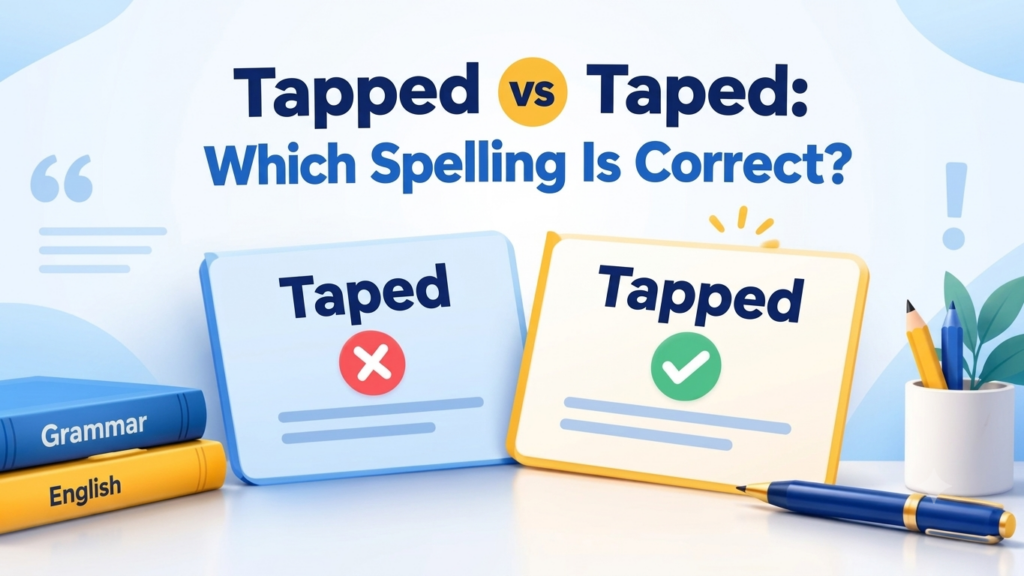

One missing letter can completely change the action being described. “Tapped” and “taped” look surprisingly similar on the page, yet they come from different verbs and carry very different meanings. “Tapped” comes from “tap,” while “taped” comes from “tape.”
If someone lightly touches your shoulder, they tapped you. If they attach a note to a wall with adhesive tape, they taped it there. The difference also appears in technology, entertainment, business, and everyday conversation.
The quickest way to choose the correct word is to identify the original verb. If the action involves touching, accessing, selecting, or drawing from a resource, “tapped” is often correct. If it involves adhesive tape or recording something, use “taped.”
Tapped vs Taped: Quick Answer
“Tapped” is the past tense and past participle of “tap.”
Example:
She tapped the screen to open the app.
“Taped” is the past tense and past participle of “tape.”
Example:
She taped the photograph to the wall.
The basic difference is:
| Word | Base Verb | Main Meaning |
|---|---|---|
| Tapped | Tap | Touched lightly, accessed, selected |
| Taped | Tape | Attached with tape or recorded |
Remember:
Tap → tapped
Tape → taped
What Does Tapped Mean?
“Tapped” has several meanings depending on context.
Its most familiar meaning is to touch or strike something gently.
For example:
He tapped me on the shoulder.
She tapped the glass with her finger.
The child tapped the table impatiently.
Someone might also tap a screen, access a resource, select someone for a role, or tap into a source of knowledge or energy.
The surrounding words normally make the intended meaning clear.
Tapped Meaning a Light Touch
When someone taps something, the action is generally brief and gentle.
Compare:
He hit the door.
He tapped the door.
“Hit” suggests stronger contact, while “tapped” suggests a lighter action.
Other examples include:
She tapped his arm to get his attention.
He tapped the microphone before speaking.
I tapped the desk with my pen.
Rain tapped softly against the window.
This meaning is especially common in everyday conversation.
Tapped in Technology
Smartphones and tablets have made another use of “tap” extremely common.
To tap a screen means to touch it briefly to activate something.
For example:
I tapped the icon to open the application.
She tapped the notification.
Tap the button to continue.
He tapped the screen twice.
In instructions for mobile devices, “tap” is often used where a desktop guide might use “click.”
Therefore:
Correct: Tap the menu icon.
Incorrect: Tape the menu icon.
“Tape” would suggest physically applying adhesive tape to the screen.
Tapped Into Meaning
“Tap into” is a common phrasal verb meaning to access or make use of something that is already available.
For example:
The company tapped into a new market.
She tapped into her previous experience.
The team tapped into local knowledge.
Businesses are trying to tap into growing consumer demand.
The phrase is often used with words such as:
Resources
Knowledge
Experience
Talent
Potential
Funding
Energy
Demand
Creativity
Here, no physical tapping occurs. The meaning is figurative.
Tapped Meaning Selected
“Tapped” can also mean selected or chosen for a particular job, responsibility, or position.
For example:
She was tapped to lead the project.
The company tapped him for a senior position.
He was tapped as the new team leader.
This use is especially common in professional and news-style writing.
In this context, “tapped” means something close to:
Chosen
Selected
Appointed
Picked
The meaning has nothing to do with adhesive tape.
What Does Taped Mean?
“Taped” comes from the verb “tape.”
It usually has two main meanings:
Something was attached using adhesive tape.
Something was recorded.
For example:
She taped the poster to the wall.
The interview was taped before the broadcast.
The meaning can usually be identified immediately from context.
Taped Meaning Attached With Tape
When adhesive tape is used to secure or attach something, “taped” is the correct word.
Examples:
He taped the box shut.
She taped the note to the refrigerator.
We taped the broken paper together.
They taped the cable to the floor.
The sign was taped to the window.
Common expressions include:
Taped shut
Taped together
Taped up
Taped to
In every case, tape is being used as a fastening material.
Taped Meaning Recorded
“Taped” can also mean recorded.
For example:
The television interview was taped earlier.
They taped the performance for later broadcast.
The conversation was taped with permission.
The episode was taped in front of a live audience.
This usage developed from the era when audio and video were commonly stored on physical recording tape.
Even though modern recording is often completely digital, “taped” remains an established way of saying “recorded.”
Tapped vs Taped: Key Differences
The easiest way to understand the difference is through context.
| Situation | Correct Word | Example |
|---|---|---|
| Light physical touch | Tapped | She tapped his shoulder. |
| Touchscreen action | Tapped | He tapped the icon. |
| Accessing a resource | Tapped | They tapped into local expertise. |
| Selecting someone | Tapped | She was tapped for the role. |
| Using adhesive tape | Taped | He taped the package shut. |
| Recording something | Taped | The interview was taped earlier. |
The words are not alternative spellings. They describe different actions.
Why Is It Tapped With Two Ps?
The verb “tap” is a short word ending in a single consonant after a short vowel.
When “-ed” is added, the final consonant is doubled:
Tap → tapped
The same pattern appears in:
Stop → stopped
Drop → dropped
Plan → planned
Clap → clapped
The doubled consonant helps preserve the short vowel sound.
The same rule applies when adding “-ing”:
Tap → tapping
Not:
Taping
“Taping” belongs to the verb “tape.”
Why Is It Taped With One P?
“Tape” already ends in silent “e.”
To create the past tense, only “d” is added:
Tape → taped
Compare:
Hope → hoped
Save → saved
Move → moved
Tape → taped
This spelling difference is important because removing or adding one letter changes the base verb.
Tapped comes from tap.
Taped comes from tape.
Tapping vs Taping
The distinction continues in the “-ing” forms.
“Tapping” comes from “tap.”
Example:
She is tapping on the window.
“Taping” comes from “tape.”
Example:
She is taping the box shut.
Another comparison:
He was tapping his foot.
He was taping the wires together.
Remember:
Tap → tapped → tapping
Tape → taped → taping
Tapped on the Shoulder or Taped on the Shoulder?
If someone lightly touched another person’s shoulder, the correct phrase is:
Tapped on the shoulder
Example:
She tapped me on the shoulder to get my attention.
“Taped on the shoulder” would suggest that adhesive tape was somehow involved, which creates a completely different meaning.
This is a good example of why the extra P matters.
Tapped on vs Taped on
Both expressions can technically appear, but they describe different actions.
Tapped on:
He tapped on the window.
This means he lightly touched or knocked on it.
Taped on:
A notice was taped on the window.
This means the notice was attached using adhesive tape.
Context determines which word is needed.
Tapped Into vs Taped Into
“Tapped into” is a standard expression.
Example:
The company tapped into a growing market.
It means accessed, used, or benefited from something.
“Taped into” does not carry this figurative meaning.
Incorrect:
The organization taped into local expertise.
Correct:
The organization tapped into local expertise.
When you are talking about resources, ideas, knowledge, potential, or markets, “tapped into” is usually the phrase you want.
Tapped for vs Taped for
“Tapped for” can mean chosen for something.
For example:
She was tapped for the leadership position.
He was tapped for a major assignment.
“Taped for” normally relates to recording.
For example:
The interview was taped for a television special.
Again, both phrases are possible, but their meanings are entirely different.
Examples of Tapped in Sentences
Here are some natural examples:
She tapped the screen to check her messages.
He tapped me gently on the arm.
The drummer tapped the cymbal softly.
I tapped the notification by mistake.
The company tapped into new sources of revenue.
The organization tapped local expertise for the project.
She was tapped to lead the new department.
He tapped his fingers against the desk.
The teacher tapped the board with a pointer.
They tapped into years of industry experience.
Each sentence involves touching, accessing, drawing from, or selecting.
Examples of Taped in Sentences
Here are examples using “taped”:
She taped the photograph to her desk.
He taped the package securely.
The broken page was taped together.
They taped the interview before lunch.
The program was taped several hours before broadcast.
A note was taped to the front door.
He taped the cable to the floor.
The box had been taped shut.
She taped the conversation for her research.
The poster was taped to the classroom wall.
These sentences involve attachment or recording.
Common Mistakes With Tapped and Taped
One common mistake is writing “taped” when describing a light touch.
Incorrect:
She taped him on the shoulder.
Correct:
She tapped him on the shoulder.
Another mistake is writing “tapped” when adhesive tape is involved.
Incorrect:
He tapped the box shut.
Correct:
He taped the box shut.
Writers also sometimes confuse the figurative phrase “tap into.”
Incorrect:
The business taped into growing demand.
Correct:
The business tapped into growing demand.
Another frequent problem involves “tapping” and “taping.”
Incorrect:
She is taping the phone screen.
Correct:
She is tapping the phone screen.
Unless she is literally attaching something with tape, “tapping” is the appropriate word.
Tapped vs Taped in Entertainment
“Taped” has long been common in television and entertainment vocabulary.
For example:
The episode was taped before a studio audience.
The interview was taped earlier in the day.
A taped performance was shown during the broadcast.
Despite digital recording replacing traditional magnetic tape in many productions, the verb remains familiar.
“Tapped,” meanwhile, may appear in entertainment reporting when someone is selected for a role.
For example:
The actor was tapped to lead the new series.
Here, “tapped” means chosen.
This produces an interesting contrast:
The actor was tapped for the show.
The show was taped before broadcast.
Both sentences are correct, but each verb performs a completely different job.
Tapped vs Taped in Business Writing
The distinction also matters in business communication.
Consider:
The company tapped into international demand.
This means the company successfully accessed or benefited from that demand.
Now compare:
The company taped the presentation.
This means the presentation was recorded.
A single missing P changes the meaning entirely.
Other business examples include:
The firm tapped new sources of funding.
Executives tapped her for the new role.
The training session was taped for employees who could not attend.
Pronunciation of Tapped and Taped
The words are spelled similarly, but they have different vowel sounds.
“Tapped” has the short vowel sound heard in “cat.”
“Tapped” sounds like:
tap + t
“Taped” has the long vowel sound heard in “day.”
“Taped” sounds like:
tape + t
The difference may be easier to hear when the words are spoken slowly.
Still, context is more reliable than pronunciation when deciding how to spell the word.
A Simple Editing Trick
If you are unsure whether to use “tapped” or “taped,” remove the past-tense ending and check the base verb.
For example:
She _____ the icon.
Would you say:
Tap the icon?
Yes.
Therefore:
She tapped the icon.
Now consider:
She _____ the photograph to the wall.
Would you say:
Tape the photograph to the wall?
Yes.
Therefore:
She taped the photograph to the wall.
This base-verb test works in almost every everyday situation.
Tapped vs Taped: Easy Memory Trick
Remember two simple connections:
Tapped = tap
Taped = tape
Then associate them with examples:
Tapped the screen.
Taped the box.
Another useful memory clue is the extra P:
Tapped has two Ps because “tap” doubles its final P when “-ed” is added.
Taped has one P because it comes from “tape.”
If you can identify the original verb, you can usually choose the correct spelling immediately.
Frequently Asked Questions
What Is the Difference Between Tapped and Taped?
“Tapped” comes from “tap” and can mean touched lightly, selected, or accessed. “Taped” comes from “tape” and usually means attached with tape or recorded.
Is It Tapped or Taped on the Shoulder?
Use “tapped.”
Correct:
She tapped him on the shoulder.
Is It Tapped Into or Taped Into?
“Tapped into” is correct when you mean accessed or made use of something.
Example:
The company tapped into a new market.
Is It Taped or Tapped an Interview?
If the interview was recorded, use “taped.”
Example:
The interview was taped earlier.
Why Does Tapped Have Two Ps?
“Tap” ends in a consonant after a short vowel, so the final P is doubled before adding “-ed.”
Tap → tapped
Why Does Taped Have Only One P?
“Taped” comes from “tape,” which already ends in silent “e.”
Tape → taped
Is It Tapping or Taping a Screen?
If you mean touching a touchscreen, use “tapping.”
Example:
She is tapping the screen.
Can Tapped Mean Selected?
Yes.
Example:
She was tapped to lead the department.
Here, “tapped” means chosen or selected.
Can Taped Mean Recorded?
Yes.
Example:
The show was taped before broadcast.
Are Tapped and Taped the Same Word?
No. They come from different verbs and describe different actions.
Final Thoughts
“Tapped” and “taped” are not two spellings of the same word. They come from different verbs, and choosing the wrong one can completely change a sentence.
Use “tapped” when the base verb is “tap.” This includes touching something lightly, using a touchscreen, accessing a resource, or selecting someone for a role.
Use “taped” when the base verb is “tape.” This usually means attaching something with adhesive tape or recording audio or video.
The simplest rule is:
Tap → tapped
Tape → taped
When in doubt, remove “-ed” and identify the original verb. That one quick check will usually tell you exactly which word belongs in your sentence.