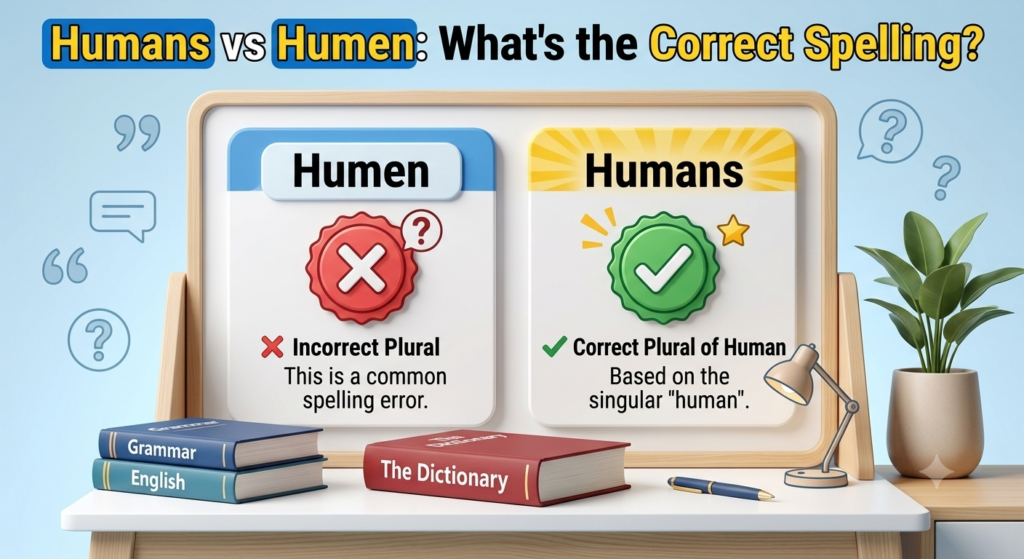

If you are wondering whether the correct plural is humans or humen, the answer is simple: humans is the standard plural form of human.
The confusion is understandable. English changes man to men and woman to women, so it may seem logical that human should become humen. English grammar does not work that way in this case. Human is treated as a regular noun when forming its plural, which means you simply add “s.”
One human becomes two humans, several humans, or all humans.
Knowing this small rule can prevent an easy spelling mistake in essays, professional writing, emails, articles, and everyday communication.
Expert Grammar Rule: The Plural of Human Is Humans
Human is a regular countable noun when it refers to a person or member of the human species.
The singular and plural forms are:
Human: one person or member of the human species
Humans: two or more people or members of the human species
The plural follows one of the most basic English noun rules:
human + s = humans
For example:
“One human entered the room.”
“Several humans entered the room.”
“A human needs oxygen to survive.”
“Humans need oxygen to survive.”
There is no internal spelling change when human becomes plural.
This makes human different from irregular nouns such as:
man → men
woman → women
child → children
mouse → mice
person → people
Human does not belong to this group. Its standard plural is formed simply by adding “s.”
Why Is Humen Incorrect?
Humen is not the standard plural of human in modern English.
The spelling usually appears because writers notice the word “man” inside human and assume the same plural rule should apply.
That reasoning might seem sensible at first:
man → men
human → humen?
But the second transformation does not follow standard English grammar.
Human is its own word with its own grammatical history. It does not form its plural by changing “a” to “e.”
Correct:
“Humans have developed complex languages.”
Incorrect:
“Humen have developed complex languages.”
Correct:
“Modern humans use technology every day.”
Incorrect:
“Modern humen use technology every day.”
In ordinary academic, professional, journalistic, and conversational English, humans is the form to use.
You may occasionally encounter humen as intentional wordplay, humorous writing, a username, brand name, or other creative usage. That does not make it the standard grammatical plural of human.
Why Doesn’t Human Follow Man and Men?
This is the part that causes most of the confusion.
Man is an old English word with an irregular plural. Its plural form, men, developed through historical changes in the language.
Human has a different linguistic history. The modern English word developed through French and ultimately traces back to Latin humanus.
Despite the fact that human ends with the letters “man,” its plural formation is not based on the modern noun man.
This means the correct patterns are:
man → men
woman → women
human → humans
The visual similarity between the words can be misleading, but their plural rules are different.
A useful comparison is to think about other words whose spelling contains familiar letters without following the grammar of the smaller word inside them. English spelling often reflects a word’s history rather than a perfectly consistent set of modern patterns.
Human vs Humans: What Is the Difference?
Human and humans differ mainly in number when they are used as nouns.
Human refers to one person.
“A human can survive only a limited time without water.”
Humans refers to more than one person or to people generally.
“Humans need water to survive.”
The distinction becomes particularly important when the verb in the sentence changes.
Singular:
“A human is capable of learning.”
Plural:
“Humans are capable of learning.”
Singular:
“One human has entered the building.”
Plural:
“Three humans have entered the building.”
Notice that changing human to humans may also require changing the verb from is to are or has to have.
Correct noun and verb agreement makes the whole sentence grammatically complete.
Human Can Be a Noun or an Adjective
One useful detail is that human does not always function as a noun.
As a noun, human refers to a person or member of the human species.
“She is only human.”
“A human approached the machine.”
“Humans have explored space.”
As an adjective, human describes something related to people.
“Human behavior can be difficult to predict.”
“The researchers examined human movement.”
“Human history stretches back thousands of years.”
“Human error caused the problem.”
When human functions as an adjective, you do not add “s” simply because the following noun is plural.
Correct:
“human beings”
Incorrect:
“humans beings”
Correct:
“human rights”
Incorrect:
“humans rights”
Correct:
“human activities”
Incorrect:
“humans activities”
This is because adjectives in English normally do not change between singular and plural nouns.
We say:
“a human activity”
“human activities”
The adjective human remains unchanged.
Humans, Human Beings, People, and Humanity
Several related terms can refer to people, but their meanings and uses are slightly different.
Humans is often used when discussing people as members of a species, particularly in scientific, historical, environmental, or technological contexts.
“Humans share the planet with millions of other species.”
Human beings has almost the same basic meaning but sometimes sounds slightly more personal or formal.
“Every human being deserves to be treated with dignity.”
People is the most natural everyday plural word when referring to individuals.
“Twenty people attended the meeting.”
In many ordinary conversations, people sounds more natural than humans.
For example:
“Five people are waiting outside.”
is usually more natural than:
“Five humans are waiting outside.”
Humans is particularly useful when contrasting people with animals, machines, artificial intelligence, or other species.
“Humans and machines process information differently.”
Humanity normally refers collectively to humankind or the human race.
“Climate change presents challenges for humanity.”
Humanity can also describe kindness or compassion.
“She showed great humanity toward those in need.”
Choosing among these words depends on context rather than simply singular and plural grammar.
Examples of Humans Used Correctly
The easiest way to make the spelling feel natural is to see it used in different contexts.
“Humans need food and water to survive.”
“Early humans developed tools for hunting and daily life.”
“Scientists continue to study how humans learn languages.”
“Humans have explored only a small portion of the deep ocean.”
“Technology has changed how humans communicate.”
“Many animals can recognize individual humans.”
“Humans can adapt to very different environments.”
“Researchers are studying interactions between humans and artificial intelligence.”
“Modern humans depend heavily on digital technology.”
“Humans have always searched for ways to understand the natural world.”
Each example uses humans because the sentence refers to more than one human or to people collectively.
Human’s, Humans, and Humans’: Don’t Confuse Them
Another spelling problem can appear when possession is involved.
Humans is simply the plural.
“Humans communicate through language.”
Human’s with an apostrophe usually shows possession by one human.
“A human’s body contains trillions of cells.”
Here, the body belongs to one human.
Humans’ shows possession by multiple humans.
“Humans’ ability to communicate has shaped societies.”
Here, the ability belongs collectively to humans.
Compare the three forms:
human = one human
humans = more than one human
human’s = something belonging to one human
humans’ = something belonging to multiple humans
The apostrophe changes the grammatical function, so it is important not to add one simply because a word is plural.
Common Mistakes to Avoid
The most common mistake is writing humen because of the man → men pattern.
Incorrect:
“Ancient humen used stone tools.”
Correct:
“Ancient humans used stone tools.”
Another mistake is using humans as an adjective.
Incorrect:
“Humans behavior is complicated.”
Correct:
“Human behavior is complicated.”
Writers may also confuse a plural with a possessive.
Incorrect:
“Human’s have created many languages.”
Correct:
“Humans have created many languages.”
The apostrophe is unnecessary because the sentence simply refers to multiple humans.
A final issue involves using humans where people would sound more natural. This is not necessarily grammatically wrong, but word choice matters.
For example:
“There were six humans at the restaurant.”
The sentence is grammatical, but it sounds unusual in everyday English.
“There were six people at the restaurant.”
is much more natural.
By contrast:
“The study compared the reactions of humans and chimpanzees.”
Here humans is an excellent choice because the sentence compares species.
An Easy Way to Remember the Correct Spelling
A simple memory trick is:
One human, many humans.
Do not connect the plural of human with man → men. Instead, group human with regular nouns such as:
student → students
teacher → teachers
doctor → doctors
animal → animals
human → humans
All you need to do is add “s.”
You can also remember the sentence:
“Humans always keeps the word human intact.”
The entire word human remains there, with an “s” added at the end.
Editorial Guidance for Formal English
For school assignments, academic work, professional emails, articles, reports, and other formal writing, always use humans when you need the plural noun.
Examples:
“Humans have significantly altered many natural environments.”
“Researchers examined how humans respond to stress.”
“The relationship between humans and technology continues to evolve.”
When human is being used descriptively, keep it singular:
“human development”
“human intelligence”
“human behavior”
“human rights”
“human communication”
This distinction is particularly useful for writers because humans and human often appear close together in scientific, educational, and technology-related content.
For example:
“Humans have developed sophisticated systems of human communication.”
The first word is a plural noun. The second is an adjective.
Final Grammar Takeaway
The correct choice between humans and humen is humans.
Human is a regular noun for plural formation, so you simply add “s”:
human → humans
Do not change human to humen just because man becomes men. Man is an irregular noun, while human follows the regular plural pattern.
Remember the basic rule:
One human.
Two humans.
Many humans.
When human describes another noun, however, it usually stays unchanged, as in human behavior, human beings, and human rights.
Once you separate human from the irregular man → men pattern, the spelling becomes much easier to remember.