
Choosing between “interested in” and “interested on” can feel confusing because both in and on are common English prepositions. However, when interested describes curiosity, enthusiasm, attraction, or a desire to learn more about something, standard English follows one clear pattern.
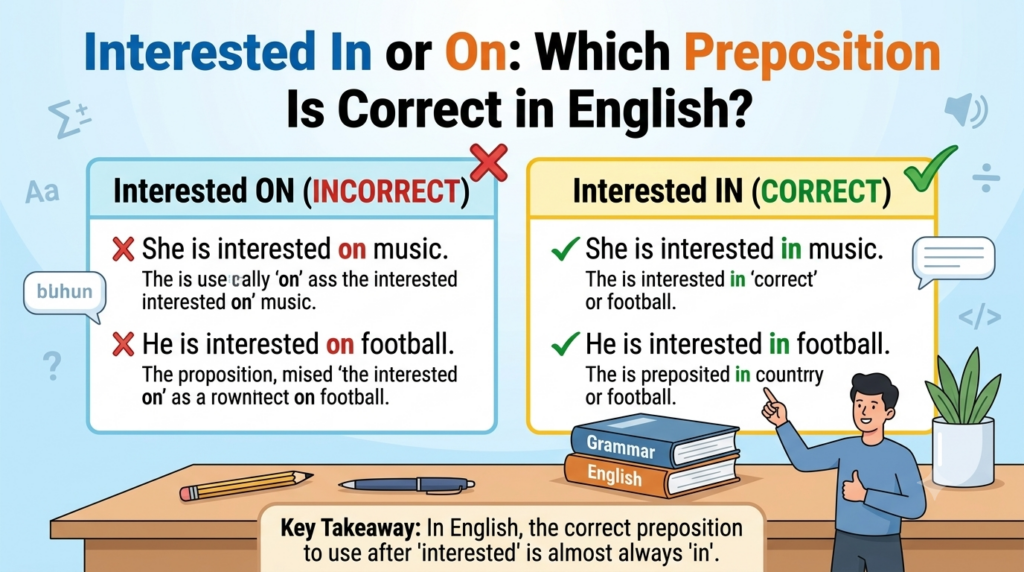
The correct expression is “interested in.”
You can be interested in music, interested in a new job, interested in learning Spanish, or interested in someone. “Interested on” does not normally work in these situations.
The simplest pattern to remember is:
interested + in + noun
or
interested + in + verb ending in -ing
Once you learn this combination as a complete phrase, using it correctly becomes much easier.
Expert Grammar Rule: Interested In Is Correct
The adjective interested is normally followed by the preposition in when it describes what attracts someone’s attention or curiosity.
Correct:
“I am interested in photography.”
“She is interested in science.”
“They are interested in the proposal.”
“He is interested in learning Japanese.”
Incorrect:
“I am interested on photography.”
“She is interested on science.”
“They are interested on the proposal.”
In English, some adjectives naturally form fixed combinations with particular prepositions. We say afraid of, good at, responsible for, and interested in.
Trying to choose the preposition by translating each word separately can therefore cause mistakes. It is usually better to learn “interested in” as one complete expression.
What Does Interested In Mean?
Interested in means that a person feels curious about something, enjoys it, wants to know more about it, or would like to become involved with it.
For example:
“She is interested in astronomy.”
This tells us that astronomy attracts her attention.
“They are interested in buying the house.”
Here, the phrase suggests that buying the property is something they are seriously considering.
“I am interested in your idea.”
This means the speaker finds the idea worth hearing or learning more about.
The expression works across many situations, including education, employment, hobbies, relationships, travel, business, technology, and everyday conversation.
You might say:
“My daughter is interested in painting.”
“I’m interested in applying for the position.”
“Our company is interested in working with you.”
“He became interested in history at school.”
The grammar remains the same regardless of the topic.
Why Do We Say Interested In Instead of Interested On?
Prepositions are one of the less predictable parts of English. Their use cannot always be explained by their basic meanings alone.
For example, in often describes something located inside another thing:
“The keys are in the drawer.”
On often describes contact with a surface:
“The keys are on the table.”
But these literal meanings do not explain every English expression. In phrases such as interested in, the preposition forms part of an established word pattern.
That is why learners should avoid reasoning that someone is interested “on” a topic because the topic is what they are focusing on. English simply uses interested in for this meaning.
Compare:
Correct: “She is interested in politics.”
Incorrect: “She is interested on politics.”
Correct: “We are interested in your services.”
Incorrect: “We are interested on your services.”
Learning the adjective and preposition together is more reliable than trying to calculate which preposition sounds logical each time.
How to Use Interested In With Nouns and Pronouns
One of the most common structures is:
interested in + noun
For example:
“I’m interested in art.”
“She is interested in medicine.”
“We are interested in the property.”
“Tom is interested in photography.”
A pronoun can also follow the preposition.
“She seems interested in him.”
“They are interested in us.”
“Why are you interested in it?”
In these sentences, the pronoun acts as the object of the preposition in.
This structure can describe general curiosity, professional interest, or personal attraction depending on the context.
For instance, “She is interested in him” may suggest romantic interest, while “The recruiter is interested in him” may simply mean the recruiter considers him a promising candidate.
Context determines the meaning, but the grammar does not change.
Interested In With Verbs: Why the -ing Form Matters
Another common mistake happens when a verb comes after interested in.
Because in is a preposition, a verb that follows it normally appears in the -ing form.
Correct:
“I am interested in learning English.”
“She is interested in becoming a doctor.”
“They are interested in moving abroad.”
“We are interested in hearing your proposal.”
Incorrect:
“I am interested in learn English.”
“She is interested in become a doctor.”
“They are interested in move abroad.”
The pattern is:
interested in + verb-ing
This is especially useful in professional and academic English.
For example:
“I am interested in applying for the internship.”
“We are interested in exploring possible partnerships.”
“The researchers are interested in examining the results further.”
“She became interested in studying environmental science.”
The same structure works naturally in casual conversation:
“Are you interested in going out tonight?”
“I’m interested in trying that restaurant.”
“He isn’t interested in watching the game.”
Common Mistakes English Learners Should Avoid
The most obvious mistake is replacing in with on.
Incorrect:
“I’m interested on football.”
Correct:
“I’m interested in football.”
Another mistake is using the base form of a verb after interested in.
Incorrect:
“She is interested in study abroad.”
Correct:
“She is interested in studying abroad.”
Some learners also write constructions such as:
“I am interested to join your company.”
In most situations where you mean that joining the company appeals to you, the more natural construction is:
“I am interested in joining your company.”
Likewise:
“I’m interested in knowing more.”
“I’m interested in working with your team.”
“I’m interested in purchasing the product.”
These structures are particularly useful in emails, applications, enquiries, and professional communication.
Interested In vs Interesting
Interested and interesting are related, but they do different jobs.
Interested describes how a person feels.
“I am interested in history.”
Interesting describes the thing that creates that feeling.
“History is interesting.”
Compare:
“She is interested in the book.”
“The book is interesting.”
“The students are interested in the lesson.”
“The lesson is interesting.”
A simple way to remember the difference is that people are usually interested, while subjects, stories, activities, ideas, and experiences can be interesting.
Of course, a person can also be described as interesting:
“He is an interesting person.”
That means other people find him engaging or worth knowing.
“He is interested in science.”
That means science attracts his attention.
The difference is small in spelling but important in meaning.
Interested In vs Curious About
Interested in and curious about are similar, but they are not always identical.
Interested in often suggests an existing attraction, enthusiasm, or willingness to become involved.
“I’m interested in photography.”
This may mean photography is one of your hobbies or something you would like to explore.
Curious about usually emphasizes wanting to discover information.
“I’m curious about photography.”
This may simply mean you want to know how it works or learn more about it.
Consider another example:
“She is interested in the new employee.”
Depending on the context, she may want to work with the person, learn more about them, or even feel personal attraction.
“She is curious about the new employee.”
This mainly suggests that she wants to know more about the person.
Both phrases are correct. The best choice depends on the meaning you want to communicate.
Real-Life Examples in Work, School, and Conversation
Interested in is extremely common because it fits naturally into both formal and informal English.
At work:
“I’m interested in discussing the position further.”
“Our team is interested in your proposal.”
“She is interested in developing her leadership skills.”
“We are interested in forming a long-term partnership.”
In education:
“He is interested in studying engineering.”
“The students are interested in environmental science.”
“I became interested in literature during college.”
“She is interested in taking an advanced English course.”
In everyday conversation:
“Are you interested in going to the concert?”
“I’m really interested in cooking.”
“My brother is interested in cars.”
“They are interested in visiting Italy.”
In business enquiries:
“I am interested in learning more about your services.”
“We are interested in receiving a quotation.”
“The client is interested in purchasing several units.”
Learning these complete sentence patterns makes the grammar easier to reproduce naturally when you need it.
A Simple Way to Remember the Correct Preposition
Instead of memorizing a long explanation every time you write a sentence, remember one short combination:
Interested IN something.
You can even connect in with the word interest:
“You have an interest in something, so you are interested in it.”
For example:
“I have an interest in technology.”
“I am interested in technology.”
Both expressions use in.
It also helps to learn other fixed English combinations as complete units:
believe in
participate in
succeed in
specialize in
interested in
English becomes much easier when common combinations are stored in your memory as phrases instead of separate words.
Editorial Guidance for Formal and Professional English
In professional writing, choosing the correct preposition matters because small grammatical errors can make an otherwise polished message feel less natural.
For job applications, use:
“I am interested in applying for the marketing position.”
For business enquiries:
“We are interested in learning more about your services.”
For academic writing:
“The researchers were interested in examining the relationship between the two variables.”
For customer communication:
“I am interested in purchasing your annual plan.”
In each example, interested in creates a clear and standard grammatical structure.
Writers should also pay attention to what follows the phrase. A noun can appear directly after interested in, while an action is normally expressed using the -ing form.
Final Grammar Takeaway
When choosing between interested in and interested on, use interested in.
Use:
interested in + noun
“She is interested in photography.”
interested in + pronoun
“He is interested in her.”
interested in + verb-ing
“They are interested in starting a business.”
Avoid “interested on” when expressing curiosity, enthusiasm, attraction, or involvement. It is not the standard construction for this meaning.
The best way to make the rule feel natural is to stop thinking of interested and in as two separate choices. Learn “interested in” as one familiar English pattern.
Once that combination becomes automatic, sentences such as “I’m interested in learning more,” “She’s interested in art,” and “We’re interested in your proposal” will feel natural every time.