
If you have ever written “sweeped” and immediately wondered whether it looked right, you are not alone. The confusion makes sense because hundreds of English verbs form their past tense simply by adding “-ed.” Walk becomes walked, clean becomes cleaned, and wash becomes washed. Sweep, however, does not follow that pattern.
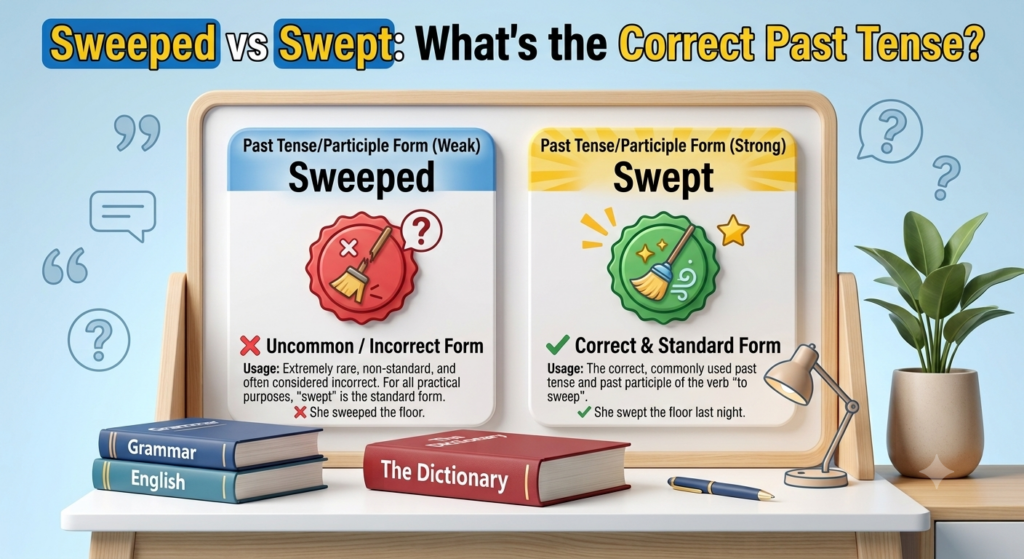
The correct past tense of sweep is swept. Swept is also the past participle. “Sweeped” is not the standard form used in modern English.
The basic pattern is easy to remember:
Sweep: present tense
Swept: past tense
Swept: past participle
Sweeping: present participle
So, you should write “I swept the kitchen yesterday,” not “I sweeped the kitchen yesterday.”
Once you understand that sweep is an irregular verb, the difference between sweeped and swept becomes much easier to remember.
Expert Grammar Rule: Why Swept Is Correct
Sweep is an irregular verb. Regular verbs normally take an “-ed” ending when an action moves into the past, but irregular verbs change in different ways.
Compare these regular verbs:
Clean → cleaned
Walk → walked
Wash → washed
Jump → jumped
Now compare sweep:
Sweep → swept
The spelling changes instead of simply adding “-ed.”
For example:
Present: “I sweep the floor every morning.”
Past: “I swept the floor this morning.”
Past participle: “I have swept the floor already.”
The same form, swept, is used for both the simple past and the past participle.
This means sentences such as these are correct:
“She swept the hallway before the guests arrived.”
“We have swept the entire building.”
“They had swept the driveway before it started raining.”
Using “sweeped” in any of these sentences would be considered nonstandard.
The mistake usually happens because people apply the regular verb rule automatically. Grammatically, though, sweep belongs to the irregular group.
What Does Sweep Mean and How Is Swept Used?
Most people first learn sweep in connection with cleaning.
To sweep means to clean a surface using a broom, brush, or similar tool, usually by gathering dust, dirt, leaves, or other material.
For example:
“I sweep the kitchen after dinner.”
“She swept the porch yesterday.”
“The cleaner has swept the hallway.”
But sweep has several broader meanings too.
It can describe something moving quickly or forcefully across an area.
“The wind swept across the field.”
A wave or strong current can also sweep something away.
“The floodwater swept several branches downstream.”
Sweep can describe rapid movement by a person.
“She swept into the room without saying anything.”
It may also refer to something spreading quickly.
“Excitement swept through the crowd.”
In every one of these past-tense examples, the correct form remains swept.
You can also use swept in passive constructions:
“The leaves were swept into a pile.”
“The boat was swept out to sea.”
“The old buildings were swept away by the flood.”
Whether sweep means cleaning, movement, force, or rapid change, its past form does not change.
Why People Write Sweeped and How to Avoid the Mistake
“Sweeped” looks believable because English learners are taught early that past-tense verbs often end in “-ed.”
For example:
Play → played
Open → opened
Start → started
Work → worked
Applying the same rule would seem to give:
Sweep → sweeped
But English has many common verbs that do not follow the regular pattern.
Some especially useful examples are:
Keep → kept
Sleep → slept
Weep → wept
Feel → felt
Leave → left
Teach → taught
Sweep fits naturally beside several of these words:
Sweep → swept
Sleep → slept
Keep → kept
Weep → wept
That similarity provides an easy memory trick.
Think:
“I sleep, I slept.”
Then:
“I sweep, I swept.”
You can also remember the short pattern:
Sweep today. Swept yesterday. Swept already.
For example:
“I sweep the porch every day.”
“I swept the porch yesterday.”
“I have swept the porch already.”
Repeating these three forms together can make the correct version feel much more natural.
Correct and Incorrect Examples in Everyday English
Looking at complete sentences is one of the easiest ways to understand the difference.
Correct:
“She swept the floor before breakfast.”
Incorrect:
“She sweeped the floor before breakfast.”
Correct:
“The wind swept the leaves across the garden.”
Incorrect:
“The wind sweeped the leaves across the garden.”
Correct:
“We have swept the classroom already.”
Incorrect:
“We have sweeped the classroom already.”
Correct:
“He swept the broken glass into a pile.”
Incorrect:
“He sweeped the broken glass into a pile.”
Correct:
“The storm swept through the coastal town.”
Incorrect:
“The storm sweeped through the coastal town.”
Correct:
“They had swept the office before everyone arrived.”
Incorrect:
“They had sweeped the office before everyone arrived.”
The same rule applies when using phrasal constructions such as swept away, swept aside, swept up, or swept out.
Correct:
“She swept up the crumbs after lunch.”
“The strong current swept the boat away.”
“He swept the papers aside.”
“The workers swept out the garage.”
Using sweeped in these examples would sound unnatural to proficient English speakers and would normally be corrected in formal writing.
Common Expressions and Idioms Using Swept
Swept also appears in several familiar English expressions. Understanding them can improve both vocabulary and grammar.
“Swept off your feet” commonly describes becoming suddenly and strongly attracted to someone.
For example:
“She was swept off her feet by his confidence and charm.”
“Swept away” can describe strong emotion or excitement.
“The audience was swept away by the performance.”
It can also be literal:
“The small boat was swept away by the current.”
“Swept under the rug” means trying to hide or ignore an uncomfortable issue rather than dealing with it.
“The complaint should not have been swept under the rug.”
“Swept aside” can mean physically moving something away or ignoring an obstacle, objection, or concern.
“His objections were quickly swept aside.”
“Swept up” can describe being carried along by emotion, activity, or excitement.
“They became swept up in the celebrations.”
These expressions all use swept, never sweeped.
They are useful because they show that the verb appears in far more situations than simply cleaning a floor.
Professional Usage and Final Grammar Guidance
The rule for sweep is the same in standard American and British English. You do not need to change the spelling depending on your audience.
Whether you are writing an essay, business email, school assignment, news article, social media caption, or professional report, use swept for both the past tense and past participle.
The complete verb pattern is:
Base form: sweep
Third-person present: sweeps
Present participle: sweeping
Simple past: swept
Past participle: swept
Examples in professional or formal writing include:
“The maintenance team swept the entrance before opening.”
“The area has been swept and cleaned.”
“Strong winds swept through the region overnight.”
“The previous concerns were swept aside during the discussion.”
One important detail is the difference between simple past and past participle structures.
Simple past:
“She swept the floor.”
Present perfect:
“She has swept the floor.”
Past perfect:
“She had swept the floor.”
Passive:
“The floor was swept before the meeting.”
In all four cases, swept is correct.
The easiest rule to keep in mind is straightforward: sweep is irregular, so its past form is swept, not sweeped.
If you remember the similar pattern sleep → slept, the spelling is even easier to recall.
So the next time you are choosing between sweeped and swept, use swept whenever you are describing a past or completed action.
Correct: “I swept the room.”
Incorrect: “I sweeped the room.”
That single rule works in everyday speech, academic writing, business communication, and virtually every standard English context.