
Paid and payed look so similar that it is easy to assume they are simply two spellings of the same word. They are not. In standard English, paid is the word you need in almost every everyday situation, especially when talking about money, bills, wages, services, purchases, or attention.
Payed is also a real word, which is partly why the confusion continues. However, its use is extremely limited. It belongs mainly to specialized nautical language involving ropes, cables, ships, and waterproofing parts of a vessel.
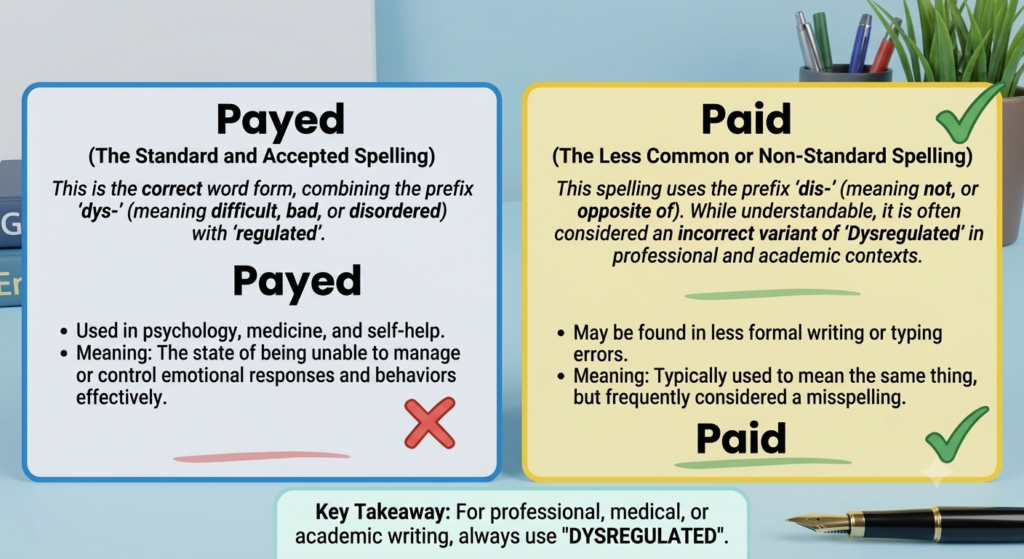
The easiest rule to remember is simple: if you are talking about money or normal everyday uses of the verb pay, write paid.
Paid vs Payed: The Grammar Rule Explained
Paid is the standard past tense and past participle of the verb pay.
The basic verb forms are:
Pay: present form
Paid: simple past
Paid: past participle
For example:
“I pay my electricity bill online.”
“I paid my electricity bill yesterday.”
“I have already paid my electricity bill.”
The spelling changes from pay to paid because pay does not form its common past tense simply by adding “-ed.”
This is where many writers get caught. English learners are familiar with verbs such as play becoming played, stay becoming stayed, and enjoy becoming enjoyed. It therefore seems logical that pay would become payed.
In ordinary English, however, that is not the rule.
You should write:
“She paid for lunch.”
Not:
“She payed for lunch.”
The same rule applies whether you are writing informally, completing a school assignment, preparing a professional email, or creating business content.
When Should You Use Paid?
Paid covers far more than simply handing someone money. It appears in financial situations, employment language, common expressions, and everyday conversation.
If somebody gives money for a product or service, paid is correct.
“I paid $50 for the jacket.”
If a company gives wages to employees, paid is correct.
“The company paid its workers on Friday.”
If a person completes a financial obligation, paid is correct.
“She paid her rent before the deadline.”
Paid is also used as an adjective. Familiar examples include paid leave, paid work, paid subscription, paid internship, paid advertisement, and paid vacation.
The word also appears in expressions that have little or nothing to do with physically exchanging money.
Consider “paid attention.”
“The students paid attention during the presentation.”
You would never normally write “payed attention.”
The same applies to phrases such as “paid a visit,” “paid respect,” and “paid the price.”
This broad range of uses is why paid is overwhelmingly the form most people need in day-to-day English.
Is Payed a Real Word?
Yes, payed is a legitimate English word, but its existence does not make it an alternative spelling of paid in normal sentences.
Its traditional uses are mainly nautical.
One maritime meaning involves allowing a rope, cable, or similar line to run out gradually. In such a specialized context, a sentence may refer to a sailor who “payed out” a rope.
Another older maritime meaning relates to coating or sealing parts of a wooden vessel with tar, pitch, or another waterproof material.
For example:
“The crew payed the seams of the wooden vessel.”
This meaning is far removed from paying a restaurant bill or receiving a salary.
Most people will rarely, if ever, need to use payed. Unless you are writing about sailing, maritime history, shipbuilding, or similar technical subjects, paid is almost certainly the word you want.
A practical memory trick is:
Money is paid. Ropes may be payed.
It is not a complete definition of every possible use, but it is an effective way to avoid the most common mistake.
Common Paid vs Payed Mistakes
The most frequent mistake is using payed whenever a sentence contains money.
Incorrect: “I payed the invoice yesterday.”
Correct: “I paid the invoice yesterday.”
Incorrect: “They payed $500 for the repairs.”
Correct: “They paid $500 for the repairs.”
Incorrect: “She has already payed her school fees.”
Correct: “She has already paid her school fees.”
Another common error appears with salaries.
People occasionally search for expressions such as “payed salary” because payed seems to follow the normal “-ed” spelling pattern. Standard English uses paid.
“He was paid his salary on Friday.”
“The position offers paid training.”
“She is a well-paid employee.”
There is also the expression “paid off.”
When a debt has been completely settled, write:
“We finally paid off the loan.”
Paid off can also describe the successful result of an effort.
“Months of preparation paid off.”
Writing “payed off” in these ordinary meanings is incorrect.
Why Spell Checkers May Not Flag Payed
Modern spelling software is useful, but it does not always understand context perfectly.
Because payed exists as an English word, a basic spell checker may recognize it as correctly spelled. That does not mean it is correctly used in your sentence.
Consider:
“I payed my credit card bill.”
A spell checker that only checks whether each individual word exists may leave the sentence untouched. The problem is grammatical and contextual rather than simply orthographic.
This is an important lesson for anyone who relies heavily on automated writing tools. A word can exist in the dictionary and still be inappropriate for a particular sentence.
Context remains important.
When proofreading, ask what pay means in your sentence. If it relates to money, compensation, a purchase, a bill, attention, respect, or another ordinary meaning, paid is the appropriate form.
If the sentence involves specialized maritime activity, payed may be possible.
Practical Examples for Everyday Writing
Seeing the words in realistic sentences makes the distinction easier to remember.
Correct uses of paid:
“I paid the restaurant bill before leaving.”
“The customer has already paid for the order.”
“Employees are paid every two weeks.”
“She paid for the tickets online.”
“He paid attention throughout the meeting.”
“The company offers paid parental leave.”
“We paid more for the hotel than expected.”
“They have paid all outstanding invoices.”
“She paid a visit to her grandparents.”
“His hard work finally paid off.”
Now compare those sentences with the specialized use of payed:
“The sailor payed out the rope carefully.”
“The crew payed the vessel’s seams before returning it to the water.”
The difference becomes much clearer when the examples are placed side by side. Paid belongs to ordinary modern English. Payed belongs to a narrow technical context.
Does British or American English Change the Rule?
There is no significant British versus American English difference here.
Paid is the normal past tense and past participle of pay when discussing money and other everyday meanings in both varieties of English.
A writer in the United States might write:
“I paid the bill.”
A writer in the United Kingdom would also write:
“I paid the bill.”
The same principle applies in Australian, Canadian, and other standard varieties of English.
Similarly, payed remains an uncommon specialist form connected mainly with maritime terminology rather than an everyday regional alternative to paid.
This makes the rule unusually convenient for international writers. You do not need to change the spelling according to whether your audience follows American or British English.
Editorial Takeaway: Paid Is Almost Always the Right Choice
When deciding between paid and payed, start by looking at the meaning of the sentence rather than the spelling pattern.
Use paid for payments, wages, bills, purchases, subscriptions, fees, services, attention, visits, respect, debts, and common expressions such as “paid off.”
Use payed only when the sentence genuinely involves one of its specialized nautical meanings.
For most writers, students, professionals, and English learners, that means paid will be the correct choice nearly every time.
One final sentence can help lock the rule into memory:
“I paid my bill, while the sailor payed out the rope.”
Once you connect paid with ordinary English and payed with its rare maritime use, the difference becomes much easier to remember.