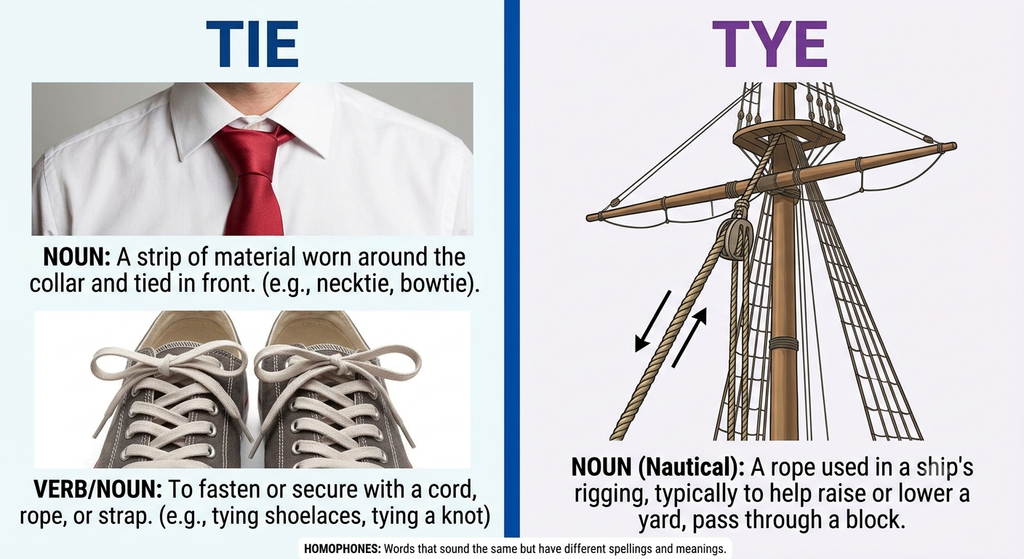

“Tie” and “Tye” sound the same when spoken, but they are not interchangeable in modern English. For ordinary everyday writing, “tie” is the correct spelling. It can mean to fasten something, a piece of clothing worn around the neck, an equal result in a competition, or a connection between people or organizations.
“Tye,” however, can still be correct in special situations. It appears as a surname, in some place names, and in historical English. This means it should not automatically be treated as a spelling mistake every time you see it.
The easiest rule is simple: use “tie” for the standard modern English word. Use “Tye” only when it is an established name, place, or historical term.
Quick Answer
For normal English, use:
Tie
Examples:
Tie your shoes before you leave.
He wore a black tie to the ceremony.
The match ended in a tie.
The two organizations have strong business ties.
“Tye” is not the standard spelling in these sentences.
However, “Tye” may be correct when it is part of a person’s name, surname, geographical name, or historical expression.
Tie vs Tye
Here is the basic difference:
| Word | Standard Modern English? | Typical Use |
|---|---|---|
| Tie | Yes | Fastening, clothing, equal score, connection |
| Tye | Not as a replacement for tie | Names, place names, historical uses |
If you mean “fasten,” “necktie,” “equal result,” or “connection,” write “tie.”
What Does Tie Mean?
“Tie” is a very flexible English word. It can function as both a verb and a noun.
As a verb, it often means to fasten or attach something.
For example:
Tie the ribbon around the box.
She tied her shoes before leaving.
He tied the rope to the fence.
As a noun, “tie” can describe a fastening, a piece of clothing, an equal result, or a relationship.
For example:
He wore a blue tie.
The game finished in a tie.
The two families have close ties.
The intended meaning becomes clear from the surrounding sentence.
Tie as a Verb
As a verb, “tie” usually means to fasten, connect, or secure something.
Examples:
Tie the package with string.
She tied her hair back.
He tied the boat to the dock.
Please tie the bag securely.
The word can appear in several patterns:
Tie something
Tie something to something
Tie something with something
Tie something together
For example:
Tie the balloons together.
Tie the rope to the post.
Tie the parcel with ribbon.
All of these use “tie,” not “tye.”
Tie as a Piece of Clothing
A tie is also the long piece of cloth usually worn around the neck with formal or business clothing.
For example:
He wore a red tie with his suit.
I bought a new tie for the wedding.
His tie matched his jacket.
You may also hear the more specific word “necktie,” particularly in American English.
The spelling remains:
Tie
Not:
Tye
Tie as an Equal Result
In sports, games, and competitions, a tie occurs when two or more participants finish with the same score or result.
For example:
The match ended in a tie.
The two runners tied for second place.
The score was tied at halftime.
In British sports English, “draw” is also commonly used for an equal result in many sports.
For example:
The match ended in a draw.
However, “tie” is still a standard English word for an equal result in appropriate contexts.
Tie as a Connection
“Tie” can also describe a connection or relationship.
For example:
The countries have strong economic ties.
She maintains close family ties.
The companies strengthened their business ties.
The school has strong ties to the local community.
In this meaning, nothing is physically being tied. The word refers to a relationship, bond, or connection.
Common phrases include:
Family ties
Business ties
Political ties
Economic ties
Cultural ties
Diplomatic ties
What Does Tye Mean?
“Tye” is not normally used as an alternative spelling of “tie” in everyday English.
However, it does have legitimate uses.
Historically, forms related to “tye” have been associated with land, common pasture, and particular geographical areas in England. The form survives in some English place names and surnames.
This is why you may see “Tye” written correctly in names even though it would be incorrect in a sentence such as “Tye your shoes.”
Tye as a Surname
“Tye” is an established surname.
For example:
Mr. Tye attended the meeting.
In this sentence, the spelling should not be changed to “Tie” because a person’s surname must retain its correct form.
The same principle applies whenever “Tye” is someone’s first name or family name.
Names do not need to follow the spelling of the common word “tie.”
Tye in Place Names
“Tye” can also appear in English geographical names.
Historical place-name usage has connected “tye” with areas of common land or pasture, particularly in parts of England.
You may therefore encounter names containing forms such as:
Tye Green
Tye Hill
Tye Farm
In these situations, “Tye” is part of the official or historical name and should not be corrected to “Tie.”
Is Tye a Misspelling?
Sometimes yes, but not always.
If someone writes:
Please tye your shoes.
then “tye” is incorrect.
The sentence should be:
Please tie your shoes.
If someone writes:
Her surname is Tye.
then “Tye” may be completely correct.
The key is context.
For everyday meanings involving fastening, clothing, competition results, or relationships, use “tie.”
For established names or historical references, “Tye” may be correct.
Why Do People Confuse Tie and Tye?
The main reason is pronunciation.
“Tie” and “Tye” are generally pronounced the same way.
Because English spelling cannot always be predicted from pronunciation, someone who hears the word without seeing it written may guess the wrong spelling.
The letter combination “ye” also appears in names, which can make “Tye” look believable as a general spelling.
However, pronunciation does not make the two forms interchangeable.
Tie, Tied, and Tying
The related forms of “tie” sometimes create additional spelling confusion.
The main forms are:
Tie
Ties
Tied
Tying
Examples:
I tie my shoes every morning.
She ties the ribbon carefully.
He tied the package yesterday.
They are tying the decorations together.
Notice that the present participle is:
Tying
Not:
Tieing
The final “e” disappears before “-ing.”
Why Is It Tying and Not Tieing?
When “tie” takes the “-ing” ending, the standard spelling changes to “tying.”
Correct:
She is tying her shoes.
Incorrect:
She is tieing her shoes.
This spelling may look unusual at first, but it follows the established form of the verb.
You can memorize the sequence:
Tie → tied → tying
Common Mistakes
One common mistake is using “tye” when talking about fastening something.
Incorrect:
Tye the rope around the box.
Correct:
Tie the rope around the box.
Another mistake is using “tye” for clothing.
Incorrect:
He wore a blue tye.
Correct:
He wore a blue tie.
You should also avoid assuming that every occurrence of “Tye” is wrong.
Incorrect correction:
Changing a person’s surname from Tye to Tie.
If “Tye” is the established name, it should remain unchanged.
Another common spelling mistake is:
Tieing
The correct form is:
Tying
Correct Uses of Tie
Here are some natural examples:
Tie your shoelaces before running.
She wore a silk tie to the meeting.
The game ended in a tie.
The company has strong ties with its suppliers.
Tie the bag securely.
The two candidates were tied in the final vote.
His family ties remain important to him.
She tied the ribbon around the gift.
These examples all use the standard everyday word “tie.”
Correct Uses of Tye
“Tye” can be correct in sentences involving names.
For example:
Tye is the family’s surname.
They visited a place called Tye Green.
The historical document uses the word “tye” in an older geographical context.
In each example, “Tye” is not replacing the modern common word “tie.”
Tie Up Meaning
“Tie up” has several possible meanings.
It can literally mean to fasten something.
Example:
Tie up the bag before putting it outside.
It can also mean to occupy someone’s time.
Example:
The meeting tied me up all afternoon.
In business, it can also describe money or resources that are unavailable because they are committed elsewhere.
Example:
Most of the company’s money is tied up in property.
The meaning depends on context.
Tie In Meaning
“Tie in” means to connect or relate something to another thing.
For example:
The new campaign ties in with the company’s broader strategy.
The final chapter ties in with events from the beginning of the story.
You may also see the noun “tie-in.”
For example:
The company launched a promotional tie-in with the film.
Tie Together Meaning
“Tie together” can mean physically fastening several objects or connecting ideas.
Physical example:
Tie the sticks together with string.
Figurative example:
The final section ties all the arguments together.
The second example means that the section connects the ideas into one coherent whole.
Tie the Knot Meaning
“Tie the knot” is an informal expression meaning to get married.
For example:
The couple plans to tie the knot next summer.
This is an idiom, so no physical knot needs to be involved.
The phrase always uses “tie.”
Not:
Tye the knot.
Tie-Breaker Meaning
A tie-breaker is an additional question, round, game, or procedure used to determine a winner when competitors are tied.
For example:
The competition went to a tie-breaker.
A final question served as the tie-breaker.
The word comes directly from the competition meaning of “tie.”
Tie vs Tye in Professional Writing
In professional writing, use “tie” whenever you mean the ordinary English word.
For example:
The evidence ties the two events together.
The organization has close ties with local businesses.
His tie was appropriate for the formal event.
Use “Tye” only if it is part of a person’s name, company name, place name, or historically accurate term.
This distinction is particularly important when editing documents. Correcting a legitimate proper name simply because it resembles a common spelling error can create a new mistake.
Tie vs Tye in Academic Writing
Academic writers should also use “tie” for the standard modern meanings.
For example:
The findings tie economic growth to increased investment.
Historical writing may occasionally preserve “tye” when discussing older documents, place names, or terminology.
In that case, retaining the historical spelling may be necessary because the spelling itself is part of the source or subject being discussed.
Easy Trick to Remember Tie vs Tye
For everyday English, remember:
Tie = the normal word.
Think of these four uses:
Tie your shoes.
Wear a tie.
Finish in a tie.
Maintain family ties.
If one of those meanings fits your sentence, use “tie.”
For “Tye,” remember:
Tye = usually a name, place, or historical form.
This simple distinction works in most situations.
Quick Decision Guide
Ask yourself what the word means.
Does it mean to fasten something?
Use “tie.”
Does it mean neckwear?
Use “tie.”
Does it mean an equal result?
Use “tie.”
Does it mean a connection or relationship?
Use “tie.”
Is it someone’s established name, a place name, or a historical term?
“Tye” may be correct.
Frequently Asked Questions
Is It Tie or Tye?
For ordinary modern English, “tie” is correct. “Tye” is mainly found in names, place names, and historical contexts.
Is Tye a Real Word?
It has legitimate historical and proper-name uses, but it is not the standard modern spelling of “tie.”
Is It Tie Your Shoes or Tye Your Shoes?
The correct phrase is:
Tie your shoes.
Is It a Tie or a Tye for Clothing?
The correct spelling is:
Tie
Example:
He wore a black tie.
Is Tye a Name?
Yes. “Tye” can appear as a personal name or surname.
Are Tie and Tye Pronounced the Same?
They can be pronounced the same, which is one reason the spellings are sometimes confused.
Is It Tying or Tieing?
The correct spelling is:
Tying
Example:
She is tying the ribbon.
What Is the Past Tense of Tie?
The past tense is:
Tied
Example:
He tied the rope securely.
Can Tie Mean a Draw?
Yes. A “tie” can describe a situation in which competitors finish with the same score or result.
Final Thoughts
The difference between “tie” and “Tye” depends largely on context.
“Tie” is the standard modern English word. Use it when talking about fastening something, a necktie, an equal competition result, or a relationship or connection.
“Tye” should not normally replace “tie” in everyday sentences. However, it can be completely correct when it appears as a surname, personal name, place name, or historical term.
The easiest rule to remember is:
Everyday meaning = tie
Established name or historical usage = Tye
If you keep that distinction in mind, choosing the correct spelling becomes simple.