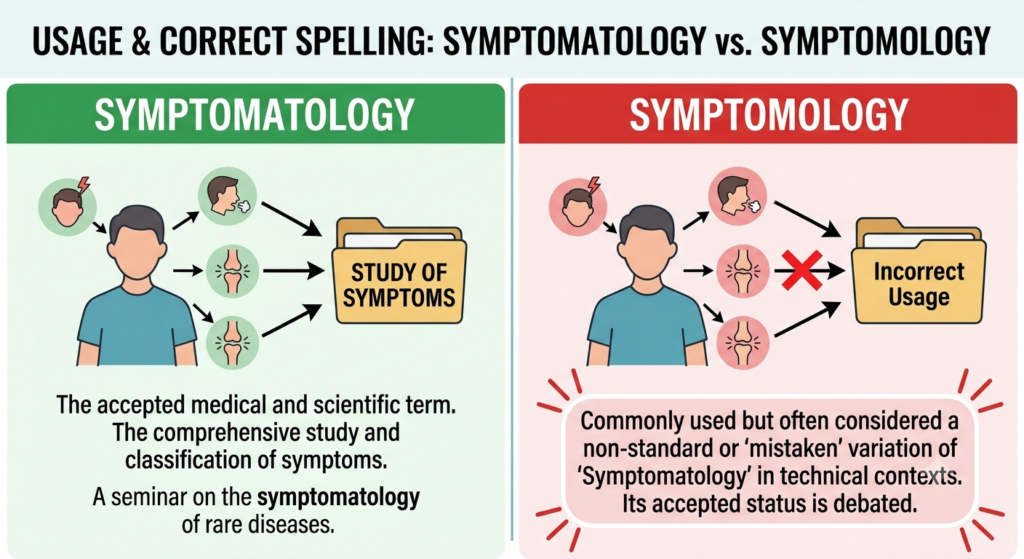

“Symptomatology” and “symptomology” are two words that can create confusion even for experienced writers. They look almost identical, refer to the same general subject, and both have appeared in English. However, they do not have the same status in medical, academic, and professional writing.
“Symptomatology” is the established term. It can refer to the collective symptoms associated with a disease or patient, or to the study and classification of symptoms. “Symptomology” is a less common variant that developed as a shorter form.
If you are writing a medical report, research paper, academic assignment, or professional health article, “symptomatology” is usually the safest choice.
Quick Answer
The preferred term is:
Symptomatology
Example:
The researchers examined the symptomatology of the disorder.
“Symptomology” can be encountered as a variant, but it is considerably less established in formal medical writing.
The easiest rule is:
Formal medical or academic writing = symptomatology
General or variant usage = symptomology may appear, but symptomatology is safer
Symptomatology vs Symptomology
Here is the difference at a glance:
| Word | Meaning | Formal Usage |
|---|---|---|
| Symptomatology | Symptoms collectively or the study of symptoms | Established and preferred |
| Symptomology | Variant referring to symptoms or their study | Less common |
| Symptoms | Individual experiences or indications | Common everyday term |
The main distinction is therefore not that one refers to an entirely different concept. The difference is largely about established usage and professional preference.
What Does Symptomatology Mean?
“Symptomatology” is a noun connected with symptoms and their overall presentation.
It commonly has two closely related meanings.
First, it can mean the collection or pattern of symptoms associated with a particular disease, condition, or patient.
For example:
The patient’s symptomatology changed over several weeks.
The study compared the symptomatology of two conditions.
Second, it can refer more broadly to the study, description, or classification of symptoms.
For example:
The researchers focused on the symptomatology of the disorder.
In both uses, the word deals with symptoms as a broader pattern rather than just one isolated complaint.
Symptomatology in Simple English
A simple way to understand the word is:
Symptoms = individual problems or experiences
Symptomatology = the overall pattern or study of those symptoms
Imagine someone reports:
Headaches
Fatigue
Nausea
Difficulty sleeping
Each one is a symptom.
When a doctor or researcher looks at how these symptoms appear together, how severe they are, how they change, or how they compare with another condition, that broader picture can be described as symptomatology.
What Does Symptomology Mean?
“Symptomology” is a shorter form that is sometimes used with essentially the same intended meaning.
For example:
The paper examined the symptomology of the condition.
Readers will usually understand that the writer means the symptoms or overall symptom pattern of the condition.
However, “symptomatology” is more firmly established in professional medical terminology.
For that reason, writers who want the most conventional wording should normally choose “symptomatology.”
Is Symptomology a Real Word?
It is too simple to say that “symptomology” never exists.
The word has appeared historically and is recognized as a variant in some usage traditions. It developed later than “symptomatology” and functions as a shortened form.
However, being understandable or recorded does not necessarily make a word the preferred choice in every type of writing.
In formal medical, scientific, and academic contexts, “symptomatology” remains the stronger default.
Why Does Symptomology Look Correct?
“Symptomology” looks natural because English contains many words ending in “-ology.”
Examples include:
Biology
Psychology
Neurology
Pathology
Sociology
This makes the pattern:
symptom + ology
seem perfectly logical.
However, “symptomatology” developed from an older learned medical formation. That historical development explains the additional “at” in the middle of the word.
So the correct established spelling is not simply created by attaching “-ology” directly to “symptom.”
Why Is Symptomatology Longer?
The word can be broken approximately into:
symp-to-ma-tol-o-gy
The middle sequence is one reason writers sometimes accidentally shorten the word.
“Symptomatology” belongs to a tradition of specialized medical vocabulary that developed through older Latin and Greek forms.
As a result, its spelling may look less intuitive than shorter English words ending in “-ology.”
A useful memory trick is to focus on the middle:
symptom + atology
rather than trying to build the word as “symptom + ology.”
Symptomatology vs Symptoms
“Symptomatology” and “symptoms” are related, but they are not always interchangeable.
A symptom is an individual indication or experience associated with a condition.
For example:
Fatigue is a symptom.
A headache is a symptom.
Nausea is a symptom.
“Symptomatology” refers to the broader pattern, collection, or study of such symptoms.
For example:
The symptomatology included fatigue, headaches, and nausea.
In many everyday sentences, however, “symptoms” is clearer and simpler.
Instead of:
The patient displayed mild symptomatology.
You could often write:
The patient had mild symptoms.
Technical vocabulary is most useful when it adds precision.
Symptom vs Sign
In medical language, symptoms and signs can also have different meanings.
A symptom is generally something experienced or reported by the patient.
Examples include:
Pain
Nausea
Dizziness
Fatigue
A sign is generally something that can be observed, measured, or detected by another person or through testing.
Examples may include:
A measurable fever
A visible rash
An abnormal laboratory result
This distinction helps explain why “symptomatology” specifically focuses on symptoms rather than every possible clinical finding.
Symptomatology in Medical Writing
“Symptomatology” is especially useful when describing the complete symptom picture associated with a patient or medical condition.
For example:
The patient’s symptomatology became more severe.
The two disorders share similar symptomatology.
Researchers documented changes in symptomatology over time.
The condition may present with varied symptomatology.
In these examples, the word refers to a broader symptom pattern rather than one symptom alone.
Symptomatology in Research
Researchers may use “symptomatology” when they need to discuss symptom patterns systematically.
For example:
The study compared symptomatology between the two groups.
Researchers examined changes in depressive symptomatology.
The analysis explored differences in symptomatology across age groups.
The term is useful when the discussion involves multiple symptoms, their severity, frequency, distribution, or relationships.
Still, researchers should not use a technical term simply because it sounds more academic. If “symptoms” communicates the meaning more clearly, the shorter word may be preferable.
Symptomatology in Psychology
The term also appears frequently in psychology and mental health research.
For example:
The researchers examined anxiety symptomatology.
The study measured changes in depressive symptomatology.
Participants reported reduced symptomatology after treatment.
Here, “symptomatology” can refer to the overall collection, pattern, or severity of symptoms associated with a psychological condition.
Again, the word describes symptoms. It is not itself a diagnosis.
Symptomatology Is Not a Diagnosis
One common misunderstanding is treating “symptomatology” as though it names a specific disease or disorder.
It does not.
For example:
The patient presented with unusual symptomatology.
This means the patient had an unusual pattern or collection of symptoms.
It does not tell us what diagnosis the patient received.
A diagnosis identifies a condition.
Symptomatology describes or studies the symptoms associated with that condition or presentation.
Correct Examples With Symptomatology
Here are several natural examples:
The doctor reviewed the patient’s symptomatology.
The researchers compared the symptomatology of the two disorders.
Her symptomatology changed significantly over time.
The paper describes the typical symptomatology of the condition.
The study examined differences in symptomatology between participants.
The illness can produce a wide range of symptomatology.
Researchers tracked symptomatology throughout the treatment period.
These sentences show how naturally the established term fits into medical and academic contexts.
Examples With Symptomology
Because “symptomology” is an attested variant, you may occasionally encounter sentences such as:
The article discusses the symptomology of the disorder.
The researcher described its symptomology in detail.
These sentences are understandable.
However, in edited professional writing, the more conventional versions would be:
The article discusses the symptomatology of the disorder.
The researcher described its symptomatology in detail.
Choosing the established form avoids unnecessary questions about terminology.
When Symptoms Is Better
“Symptomatology” can sometimes make a simple sentence sound unnecessarily complicated.
For example:
Technical:
Patients should report any changes in their symptomatology.
Simpler:
Patients should report any changes in their symptoms.
For patient information, general audiences, and everyday communication, “symptoms” may often be clearer.
Another example:
Technical:
The symptomatology typically develops gradually.
Simpler:
The symptoms typically develop gradually.
The best word depends on your audience.
Common Mistakes
One common mistake is automatically labeling “symptomology” as meaningless.
The term has documented variant usage, even though “symptomatology” is more established.
Another mistake is assuming the two forms have exactly equal standing.
They may convey the same intended idea, but “symptomatology” is generally more conventional in professional contexts.
A third mistake is using “symptomatology” where “symptoms” would be clearer.
For example:
Please tell your doctor about your symptomatology.
For a general audience, this is more natural:
Please tell your doctor about your symptoms.
Another mistake is confusing symptoms with signs. The terms may overlap in casual conversation, but medical writing sometimes distinguishes what the patient experiences from what can be externally observed or measured.
Symptomatology in Formal vs Everyday English
In formal medical or research writing:
The study examined the symptomatology associated with the condition.
In everyday English:
The study looked at the symptoms associated with the condition.
Both can communicate a similar basic idea.
The first sounds more specialized and technical.
The second is easier for a general audience to understand.
Good writing is not always about choosing the longest or most technical word. It is about choosing the word that best suits the audience and purpose.
How to Choose the Right Word
If you are writing a medical journal article:
Use “symptomatology.”
If you are writing an academic paper:
“Symptomatology” is generally the safest specialized term.
If you are writing for patients:
Consider whether “symptoms” would be clearer.
If you encounter “symptomology”:
Understand that it is a variant, but consider changing it to “symptomatology” in formal edited writing.
If you are quoting an older source:
Preserve the original spelling when accuracy to the source matters.
Easy Trick to Remember the Difference
Remember this simple pattern:
Symptomatology = established technical term
Symptomology = shorter variant
Symptoms = everyday word
Another trick is to emphasize the middle syllable:
Symptom-AT-ology
The “AT” helps distinguish the established spelling from “symptomology.”
You can repeat:
symptom
symptomatology
symptom
symptomatology
The more familiar the longer word becomes, the less likely you are to accidentally remove the middle letters.
Symptomatology vs Symptomology: Quick Comparison
| Question | Symptomatology | Symptomology |
|---|---|---|
| Refers to symptoms? | Yes | Yes |
| Can refer to symptom patterns? | Yes | Yes, as a variant |
| Used in medical writing? | Commonly | Less commonly |
| Strong choice for research? | Yes | Usually not preferred |
| Suitable for professional writing? | Yes | Use cautiously |
| Same as an individual symptom? | No | No |
| Best default? | Yes | No |
The practical difference is therefore mainly about convention and register.
Frequently Asked Questions
What Does Symptomatology Mean?
“Symptomatology” can refer to the collective symptoms associated with a disease or patient, or to the study and classification of symptoms.
Is Symptomology a Real Word?
It has appeared as a variant of “symptomatology,” but it is less established in formal medical and academic usage.
Which Is Better: Symptomatology or Symptomology?
For professional, academic, scientific, and medical writing, “symptomatology” is generally the better choice.
Is Symptomatology the Same as Symptoms?
Not exactly. Symptoms are individual experiences or indications, while symptomatology can describe their collective pattern, presentation, or systematic study.
Can Symptomatology Refer to One Patient?
Yes.
Example:
The patient’s symptomatology changed after treatment.
Here, it refers to the patient’s overall symptom presentation.
Is Symptomatology Only Used in Medicine?
It is most strongly associated with medicine and health-related disciplines, but it also appears in psychology, psychiatry, clinical research, and related fields.
Should I Use Symptomatology in Everyday Conversation?
Usually, “symptoms” sounds more natural unless you specifically need the technical term.
How Do You Spell Symptomatology?
The standard spelling is:
S-Y-M-P-T-O-M-A-T-O-L-O-G-Y
A useful reminder is to keep the “at” in the middle.
Final Thoughts
The difference between “symptomatology” and “symptomology” is mainly a matter of established usage rather than completely different meanings.
“Symptomatology” is the long-established medical term and the safest choice for formal, academic, scientific, and professional writing. It can describe the overall collection or pattern of symptoms associated with a patient or disease, as well as the study and classification of symptoms.
“Symptomology” is a shorter variant that has appeared in English, but it is less firmly established in professional terminology.
For most writers, the simplest rule is:
Use “symptomatology” in technical writing.
Use “symptoms” when plain language communicates the idea more clearly.